US Business News

How Shayk Is Expanding Access to FDA-Aligned Hormone Therapy for Women


Hormone therapy for women is undergoing a meaningful shift, shaped by updated regulatory guidance, rising demand, and a growing expectation that healthcare should be more accessible.

For years, treatment decisions around hormone therapy were influenced by broad safety warnings that came out of early interpretations of large-scale studies in the early 2000s. Those warnings created a cautious environment where many women either delayed treatment or avoided it entirely, despite experiencing symptoms that significantly affected their quality of life.

That landscape changed in late 2025. The FDA began removing long-standing boxed warnings from many hormone therapy medications, reflecting a more updated understanding of risk based on years of additional research. Rather than applying generalized caution to all women, the agency now emphasizes individualized decision-making based on factors such as age, timing of menopause, medical history, and overall health.

This shift has helped reshape conversations between patients and healthcare providers. More women are now seeking treatment for symptoms tied to hormonal changes, including hot flashes, night sweats, disrupted sleep, mood instability, brain fog, vaginal dryness, and fatigue. At the same time, healthcare systems are adjusting to meet this increased demand, creating opportunities for new models of care that improve both access and continuity.

Shayk is part of a growing group of telehealth platforms working to close that gap. The platform focuses specifically on women’s hormone therapy and simplifies access into a more structured process. Patients begin with a short intake, followed by provider review that typically happens within the same or next day. If treatment is appropriate, prescriptions are issued and delivered directly to the patient’s home, eliminating many of the delays associated with traditional office visits.

Speed is one part of the model, but it is not the defining feature. The more significant shift is how Shayk approaches continuity of care. Hormone therapy is rarely a one-time decision. As symptoms change and women respond differently to treatment, medications and dosages often need to be adjusted over time. Rather than treating therapy as a fixed prescription, Shayk is designed around ongoing communication between patients and providers.

Patients are able to message their provider directly and typically receive responses within a day. Questions about symptoms, medication adjustments, or side effects can often be addressed without waiting weeks for another appointment. That ongoing relationship allows treatment plans to evolve based on patient feedback instead of remaining static.

This approach aligns with what current clinical guidance suggests. Hormone therapy works best when it is tailored and monitored over time. A personalized treatment plan combined with regular follow-up can help providers optimize care while responding to changes in symptoms or patient needs.
Photo Courtesy: Shayk

Another defining aspect of Shayk‘s model is its use of FDA-approved medications only. In a rapidly expanding market, where different types of hormone formulations are available through a variety of providers, this creates a clear standard. By focusing on FDA-approved therapies, Shayk emphasizes treatments that have been reviewed for safety, quality, and effectiveness while remaining aligned with evolving regulatory guidance.

Pricing is also structured transparently, with both monthly and longer-term options available. The model reduces uncertainty and allows patients to understand costs before beginning treatment, helping women make informed decisions without unexpected expenses.

At the same time, supply challenges remain across the industry. Increased demand following updated FDA guidance has placed pressure on certain medications, particularly estrogen patches. These shortages have highlighted the importance of having multiple treatment pathways and consistent provider oversight. When one formulation becomes difficult to obtain, providers may need to recommend an alternative while continuing to monitor patient outcomes.

Shayk addresses this by offering different forms of therapy while maintaining a unified care model. Patients continue working with the same provider, allowing treatment to remain consistent even if medication options need to change because of supply availability or individual response.

As awareness continues to grow and barriers to access continue to fall, hormone therapy is becoming a more central part of women’s healthcare. More women are seeking evidence-based information and personalized treatment rather than accepting disruptive symptoms as an inevitable part of aging.

Digital health platforms are helping make that transition possible by reducing wait times, expanding access to qualified providers, and supporting long-term care instead of one-time prescriptions.

Platforms that combine accessibility, clinical structure, transparency, and continuity are likely to define the next phase of this category. As hormone therapy continues to evolve, patients increasingly expect care that is convenient, personalized, and grounded in current clinical evidence.

By combining streamlined access with ongoing provider relationships and FDA-approved treatment options, Shayk reflects the broader direction of women’s hormone therapy, one that prioritizes individualized care while making treatment more accessible for women seeking support throughout perimenopause and menopause.


Intel Expands AI Infrastructure Plans on Enterprise Chip Demand

Intel AI infrastructure plans moved forward after the company announced increased investment in manufacturing capacity and raised its capital spending outlook in response to stronger enterprise demand for data center processors supporting artificial intelligence workloads. The announcement also reaffirmed Intel’s roadmap for its next-generation manufacturing technology and reflected continued investment in semiconductor production.

Key Takeaways

  • Intel increased its capital spending forecast to support AI-related processor demand.
  • Enterprise demand for data center CPUs contributed to expanded infrastructure plans.
  • Intel reaffirmed its roadmap for high-volume production using its 14A manufacturing process.
  • The company reported multi-year customer agreements for data center processors and AI accelerators.
  • Intel said demand for AI computing has influenced its manufacturing investment strategy.

Intel announced expanded investment plans for AI infrastructure after reporting stronger demand for processors used in enterprise data centers. The company increased its capital spending forecast for the current year and confirmed continued investment in manufacturing technologies designed to support future generations of advanced semiconductors.

Company executives said demand for central processing units used in AI-enabled data centers exceeded earlier expectations, prompting Intel to revise its spending plans. The updated outlook reflects additional investment in manufacturing capacity intended to support long-term production requirements for enterprise computing customers.

The company also confirmed progress toward its 14A semiconductor manufacturing process, which remains a central element of Intel’s strategy to produce advanced chips for both internal products and external foundry customers. Executives stated that customer engagement surrounding the manufacturing platform strengthened during the latest quarter.

Intel Expands AI Infrastructure Plans Following Enterprise Demand

Intel said growing enterprise adoption of AI applications has increased demand for processors used in cloud computing and data center environments. Company executives reported that organizations deploying AI workloads continue to require high-performance CPUs alongside specialized AI accelerators to support a broad range of computing tasks. Businesses expanding AI deployments are also evaluating new Google AI chips for enterprise inference as organizations assess computing options for AI workloads.

The company stated that demand has been particularly strong for processors supporting enterprise AI deployments, including workloads involving autonomous software agents and advanced computing applications. Intel reported that orders for certain data center CPUs exceeded available manufacturing capacity during the quarter.

Executives also confirmed that customer demand contributed to the company’s decision to expand investment in production capabilities. Intel said it remains focused on increasing manufacturing output while maintaining its long-term technology roadmap.

The company reported that enterprise customers continue to sign multi-year agreements covering future processor deliveries. These agreements include products intended for data centers and AI computing environments, providing greater visibility into future production requirements.

Capital Spending Outlook Increases for Semiconductor Production

Updated Investment Forecast

Intel increased its projected capital expenditures for the year from $18 billion to $20 billion. Company executives stated that spending is also expected to rise further during the following year as manufacturing projects continue.

The increased investment is intended to support production capacity for processors used in enterprise computing and artificial intelligence workloads. Intel said manufacturing expansion remains aligned with customer commitments and anticipated demand for future products.

Executives stated that the company continues to evaluate investment decisions carefully while maintaining financial discipline. They also noted that long-term customer agreements provide additional confidence when planning manufacturing capacity.

Manufacturing Capacity Priorities

Intel said its investment strategy focuses on expanding semiconductor production capabilities while preparing facilities for future manufacturing technologies. These investments support both Intel-designed products and the company’s contract manufacturing operations. The company’s manufacturing priorities also align with ongoing discussions surrounding U.S. AI semiconductor export rules and their impact on domestic chip production.

The company continues to position its foundry business as an important component of its manufacturing strategy. Executives stated that customer engagement for future production technologies has improved, supporting confidence in planned manufacturing expansion.

Intel also confirmed that production planning considers both current processor demand and future customer commitments. Manufacturing investments are expected to support increasing requirements from enterprise customers deploying AI-enabled computing infrastructure.

Data Center CPU Orders Support Manufacturing Strategy

Multi-Year Customer Agreements

Intel reported that it has secured multi-year agreements with customers purchasing data center processors and AI accelerators. Company executives said these agreements typically extend between three and five years and include commitments covering future product deliveries.

Some agreements include both pricing and volume commitments, while others focus primarily on production volumes. Intel stated that these long-term arrangements assist manufacturing planning by providing greater visibility into customer demand.

The company said enterprise customers continue investing in infrastructure capable of supporting AI computing workloads. These purchasing commitments contribute to Intel’s production planning and capital allocation decisions, reflecting a new frontier for enterprise AI as organizations integrate advanced computing into business operations.

AI Workload Requirements

Intel stated that enterprise AI deployments require substantial computing resources beyond specialized accelerators alone. Central processing units remain responsible for many core computing functions within data center environments, including workload management, system coordination, and application execution.

Executives reported that growing adoption of AI agents has contributed to stronger demand for server processors. These systems support enterprise applications that perform automated tasks requiring continuous processing across large-scale computing environments.

Intel also reported stronger performance in its data center and AI business during the latest quarter, reflecting continued customer demand for enterprise computing products.

Intel Reaffirms 14A Process Roadmap for Future Production

Intel confirmed that development of its 14A manufacturing technology continues according to its planned roadmap. Company executives said recent customer engagement increased confidence in achieving high-volume production using the process beginning in 2028.

The 14A process represents Intel’s next generation of semiconductor manufacturing technology. The company intends to use the platform for future processors while also offering manufacturing services to external customers through its foundry business.

Executives stated that progress during the latest quarter strengthened the company’s commitment to advancing the manufacturing process. Intel said customer interest has improved compared with previous expectations, supporting continued investment in production technology.

The company also indicated that manufacturing development remains an important element of its broader semiconductor strategy. Continued investment in advanced fabrication technologies is intended to strengthen production capabilities for future enterprise computing products.

Enterprise AI Adoption Shapes Long-Term Infrastructure Investment

Demand for Data Center Computing

Intel reported that enterprise customers continue expanding data center infrastructure to support artificial intelligence applications. Organizations deploying AI workloads require computing platforms capable of processing increasing volumes of enterprise data while maintaining system performance.

The company stated that CPUs remain essential components of these environments because they coordinate many computing tasks performed alongside AI accelerators. Enterprise deployments typically combine multiple processor technologies depending on workload requirements.

Intel said the continued expansion of enterprise AI computing has influenced customer purchasing decisions for both processors and supporting infrastructure.

Long-Term Production Planning

Intel stated that future manufacturing decisions will continue to reflect customer demand and long-term production requirements. The company said multi-year agreements and increased enterprise investment in AI computing support continued expansion of manufacturing capacity.

Executives confirmed that production planning includes both internally designed products and semiconductor manufacturing services provided to external customers. The company also reaffirmed its commitment to advancing manufacturing technologies that support future enterprise computing platforms.

Intel’s updated investment plans reflect the company’s focus on expanding production capabilities while meeting growing requirements from organizations deploying AI-powered data center infrastructure. Companies scaling these facilities are also monitoring AI data center electricity costs as power demand becomes an increasingly important operational consideration.

Frequently Asked Questions

What are Intel AI infrastructure plans?

Intel AI infrastructure plans include increased capital spending, expanded semiconductor manufacturing investment, and continued development of advanced chip production technologies to support enterprise AI computing.

Why did Intel increase its capital spending forecast?

Intel increased its capital spending forecast after reporting stronger enterprise demand for data center processors supporting artificial intelligence workloads and additional manufacturing requirements.

What is driving demand for Intel’s data center processors?

Intel said enterprise adoption of AI applications and expanding data center computing requirements have increased demand for processors used alongside AI accelerators.

What is Intel’s 14A manufacturing process?

Intel’s 14A manufacturing process is the company’s next-generation semiconductor fabrication technology that it plans to use for future processors and foundry customers, with high-volume production targeted for 2028.

How does enterprise AI affect demand for data center CPUs?

Enterprise AI deployments require central processing units to manage computing tasks, coordinate workloads, and support applications operating alongside specialized AI accelerators, contributing to increased demand for data center processors.

ENERGYbits Inc. and the Direct-to-Consumer Business Model Shaping Its Algae-Based Food Tablet Distribution Strategy

There has been an evolution in the way small food and nutrition businesses market their products to the American public through digital commerce channels. In the past ten years, most companies within the wellness industry have moved from using physical retail channels to selling products online. In addition to that, small food companies have opted for direct marketing methods that enable them to sell their products directly to customers online without having to use big supermarkets or wellness shops.

Within this environment, ENERGYbits Inc., founded in Boston in 2010 by Catharine Arnston, operates with a distribution strategy centered on direct-to-consumer channels. The company sells algae-based food tablets made from spirulina and chlorella primarily through its own website and through selected third-party platforms, including Amazon. Its structure reflects a wider trend in which specialized nutrition brands prioritize e-commerce over physical retail expansion.

ENERGYbits’ business model is built around a narrow product line distributed through digital channels rather than wholesale shelf placement. Company communications and interviews with Arnston have described an intentional preference for avoiding large-scale retail expansion. Instead, distribution is focused on controlled online sales environments where pricing, presentation, and customer engagement remain centralized. This approach contrasts with traditional consumer packaged goods companies that rely heavily on supermarket and pharmacy distribution networks.

The company’s product sales are organized around its four core lines: ENERGYbits, RECOVERYbits, BEAUTYbits, and VITALITYbits. Each is sold through the same online infrastructure, with variations in packaging size and purchasing format. Standard offerings include single containers, multi-pack bundles, and subscription options that allow recurring deliveries at set intervals. Subscription models are widely used in direct-to-consumer e-commerce, particularly in categories such as supplements, functional foods, and personal care products, where repeat purchasing patterns are common.

Bundling also plays a role in the company’s distribution strategy. Products are often grouped into combinations that include multiple algae types or multiple product lines in a single order. This structure is consistent with broader e-commerce practices where bundled pricing is used to increase average order value and encourage multi-product trials. ENERGYbits applies this approach within its limited product range, combining spirulina-based and chlorella-based tablets in different configurations depending on consumer preference.

Another aspect that characterizes the company’s operations model is a rather limited connection with traditional methods of brand expansion via the retail sector. Whereas many wellness brands grow through sales within grocery chains, drugstores, or niche retail stores, ENERGYbits’ operations are primarily connected with direct sales over the internet. According to Arnston’s interviews, this approach to sales and marketing was chosen because it allowed the company to retain full control over its message. Although direct-to-consumer sales limit intermediaries’ share in the process, they also require significant investments into promotion and marketing.

Amazon serves as one of the secondary outlets for our business operations. Although the priority is the official website of the business, other online marketplaces like Amazon serve to give it wider exposure as well as connect with more consumers. In relation to online commerce, Amazon is considered to be a platform for distribution and a marketplace that is driven by searches, and which is affected by rankings, reviews, and algorithms. The company’s niche product line can also gain some exposure through this platform.

Wholesale distribution, while not the company’s primary focus, exists in limited forms according to company descriptions. Selected partnerships and bulk purchasing arrangements have been referenced in relation to wellness practitioners and fitness-oriented distribution channels. These arrangements are typically smaller in scale compared with mass retail supply chains. They are structured around specialized use cases rather than broad consumer shelf placement.

The operational structure of ENERGYbits reflects a centralized model where manufacturing, branding, and distribution are closely aligned. Spirulina and chlorella tablets are produced as single-ingredient compressed food products and then distributed through controlled channels. The absence of multiple ingredient lines or diversified product categories reduces complexity in logistics and inventory management, but it also concentrates revenue generation within a narrow product base.

Recognition in entrepreneurial lists, including BostInno’s Fifty on Fire in 2014 and Entrepreneur Magazine’s Project Grow Challenge in 2015, contributed to early visibility of the company within startup networks. However, these recognitions were tied to business activity rather than retail scale or distribution reach. The company’s subsequent growth trajectory remained primarily centered on its online sales infrastructure.

Over the past sixteen years, since its establishment, ENERGYbits has still used the same distribution strategy, which revolves around the idea of using direct online sales to move products. The use of e-commerce sites, subscription plans, and price control is a reflection of the new approach used by niche nutrition firms operating in the digital era. The core product of spirulina and chlorella food tablets is still at the center of this strategy.

Disclaimer: These statements have not been evaluated by the Food and Drug Administration and are not intended to diagnose, treat, cure, or prevent any disease. Consult a qualified healthcare professional before making dietary changes.

The Breakfast I Thought I’d Left Behind

By: Bridget Mulroy

There are moments when homesickness catches you completely off guard.

It isn’t always Christmas, or a birthday, or hearing someone speak with an Irish accent on the PATH train. Sometimes it arrives on an ordinary Saturday morning when you’re standing in an American supermarket, staring at shelves full of food that somehow never quite tastes like home.

I’ve lived in New York and New Jersey long enough to know that you adapt. You find your favorite coffee shop. You learn where to buy decent butter. You stop comparing every loaf of bread to Brennan’s. Life moves on, as it should.

But if you’re Irish, there’s one tradition that never really leaves you.

A proper breakfast.

Not just any breakfast, a real Irish fry. Rashers curling in the pan. Bangers sizzling away beside slices of black and white pudding. Mushrooms soaking up every bit of flavor. Tomatoes softening just enough before the eggs go in. Beans warming slowly while someone puts the kettle on. Thick slices of Brennan’s bread waiting to be buttered, and Barry’s Tea brewing in the pot before anyone has properly woken up.

It was never just about the food.

It was about slowing down.

It was about everyone finding their way into the kitchen without being called. It was the soundtrack of frying pans, kettles boiling and conversations that wandered nowhere in particular. Somehow, the best family stories always seemed to begin over breakfast.

Ar scáth a chéile a mhaireann na daoine (we live in one another’s shelter).

Growing up, I never thought much about that old Irish saying. Living thousands of miles away, I understand it differently now. Sometimes “shelter” isn’t a place at all. Sometimes it’s the comfort of familiar smells drifting through the house.

For years, I tried recreating that feeling.

I’d find decent sausages in one shop. Something resembling rashers in another. Black pudding would appear around St Patrick’s Day and disappear just as quickly. I’d convince myself it was “close enough.”

It never really was.

Then another Irish friend casually mentioned Irish Breakfast Box.

No fanfare.

No sales pitch.

Just, “Have you tried them yet?”

That recommendation was all it took.

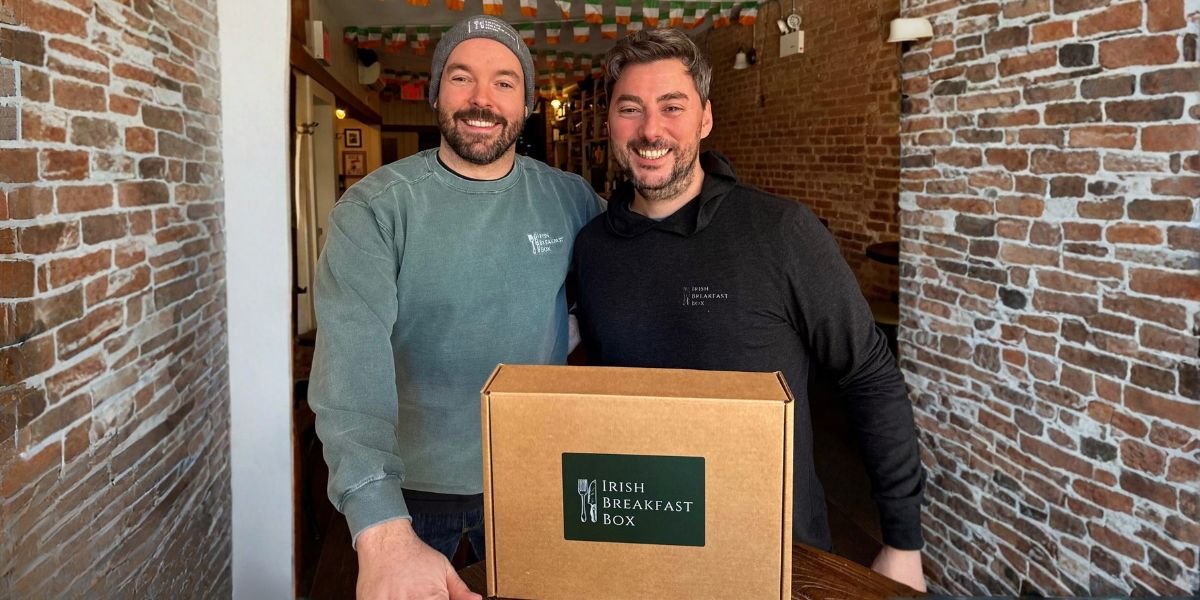
Irish Breakfast Box was founded by two Irish lads, Niall Boyle and Noel Kerin, names many New Yorkers already know from The Blasket Pub, where they’ve spent years creating the kind of welcome every good Irish pub should be known for. It makes perfect sense that the same people who know how to look after strangers over a pint also know what it means to miss home. They started the company from a small apartment in Astoria with a simple goal: make it possible for Irish people across America to enjoy an authentic breakfast without spending weeks hunting down every individual ingredient.

What struck me wasn’t just the idea.

It was how seriously they took getting it right.

They’ve partnered with an Irish butcher who has spent more than thirty years perfecting the seasoning that gives Irish sausages, rashers and puddings their unmistakable flavor. The meats are produced here in America, but every spice blend, every recipe and every decision is rooted firmly in Irish tradition.

You can taste the difference immediately.

Ordering was refreshingly uncomplicated.

No confusion. No endless menus.

You simply choose the box that suits your household. Whether you’re cooking breakfast for yourself, feeding two people, or planning a Sunday fry for the whole family, there are options that make sense. The classic Full Irish Breakfast Box has everything you’d hope for, while other collections focus on breakfast meats, Ulster favorites, breakfast rolls, tea-time treats and carefully chosen gift boxes. It all feels thoughtfully put together rather than mass-produced.

Then came delivery day.

I’ve ordered plenty of food online over the years, but this genuinely felt different.

The box itself was solid and carefully insulated, packed with ice packs and arranged with obvious care. Fresh vegetables were layered neatly alongside the meats, everything frozen exactly as it should be. I actually laughed when I unpacked the eggs because I couldn’t believe every single one had survived the journey intact.

Someone had clearly thought through every detail.

There’s a reason they only ship on Wednesdays. It means everything arrives quickly and perfectly timed for the weekend, the very moment most Irish households naturally start thinking about a proper fry.

That alone tells you these aren’t people simply shipping food.

They understand the ritual.

Opening the box felt oddly emotional.

Out came the Barry’s Tea.

The Brennan’s bread.

The butter.

The rashers.

The sausages.

The black pudding.

The white pudding.

The mushrooms.

The tomatoes.

The beans.

One ingredient after another, until my kitchen looked less like New Jersey and more like home.

As everything began cooking, something changed.

The smell.

That’s what got me.

It wasn’t subtle nostalgia. It was immediate. The familiar aroma filled the kitchen in seconds, transporting me somewhere I’d been trying to recreate for years without realizing that scent mattered just as much as flavor.

The first bite confirmed it.

The sausages had that unmistakable seasoning I’d almost forgotten.

The rashers tasted exactly the way they should.

The puddings were beautifully balanced, rich without being heavy.

Even the tea somehow tasted better because everything around it felt right.

Sláinte (good health).

I found myself saying it aloud without thinking.

What impressed me just as much was the warmth behind the business itself. Every interaction felt unmistakably Irish. Friendly. Helpful. Genuine. No scripted responses or corporate language, just real people who clearly care about what they’re sending into someone else’s home.

That authenticity runs through everything they do.

Their own words say it best:

“At Irish Breakfast Box, we believe that every morning should start with a taste of Ireland, and our curated boxes bring the heartwarming flavors of Irish breakfast to homes across the country.”

After experiencing it myself, that doesn’t read like marketing copy.

It feels like a promise they’ve quietly kept.

For Irish people living abroad, food has an extraordinary way of collapsing distance. One breakfast can transport you across an ocean. One familiar smell can bring back conversations you haven’t thought about in years. One cup of tea can remind you that although life has carried you elsewhere, Ireland has never really left you.

Céad míle fáilte (a hundred thousand welcomes).

That’s the feeling Irish Breakfast Box delivers.

Not because it arrives in a box.

But because, for one unhurried Saturday morning, it brings home to your kitchen.

Irish Breakfast Box Website

Irish Breakfast Box Instagram

The Blasket Pub

Meet Niall and Noel – Navigating New York

The Diet-Proof Body by Trent Harrison is Here to Inspire Your Fitness Journey

The official launch of The Diet-Proof Body: 5 Simple Habits to Lose Fat, Keep It Off, and Escape Diet Prison for Good by Trent Harrison has been met with excitement and anticipation, and the book is now making its way into the hands of readers ready to rethink their approach to fitness. After years of refining his methods and coaching thousands of individuals, Trent has released a book that’s grounded in sustainability, balance, and consistency, not extreme diets or exhausting workout routines. The philosophy behind it all is simple: Eat What You Love. Lose What You Don’t.

Since the launch, readers have already begun to embrace the principles laid out in the book, discovering how to make lasting changes in their fitness journey without feeling overwhelmed or restricted. The focus of The Diet-Proof Body is clear: it’s about building healthy, sustainable habits that fit naturally into everyday life, making fitness an enjoyable and consistent part of your routine.

The Diet-Proof Body: A New Way to Think About Fitness

The traditional fitness world often comes with high expectations, strict meal plans, intense workouts, and a constant race to achieve perfection. For many, these demands lead to frustration, burnout, and the feeling of being trapped in diet prison. In contrast, The Diet-Proof Body challenges that model by focusing on gradual, practical changes that are easier to maintain long-term.

Rather than focusing on drastic changes or unattainable goals, Trent’s approach is rooted in five simple habits: Mindset, Meals, Muscle, Movement, and Mission. These elements work together to create a balanced fitness routine that helps readers build consistency and resilience, ensuring their fitness journey fits into their lifestyle.

Key Principles at the Heart of The Diet-Proof Body

Since its official launch, readers have been diving into the five simple habits that make up the foundation of Trent’s approach:

Mindset: The book starts by emphasizing the importance of developing a strong, resilient mindset. Instead of relying on willpower or perfection, Trent guides readers toward adopting a mindset that promotes progress over time, helping them stay consistent even when life presents obstacles.

Meals: A flexible approach to food is central to the 5M Strategy. True to the book’s core promise of Eat What You Love. Lose What You Don’t, Trent encourages mindful eating without the need for restrictive diets. By making healthy food choices that align with fitness goals and allowing room for enjoyment, readers can develop a sustainable relationship with food.

Muscle: Building muscle through strength training is an integral part of Trent’s system. While strength training isn’t the sole focus, it plays a key role in overall fitness and vitality. The book emphasizes that strength training can be easily integrated into any routine, regardless of lifestyle or schedule.

Movement: Daily movement is another crucial element of the 5M Strategy. Rather than relying on structured, time-consuming workouts, Trent encourages simple activities like walking, stretching, and reducing sedentary behavior. These small adjustments can help individuals stay active and energized.

Mission: Lastly, having a clear mission is essential to staying motivated and consistent. Trent’s philosophy is about aligning fitness with a purpose, whether that’s improving overall health, boosting energy, or gaining mental clarity. A clear mission helps readers stay focused on their long-term goals.

The Post-Launch Response: Empowering Readers for Sustainable Fitness

Since its release, the response to The Diet-Proof Body has been overwhelmingly positive. Readers have expressed how Trent’s approach has helped them rethink their relationship with food and fitness, finally breaking free from the cycle of diet prison. Many have shared how the book has provided them with a clearer understanding of how to make realistic, sustainable changes rather than focusing on fleeting results.

The post-launch momentum highlights how much readers appreciate a fitness plan that aligns with real life. Trent’s emphasis on small, consistent changes over time has proven to resonate with those who may have struggled with rigid, short-term fitness regimens in the past.

Looking Ahead: What’s Next for The Diet-Proof Body?

Now that The Diet-Proof Body: 5 Simple Habits to Lose Fat, Keep It Off, and Escape Diet Prison for Good has officially launched, the journey continues. Trent will be engaging with readers through social media, sharing additional tips, updates, and motivational content. The book continues to inspire readers to integrate fitness into their everyday routines in a way that is achievable, enjoyable, and sustainable.

If you’re ready to take a balanced, long-term approach to fitness, The Diet-Proof Body can provide the guidance you need. The book is available for those who want to make lasting changes in their fitness journey without feeling pressured to conform to unrealistic standards. Because you really can Eat What You Love and Lose What You Don’t.

For more information on the book’s post-launch and to stay updated on future content, follow Trent Harrison on Instagram at @trizzlemanfitness.


Disclaimer: The information provided in this article and the book The Diet-Proof Body is for educational purposes only. It is not intended as medical, nutritional, or therapeutic advice. Always consult with a qualified healthcare professional before making changes to your diet, exercise routine, or lifestyle, especially if you have a medical condition, are pregnant, or are taking medication. Individual results will vary, and the strategies discussed are based on general principles and personal coaching experience.