US Business News

Canada Auto Tariffs Put Toyota, Honda U.S. Supply Under Pressure


Canada auto tariffs, referring to proposed U.S. duties on Canadian-built vehicles and parts, could create a significant supply challenge for Toyota and Honda beginning January 1, 2027. The two automakers produce more than three-quarters of Canada’s vehicles, leaving popular U.S. models including the RAV4 and CR-V exposed to higher cross-border costs.

Key Takeaways

  • A proposed 50% U.S. tariff on Canadian-built vehicles and automotive parts is scheduled to take effect January 1, 2027.
  • Canadian-built vehicles accounted for 17% of Toyota’s U.S. sales and nearly one-quarter of Honda’s U.S. sales in 2025, according to analysts cited by Reuters.
  • Toyota and Honda together account for more than three-quarters of vehicles manufactured in Canada.
  • Toyota exports Canadian-built RAV4 models to the United States, while Honda exports the CR-V from Canada.
  • Analysts say shifting Canadian production or replacing U.S. supply from other factories would be complex because plants and vehicles are configured for specific markets.

Canada Auto Tariffs Raise Toyota and Honda Exposure

Toyota and Honda face greater exposure to the proposed Canadian vehicle duties than several major competitors because of the amount of U.S. supply originating from their Canadian factories.

Canadian-built vehicles represented 17% of Toyota’s U.S. sales in 2025 and almost one-quarter of Honda’s, according to Barclays analysts cited by Reuters. The two Japanese automakers also account for more than three-quarters of all vehicles manufactured in Canada.

That concentration places the companies at the center of a major cross-border manufacturing issue. The proposed tariff would raise the U.S. duty on Canadian cars, trucks and automotive parts to 50% beginning January 1, 2027, up from the current 25% rate.

The planned increase follows weeks of U.S.-Canada tariff talks involving automotive products and other traded goods. Although the January tariff has been announced, Reuters reported that an agreement could still alter the terms before the scheduled effective date.

Toyota and Honda declined to comment to Reuters on the potential effect of the proposed auto tariffs.

For both companies, the issue extends beyond the duty charged when a finished vehicle crosses the border. North American automotive manufacturing relies on production networks in which components, suppliers and assembly operations are distributed across the United States, Canada and Mexico.

Higher duties can therefore affect decisions about where vehicles are assembled, how production is allocated and which factories supply specific markets.

Toyota already faced substantial tariff-related costs before the proposed increase on Canadian vehicles. Reuters reported that U.S. tariffs cost the company about 1.4 trillion yen, or approximately $8.8 billion, during its previous financial year.

RAV4 and CR-V Supply Creates a U.S. Market Challenge

The Toyota RAV4 and Honda CR-V place the potential supply effect directly in the U.S. consumer market. Both are established crossover models, and both companies use Canadian plants to supply vehicles to the United States.

Toyota Motor Manufacturing Canada began producing the sixth-generation RAV4 for the North American market at its Woodstock, Ontario, facility in January 2026. Toyota said its Canadian manufacturing operations assembled more than 535,000 vehicles in 2025 across facilities in Cambridge and Woodstock.

Canadian production also includes several Lexus models. Toyota’s manufacturing network gives the company substantial output in the region, but it also means changes to cross-border trade costs can affect a large production base.

Honda faces a similar issue at its manufacturing operations in Alliston, Ontario. Reuters identified the CR-V among the models Honda exports from Canada to the United States, while Toyota exports the RAV4 from its Canadian operations.

Replacing those vehicles with production from another factory would not necessarily be immediate.

Automotive assembly plants operate around specific platforms, equipment, suppliers and production schedules. Vehicles intended for the United States can also require specifications tied to U.S. regulations and customer configurations.

Reuters reported that analysts expect Toyota and Honda would likely try to redirect some Canadian-built vehicles to other markets if the tariffs take effect, then seek alternative ways to supply the United States. Capacity constraints at other factories could limit how quickly that shift occurs.

Seiji Sugiura, senior analyst at Tokai Tokyo Intelligence Laboratory, described the potential adjustment to Reuters as “a major shift from the past.”

The challenge reflects a broader issue for companies operating across tightly connected regional manufacturing systems. Previous analysis of U.S. supply chain strategy has highlighted how tariff changes can push companies to reassess sourcing and production while still depending on international suppliers.

Honda Signals Trade Uncertainty Could Affect Production Plans

Honda has separately indicated that trade conditions could influence its longer-term North American manufacturing decisions.

Executive Vice President Noriya Kaihara told reporters in Washington on August 25 that Honda was approaching full production capacity in North America and would eventually require another factory.

However, uncertainty surrounding the future of the U.S.-Mexico-Canada Agreement could affect that decision.

“If there is no USMCA agreement in the future, we may have to change our direction,” Kaihara said, according to Reuters.

Honda expects to make a decision within one or two years and would like additional capacity operating around 2030, Kaihara said. The comments illustrate how trade conditions can influence manufacturing decisions well before a new facility begins production.

The near-term issue is more immediate. Honda currently receives almost one-quarter of its U.S. vehicle sales from Canadian production, according to Barclays data cited by Reuters.

Canada’s wider automotive sector produces about 1.2 million vehicles annually and indirectly supports approximately 427,000 jobs, Reuters reported. Any reduction in production by major manufacturers could therefore extend beyond individual assembly plants into supplier and logistics networks.

Analysts cited by Reuters said some Canadian Toyota and Honda assembly lines could face closure if the 50% tariffs take effect. That remains an analyst assessment rather than an announced company plan.

January 2027 Deadline Keeps Supply Decisions Open

The January 1, 2027, effective date gives Toyota, Honda and their suppliers several months to evaluate production schedules, sourcing and vehicle allocation.

Canada Auto Tariffs Put Toyota, Honda U.S. Supply Under Pressure

Photo Credit: Unsplash.com

That period does not eliminate the operational challenge. Automakers typically coordinate supplier orders and factory schedules well before completed vehicles arrive at dealerships, which means uncertainty over the final tariff rate can affect planning before the deadline itself.

The proposed 50% duty would also create a different cost environment for Canadian-built vehicles compared with the conditions under which much of the current North American manufacturing network was established.

Neither Toyota nor Honda has announced a broad relocation of Canadian vehicle production in response to the January tariff.

Analysts instead point to several possible adjustments, including redirecting Canadian-built vehicles to other markets, changing production volumes or finding additional sources for vehicles sold in the United States. Each option depends on available factory capacity, supplier arrangements and the final trade rules.

The scale of Canadian production makes that planning particularly important. Toyota and Honda together produce more than three-quarters of the vehicles assembled in the country, while their Canadian factories supply a meaningful share of their U.S. sales.

Canada auto tariffs therefore represent more than a change in import costs for the two companies. If the scheduled 50% rate remains in place, Toyota and Honda will have to determine how to maintain U.S. vehicle supply while managing production systems that were built around regular cross-border movement.

Frequently Asked Questions

What are the Canada auto tariffs affecting Toyota and Honda?

The Canada auto tariffs discussed here refer to proposed U.S. duties on Canadian-built vehicles and automotive parts. The tariff rate is scheduled to rise to 50% on January 1, 2027, although the terms could still change before implementation.

How much of Toyota’s U.S. supply comes from Canada?

Canadian-built vehicles accounted for about 17% of Toyota’s U.S. sales in 2025, according to Barclays analysts cited by Reuters. Toyota exports vehicles including the RAV4 from its Canadian manufacturing operations to the United States.

How exposed is Honda to Canadian vehicle production?

Nearly one-quarter of Honda’s U.S. sales in 2025 consisted of Canadian-built vehicles, according to analysts cited by Reuters. The Honda CR-V is among the vehicles exported from Canada to the U.S. market.

Could Toyota and Honda move production out of Canada?

Neither automaker has announced a broad relocation of Canadian production because of the proposed tariff. Analysts told Reuters that production changes, redirected vehicles or reduced Canadian output could be considered if the higher duties take effect.

When would the 50% auto tariff take effect?

The proposed U.S. tariff on Canadian cars, trucks and automotive parts is scheduled to take effect January 1, 2027. An agreement or policy change before that date could alter the final tariff structure.


Loss Mitigation Explained: Repayment Plans and Modifications to Short Sales and the Option Servicers Rarely Mention

Loss mitigation is the set of alternatives to foreclosure a mortgage servicer will consider, running from a repayment plan through a deed in lieu. Every item on that menu assumes the borrower intends to keep the house or that the house is worth less than the debt. Where real equity exists, a straight sale that repays the lender in full usually beats all of them.

A homeowner in Round Rock, Texas, three payments behind on a 189,000-dollar loan, was offered a repayment plan that added 640 dollars to each monthly payment for a year. The house had appraised at 305,000 dollars eight months earlier. The plan meant 7,680 dollars of extra payments across twelve months on a property holding well over 100,000 dollars of equity. The equity never appeared in the conversation, because the servicer’s menu is built around the loan, not the asset.

What does a servicer put on the loss mitigation menu?

The list is fairly standard across servicers, because most of it comes from investor and agency rules. The Federal Housing Administration publishes its version in plain language, and conventional servicers follow similar shapes.

1. Repayment plan. HUD describes it as “A structured plan that lets you gradually repay your past-due mortgage payments by adding a portion of the overdue amount to your regular monthly payments over a set period.” The monthly payment rises until the arrears clear.

2. Forbearance. A temporary pause or reduction of payments, granted for a defined hardship period. The missed amounts do not vanish. The servicer works out repayment terms once the plan ends.

3. Standalone partial claim. On FHA loans, HUD explains that this option “Allows past due amounts on your mortgage to be placed in an interest-free subordinate lien against your property.” Repayment waits until the mortgage ends, the property sells, or title transfers.

4. Loan modification. A permanent change to the loan terms. HUD describes it as “a permanent change to one or more terms of your mortgage.” Arrears are usually folded into the principal balance, and the term is stretched.

5. Pre-foreclosure sale, better known as a short sale. Reserved for borrowers who are underwater, and approved case by case, since the lender agrees to take less than the payoff.

6. Deed in lieu of foreclosure. The house goes back to the lender or the insurer, ending the debt without an auction and without proceeds to the owner.

The Consumer Financial Protection Bureau publishes a comparable list for conventional loans and pairs it with one instruction that servicers echo: “If you can’t pay your mortgage or are worried about missing a mortgage payment, call your mortgage servicer right away.” Timing decides which options remain open, and the bureau’s rundown of mortgage options makes early contact the first step.

Why is a full payoff sale missing from the servicer’s list?

Photo Courtesy: Unsplash.com

Because the servicer’s job is the loan. A servicer administers the debt, applies investor guidelines, and reports outcomes to the note owner. Selling the property is the borrower’s decision and produces no file for the loss mitigation department to work with, so it rarely comes up on the phone. That does not make it a worse outcome. On a house with equity, it is generally the only route that ends the default and leaves money with the seller.

The distinction that matters is whether the sale price clears the payoff. HUD’s own wording draws the line: “If your current market value is not enough to pay the loan in full, your servicer may be able to accept less than the full amount owed by approving eligible borrowers for a Pre-Foreclosure Sale, also known as a short sale.” Above that line, no lender approval is needed at all, because the lien is satisfied at closing. The agency’s loss mitigation program page sets the retention options and the disposition options side by side.

Option

What the servicer requires

What happens to the balance

Who keeps any equity

Repayment plan

Income documentation, higher monthly payment

Arrears repaid over months

Owner, if the plan holds

Loan modification

Complete application, trial period in most cases

Arrears added to principal, term extended

Owner, reduced by the added balance

Short sale

Lender approval, proof the house is underwater

Lender accepts less than the payoff

Nobody, by definition

Deed in lieu

Clear title, marketing period usually attempted first

Debt released, property surrendered

Nobody

Sale that pays the loan in full

No lender approval, only a payoff quote

Lien released at closing

Seller, after costs and junior liens

Volume explains why the menu is being handed out so often. According to ATTOM’s Mid-Year 2026 U.S. Foreclosure Market Report, published in July 2026, 164,566 properties entered the foreclosure process in the first half of 2026, an 18 percent rise over the same months of 2025, and 227,548 properties carried a filing of some kind. Loss mitigation desks are busy, and under federal rules, a complete application can still take up to 30 days to decide.

Where does a direct buyer fit?

HomeWise, a direct home-buying company that purchases distressed single-family houses, including homes carried by owners several payments behind, in Florida, Texas, Georgia and other states, works the payoff route rather than the application route. Its staff asks the servicer for the reinstatement and payoff figures at the start, submits proof of funds and the signed contract so the file shows a credible closing, and settles the arrears, late fees and legal costs from the purchase price at closing. Sellers weighing the two paths can read its comparison of a short sale versus foreclosure and its page for owners behind on payments.

Choosing a sale over a modification is not automatic. An owner with recovered income, a stable job and a payment that fits the budget is usually better served by a modification, and free counseling is available to test that. Buyers such as HomeWise are relevant to the narrower case, where there is equity in the house, income that no longer supports the loan, and an approaching deadline.

Loss mitigation paperwork carries legal consequences, particularly around deficiency language in a short sale approval, so a homeowner comparing options should ask a licensed attorney in the relevant state to review the documents before signing.

Frequently asked questions

What is a loss mitigation application?

It is the package a servicer requires before it will consider any alternative to foreclosure, and it includes a request form, income and hardship documentation, and supporting statements. Federal rules treat an application as complete only when every listed document has arrived, and the completion date starts the review clock.

Is a short sale better than a foreclosure?

A short sale is a negotiated outcome, and a foreclosure is an imposed one, and lenders generally prefer the negotiated version. Neither leaves proceeds for the seller. Where the house is worth more than the payoff, a conventional sale outranks both, since the debt clears and the surplus belongs to the owner.

Can a house be sold while a loan modification is under review?

Yes. A borrower may withdraw the application or simply sell, because a modification request does not restrict the right to convey the property. The payoff quote governs the closing, and the servicer releases the lien once the full amount arrives from the title company.

How long does a servicer take to answer a loss mitigation application?

Federal servicing rules require a written decision within 30 days of a complete application, followed by an appeal window in many cases. Incomplete files reset that timetable, which is why documents requested by the servicer should be sent back the same week they are requested.

Disclaimer: This content is for general informational purposes only and should not be considered as financial advice. The content is not intended to be a substitute for professional financial advice, investment advice, or any other type of advice. You should seek the advice of a qualified financial advisor or other professional before making any financial decisions.

Manufacturing for an Audience of One and William Lichauer’s Redefinition of Success

Business leaders are constantly evaluating performance through measurable outcomes such as revenue growth, operational efficiency, customer satisfaction, and market expansion. While these metrics remain essential, William Lichauer believes they tell only part of the story. The more fundamental question, he argues, is whether an organization has first defined what success actually means.

As the founder of EOTA Manufacturing and author of The Eden Enterprise: Rebuilding Work, Leadership, and Industry the Way God Designed, Lichauer has spent years helping manufacturers improve operations and strengthen organizational performance. Throughout that experience, he has developed a leadership philosophy centered on bringing clarity to operational decisions and organizational priorities. Rather than allowing individual KPIs or isolated performance metrics to drive business decisions, he encourages leaders to establish a purpose that guides every priority and KPI. In his view, that clarity naturally eliminates options that conflict with the organization’s purpose, allowing leaders to focus on the decisions that create the greatest long-term impact.

Success Begins With a Clear Standard

Organizations rarely struggle because they lack goals. More often, they struggle because different departments, teams, and leaders define success in different ways.

Lichauer believes this disconnect can lead to inconsistent decision-making, weakened organizational culture, and competing priorities that pull organizations in different directions. Without a shared standard, individuals naturally prioritize the metrics and objectives closest to their own responsibilities rather than the organization’s broader purpose. Before pursuing growth, he argues, businesses should establish the principles that guide every strategic decision and align priorities across every level of the organization.

This philosophy is reflected in what he calls “manufacturing for an audience of one.” Rooted in his Christian faith, the concept means partnering with God and asking Him, “What do you want me to make and how?” Lichauer frames that as an act of stewardship rather than merely a business activity. In his view, that partnership brings clarity to decisions and priorities, making business straightforward and fulfilling because it eliminates organizational decision bloat. Rather than chasing the market, he argues that leaders should position themselves to receive one, focusing on problems that align with the organization’s purpose instead of pursuing demand directly.

According to Lichauer, organizations that pursue a defined purpose are better equipped to handle uncertainty. However, he believes that partnering with God and receiving an organizational purpose places the need to make it work squarely on His shoulders rather than the leader’s own. When that is established, leaders now have the autonomy and organizational backing to invest in solutions that genuinely serve people when the higher-order consequences cannot be easily captured on a spreadsheet.

Building Organizations That Last

Today’s business environment rewards organizations that can adapt quickly while maintaining the trust of customers, employees, and stakeholders. Lichauer believes that trust grows when leaders evaluate success holistically rather than through financial performance alone. When an organization’s purpose is active and clearly defines what is and is not acceptable, it becomes a guide for every decision. Instead of sacrificing long-term impact for short-term results, leaders build consistency, strengthen trust, and create organizations that are equipped to thrive well into the future.

Revenue, productivity, and market share remain important indicators, but their long-term durability depends on an organization’s purpose defining how those results are achieved. Without that guiding purpose, priorities continually shift, causing leaders to pursue competing objectives that pull the organization in different directions. Lichauer believes leaders should instead focus on the decisions, systems, and investments that purpose identifies as most important. Revenue, productivity, market share, and other desired outcomes then emerge as second-, third-, and fourth-order consequences of an organization aligned around a clear purpose.

For Lichauer, purpose is not separate from business strategy; it defines the strategy. Without a clearly defined purpose, leaders cannot confidently determine the right course of action because they are trying to decide how to succeed before understanding why the organization exists.

A Legacy That Extends Beyond Financial Results

Many organizations devote significant resources to improving systems and increasing efficiency. While these initiatives can temporarily raise the bottom performance standard, they cannot sustain that improvement on their own. Once the energy, motivation, or resources behind an initiative run out, performance can return to its previous baseline. For Lichauer, initiatives are temporary fixes at best and opportunities to identify what should become permanent.

The lasting improvement comes when leaders determine what should stay and then create an environment that sustains it, rather than cycling through initiatives that produce short-term gains followed by regression. Lichauer believes an organization’s greatest competitive advantage lies in creating clarity around what is and is not acceptable throughout the organization. When people can sense around them the standards that guide decisions and behavior, uncertainty gives way to consistency, even in the complex, fast-moving environment of a manufacturing floor.

Leadership decisions influence workplace environments, shape employee experiences, and establish the values that guide future growth. Businesses that consistently operate with integrity and purpose command lasting trust while creating value that extends well beyond quarterly performance.

This perspective encourages leaders to think beyond immediate results and intentionally cultivate the deeper, often immeasurable outcomes that compound over time. For Lichauer, trust, clarity, purpose, and the development of people create a lasting legacy, one that ultimately produces the kind of business results many organizations pursue directly but rarely sustain or see.

Rethinking Success for the Future

In The Eden Enterprise: Rebuilding Work, Leadership, and Industry the Way God Designed, Lichauer explores how purpose-driven leadership can strengthen organizations by aligning operational excellence with enduring principles.

His message offers business leaders an alternative way to evaluate success by flipping the traditional scorecard. Rather than making financial outcomes and market recognition the primary measures of success, Lichauer encourages leaders to measure the intangible drivers that determine how an organization functions, its clarity, purpose, consecration, and the people it develops. Revenue, quality, productivity, and market growth remain important, but he views them as secondary consequences of an organization that consistently gets the fundamentals right.

For Lichauer, manufacturing for an audience of one is ultimately about building God-focused businesses anchored in God’s focus. That focus reveals organizational purpose and produces the standard by which leaders determine what is worth pursuing, what should be rejected, and ultimately how success is defined.

Explore More and Connect with William Lichauer

Learn more about William Lichauer’s work at EOTA Manufacturing, where he outlines his approach to purpose-driven manufacturing leadership. Additional commentary and industry perspective are shared on William Lichauer’s LinkedIn profile.

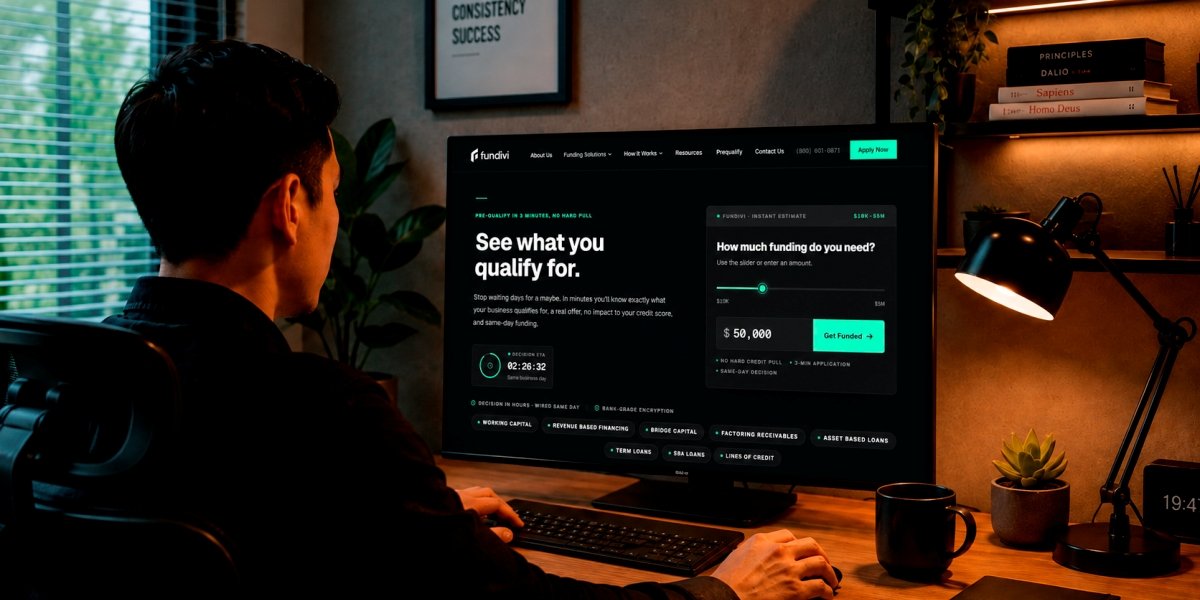
How fundivi’s Partner Network Expands Small Business Funding Options

A flat decline is one of the most frustrating outcomes a business owner can receive from a lender, not because the answer is no, but because it usually comes without a clear path forward. fundivi’s vetted partner network exists specifically to address that dead end, so that a business that doesn’t fit fundivi’s own direct lending criteria may still have options available within the same relationship.

Why a Single-Lender Model Inevitably Leaves Businesses Behind

Every direct lender, regardless of how sophisticated its underwriting technology is, has criteria that fit some businesses better than others. A lender built primarily to serve businesses with steady, predictable monthly revenue may not be the ideal fit for a construction company with project-based, milestone-driven income, even if that construction company is perfectly capable of repaying a loan reliably. A single-lender model has no answer for this mismatch beyond a decline. fundivi’s hybrid structure was built specifically to solve this problem.

How the Partner Network Actually Functions

When a business’s profile doesn’t align cleanly with fundivi’s own direct lending criteria, its application isn’t simply rejected; it’s matched with a suitable lender from fundivi’s vetted partner network, built over years of established relationships with trusted lending partners. This matching happens within the same application and the same relationship, meaning a business owner never has to start over from scratch with an entirely new, unfamiliar platform. The years of relationship-building that make this possible happen behind the scenes, well before any individual business owner ever submits an application.

What This Means for Bridge Capital Specifically

fundivi’s bridge capital product, designed to close the gap between a current need and a known, upcoming funding event, particularly benefits from this network structure. Bridge capital needs are often time-sensitive and situation-specific: a real estate closing, a pending contract payment, an anticipated but not-yet-finalized funding round, which means the right fit sometimes depends on a partner lender with specific experience in that exact kind of transitional financing. Fundivi’s short-term bridge loans range from fifty thousand dollars to one million dollars, with decisions typically available within three hours, whether funded directly or matched to a partner suited to the specific situation.

Vetted Relationships, Not Just Any Available Lender

The partner network behind fundivi’s hybrid model isn’t an open marketplace where any lender can participate. Each partner relationship has been built and vetted over years, ensuring that when an application is routed to a partner, it’s going to a lender fundivi has genuine confidence in, not simply whichever provider happens to be available at that moment. This vetting process is part of what allows fundivi to maintain consistent speed and quality even when an application moves outside its own direct lending criteria.

Why Industry Diversity in the Partner Network Matters

Because fundivi funds businesses across construction, restaurants, retail, professional services, automotive, manufacturing, health care, and logistics, its partner network needs to reflect that same industry diversity to be genuinely useful. A partner network built around only one or two industry specialties would leave large portions of fundivi’s actual applicant base without a meaningful fallback option. Instead, the network has been developed specifically to include lenders with deep experience across the range of industries fundivi serves, which is part of why a construction contractor, a trucking company, and a healthcare practice can each be evaluated against lenders with experience in their sector if their specific profile calls for a partner rather than direct funding.

This industry-aware approach to building the partner network reflects the same underlying philosophy driving fundivi’s broader business: that a lending platform should be built to serve the full breadth of the small business economy, not a narrow, easily-underwritten slice of it.

What Business Owners Experience When a Partner Match Happens

From a business owner’s perspective, being matched with a partner lender doesn’t feel like being redirected to a different company entirely. The process remains housed within the same fundivi relationship, with the same application data carrying over rather than requiring a business owner to start from a blank form again. This continuity is a deliberate design choice, since the entire value of the hybrid model depends on business owners experiencing it as one continuous process rather than a referral that dumps them into an unfamiliar system with no context carried forward.

How This Structure Compares to Shopping Multiple Lenders Independently

It’s worth contrasting fundivi’s hybrid approach against the alternative most business owners would otherwise face: applying independently to several different lenders in hopes that one of them fits. That approach requires submitting the same sensitive financial information repeatedly, tracking multiple simultaneous applications with different timelines and different points of contact, and often receiving several unexplained declines before finding a fit, if one is found at all. fundivi’s partner network compresses this entire fragmented process into a single application evaluated once, with any necessary matching happening automatically and invisibly on the business owner’s behalf.

This difference isn’t just a matter of convenience, though the time savings alone are significant. It also means a business owner isn’t left guessing which of several unfamiliar lenders to trust with sensitive financial data, since every partner in fundivi’s network has already been vetted as part of an established, ongoing relationship rather than being encountered for the first time during a stressful, time-pressured search for funding.

Why Bridge Capital Specifically Benefits From This Flexibility

Bridge capital, by its nature, often involves specific, situational circumstances that don’t fit a single standardized underwriting template. A business bridging the gap before a commercial real estate closing has a different risk profile than one bridging toward an anticipated but not yet finalized investment round, which in turn differs from a business waiting on a large, confirmed but delayed client payment. fundivi’s partner network, built with this kind of situational diversity in mind, means a business owner with an unusual or highly specific bridge financing need is considerably more likely to find a well-matched option than they would through a single, generalist lender applying the same criteria to every bridge capital request regardless of its particular circumstances.

This flexibility is part of why fundivi can offer bridge capital decisions in as little as three hours even for situations that might otherwise require more specialized underwriting attention, since the right partner with relevant experience can often move through that specific kind of evaluation more efficiently than a generalist lender encountering the situation for the first time.

Frequently Asked Questions

How do I know if my application will be funded directly or through a partner?

fundivi’s underwriting technology evaluates your application against its own criteria first, and if a different structure fits better, you’ll be matched with a suitable partner within the same relationship.

Does working with a partner lender mean worse terms than direct funding?

Not necessarily, since partner terms are based on that lender’s own assessment of your specific business profile, similar to how fundivi’s own direct pricing works.

Is the partner network available for every fundivi product, including bridge capital?

Yes, the hybrid model and partner network apply across fundivi’s full range of funding solutions, including bridge capital and other time-sensitive products.

How long does it take to get matched with a partner lender if needed?

This typically happens within the same overall timeline as a direct decision, since the matching occurs automatically as part of fundivi’s underwriting process rather than requiring a separate application.

Do I need to communicate directly with the partner lender myself?

fundivi’s team typically facilitates this connection as part of the same relationship, so you don’t need to start over or manage a separate application process independently.

What if neither fundivi’s direct lending nor its partner network can fund my request?

While no lender can fund every application, fundivi’s combination of direct lending and a broad, vetted partner network is designed to widen the range of businesses that receive a real funding option.

fundivi’s partner network is built to turn what would otherwise be a dead-end decline into a path forward for businesses across a far wider range of profiles and situations. Eligibility details and the application process for bridge capital are outlined on fundivi’s bridge capital prequalification page.