US Business News

Noodle Seed: Revolutionizing Custom Software Development for Businesses

By: Noodle Seed

“Custom software” has traditionally been associated with high costs, long development cycles, and limited accessibility—typically reserved for larger corporations. As a result, many businesses have relied on off-the-shelf tools—not because they were perfect, but because they were the most feasible option.

This perception is starting to shift.

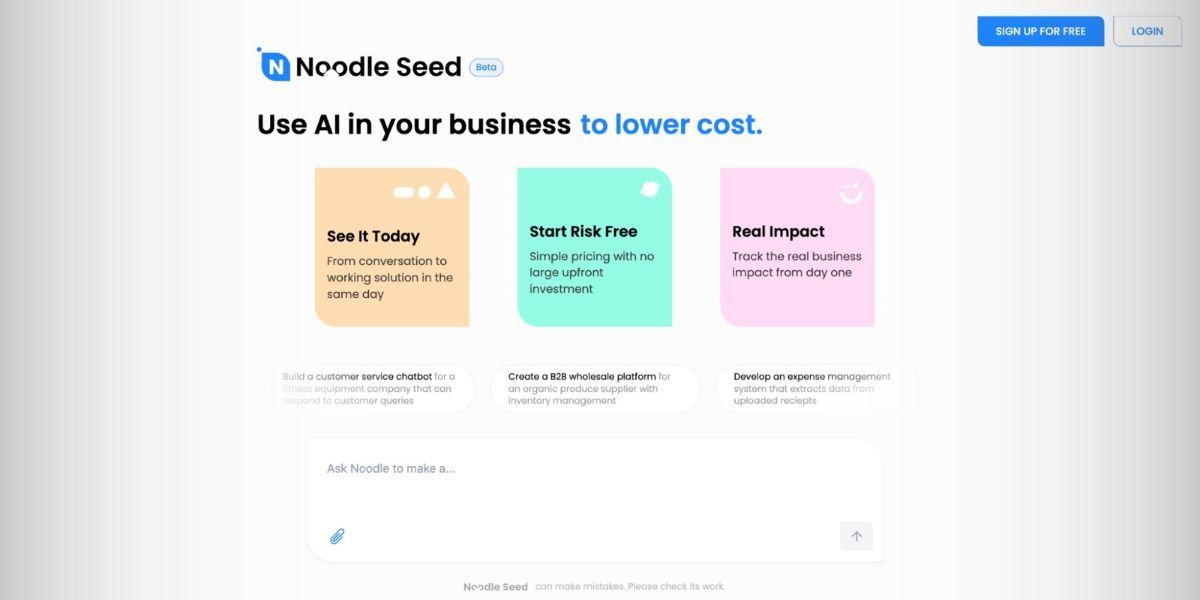
Enter Noodle Seed, a Bay Area startup that’s approaching software development in a new way. Through the use of generative AI, Noodle Seed creates custom software tailored to a business’s specific needs, with a speed and affordability more commonly associated with SaaS products. Their mission is to make custom software more accessible and simpler to create, similar to how easy it is to use a platform like Google Docs.

From Templates to Tailored Systems

Noodle Seed’s approach is referred to as “bespoke-as-a-service.” Instead of offering generic tools or templates, they deliver ready-to-use, custom-built systems designed around existing business workflows. Businesses outline what they need in straightforward language, and the platform delivers operational software in a timeframe that’s considerably shorter than traditional development cycles.

The pricing is designed to be straightforward and predictable: businesses pay per user or per transaction, eliminating high retainers, surprise invoices, and—importantly—upfront development costs.

This is not a low-code or no-code solution. It’s designed to simplify the development process, reducing complexity.

The Cost of “Good Enough” Software

Off-the-shelf software may appear cost-effective initially, but it can lead to inefficiencies that build over time. Teams often end up integrating multiple tools, which can create disjointed workflows and inconsistent data. This can result in wasted time, compromised customer experiences, and challenges when scaling.

Noodle Seed aims to address these issues by designing software that aligns with the way businesses already function. For instance, an accounting firm used Noodle Seed’s AI-powered agents to follow up on overdue invoices via text, email, and voice, resulting in over $1M in recovered cash flow and significant improvements in team productivity.

Built for Outcomes, Not Interfaces

Unlike other development tools that require technical knowledge, Noodle Seed focuses on delivering fully integrated, operational systems right out of the gate. The software is ready to scale, support, and drive business success—without requiring the usual barriers.

“We understand that our customers don’t want to spend time coding,” says co-founder Asad Iqbal. “They want results. We’re not providing development tools—we’re offering fully functioning systems that address business challenges from day one.”

A New Category: Conversational Application Development

Co-founder Fahd Rafi refers to this shift as “conversational application development.” Businesses articulate their needs in clear terms, and Noodle Seed constructs the solution.

“It’s not about giving users more tools,” explains Rafi. “It’s about delivering operational systems that are in harmony with business goals. The software should feel custom-built for each business, not a one-size-fits-all solution.”

Instead of positioning themselves as the hero, Noodle Seed positions itself as a behind-the-scenes ally, helping businesses thrive while they shine in front of their customers.

Why It Matters Now

The change is already underway. As AI continues to automate more of the software development lifecycle, businesses no longer need to choose between customization and speed, or between scalability and budget. Noodle Seed’s approach makes it possible to launch high-quality, enterprise-grade software with less time, cost, and risk compared to traditional software development methods.

Much like what Shopify did for e-commerce, Noodle Seed is redefining how businesses can access powerful infrastructure, once out of reach for many, now made more achievable for those with a vision.

Custom software isn’t months away anymore. With Noodle Seed, it’s closer than ever—and more affordable than it used to be.

Disclaimer: The results mentioned in this article, including the example of over $1M in recovered cash flow, are specific to individual clients and may not be representative of outcomes for all businesses. The use of Noodle Seed’s platform may vary depending on the specific needs and circumstances of each business. The article is intended for informational purposes and does not constitute an endorsement or guarantee of specific results.

Strategies for Enhancing Online Presence Through Consistent Blogging

In the digital age, building and maintaining a visible and engaging online presence is increasingly important for businesses seeking to attract new customers and remain competitive. One approach that has shown meaningful results for many organizations is consistent blogging. Publishing thoughtful, value-driven blog posts on a regular basis can significantly improve a website’s discoverability, credibility, and audience interaction.

This article outlines the potential benefits of blogging and provides strategies to help strengthen your online presence through consistent content creation.

1. Enhance SEO with Fresh and Relevant Content

Search engines such as Google often reward websites that are updated with relevant and timely content. Each new blog entry may serve as an additional indexed page, potentially increasing the chances of appearing in search results across various topics. This broader footprint can help attract more organic visits from users searching for information aligned with your industry.

To improve SEO outcomes, it’s helpful to begin with keyword research. Identify phrases and questions your audience commonly uses when browsing online. Integrate these keywords naturally into blog titles, subheadings, and body content. Rather than overusing keywords, focus on creating clear, useful material that aligns with what users are trying to find.

Technical enhancements—such as optimized meta descriptions, image alt text, and clean URL structures—can also contribute to improved visibility and higher engagement rates.

2. Establish Authority and Build Customer Trust

Blogging creates an opportunity to share your experience and understanding of your field. By consistently offering practical insights, tutorials, case studies, or updates, your brand can gradually earn recognition as a knowledgeable and dependable source. Over time, this perception can increase customer trust and confidence in your offerings.

Content that answers common questions, explains industry changes, or clarifies misconceptions can support your audience’s decision-making process. When users find your content helpful, they are more likely to return and engage further.

3. Drive Targeted Traffic and Encourage Lead Generation

Unlike broader marketing strategies that cast a wide net, blogging has the potential to attract users already seeking related content or solutions. As a result, the traffic you receive may be more aligned with your offerings and more likely to explore your services.

Including appropriate calls to action (CTAs)—such as prompting readers to subscribe to a newsletter or learn more about a service—can help guide visitors toward deeper engagement. This measured approach can gradually contribute to improved lead generation outcomes.

4. Support Broader Marketing and Social Media Efforts

Blog posts can serve as a valuable source of content for other marketing activities. Sharing blogs across social media channels can help maintain visibility and encourage interaction, often extending your reach without additional costs. In addition, including blog links in newsletters provides subscribers with useful information, increasing the likelihood they’ll engage with your communications.

For advertising campaigns, directing traffic to informative blog posts—rather than promotional landing pages—can offer readers more value and encourage them to take the next step at their own pace.

5. Build Long-Term Relationships and Encourage Loyalty

A blog is not only a tool for reaching new users—it also plays a role in maintaining contact with existing customers. Providing regular, insightful content encourages repeat visits, allowing your brand to stay relevant in the minds of past buyers and clients.

Encouraging readers to leave comments, share posts, or ask questions fosters interaction and community. This long-term engagement can reinforce customer satisfaction and gradually build brand loyalty.

6. Measure and Adjust Your Content Strategy

To ensure your blogging efforts are effective, it’s helpful to regularly review performance metrics using platforms like Google Analytics. Focus on data such as:

  • Blog-generated website traffic
  • Average time spent on pages
  • Bounce rates and exit points
  • Conversion rates from blog visitors

By identifying which topics resonate most with your audience, you can refine your strategy to focus on themes that perform well. Underperforming content can be updated or restructured, while new content formats—such as infographics, interviews, or videos—can be tested to see how they influence engagement.

Summary

Maintaining a consistent blogging schedule can be a practical and budget-friendly way to enhance your digital presence. By producing keyword-conscious, informative, and audience-centered content, businesses can experience steady gains in search visibility, trust, and lead quality. Blog posts can also reinforce broader marketing efforts and contribute to building a loyal customer base over time.

Developing a content calendar and integrating blogging into your marketing strategy may yield compounding benefits, helping transform your website into a more dynamic and valuable resource for your audience.