Safehaven Marine’s Record-Breaking Voyages: Engineering Tested in Challenging Conditions

Summary
Safehaven Marine, an Irish boatbuilding company founded in 1998, has built a strong reputation for its durable and high-performance vessels, as well as for its record-setting maritime achievements. From the ambitious circumnavigation of Ireland via Rockall to a high-speed North Atlantic crossing, the company has continually tested the limits of its vessels. These daring missions provide valuable insights into the capabilities of Safehaven Marine’s designs, demonstrating that their boats are engineered to perform in challenging sea conditions. This article explores Safehaven Marine’s most notable record-breaking voyages, the technological advancements derived from these feats, and their potential impact on the maritime industry.
Safehaven Marine has consistently pushed the boundaries of vessel endurance and performance. Under the leadership of its founder, Frank Kowalski, the company has built a range of highly capable pilot boats, naval interceptors, and patrol vessels. To demonstrate their resilience and seaworthiness, Safehaven has undertaken several record-setting voyages that have reinforced its reputation as an innovative boat builder.
One of Safehaven Marine’s most significant accomplishments was the circumnavigation of Ireland via Rockall in 2017, which set a new record. The company’s wave-piercing interceptor, Thunder Child, was selected for the challenge, a 2,000-kilometer journey through unpredictable North Atlantic waters. Departing from the Old Head of Kinsale, the vessel took an anti-clockwise course, navigating Ireland’s rugged coastline before heading into open waters towards Rockall
The challenges of this voyage were considerable, with shifting sea states, powerful Atlantic swells, and the need for precise fuel calculations. Thunder Child successfully completed the journey in a record time, furthering Safehaven’s reputation for designing boats that perform well under difficult conditions.
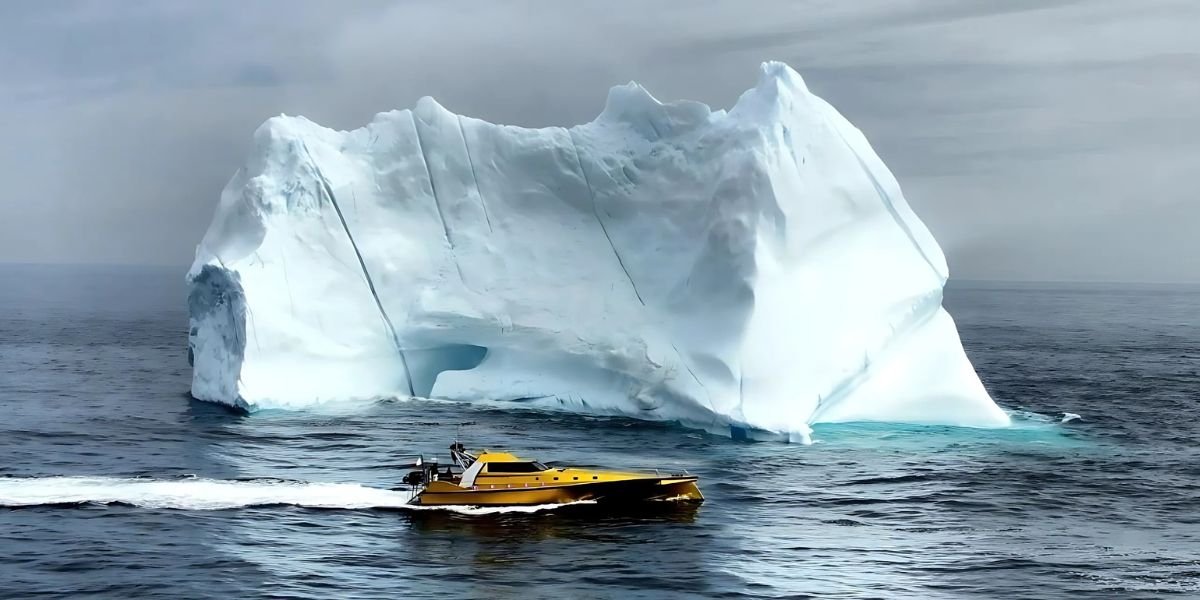
Building on this success, Safehaven Marine embarked on an even more ambitious challenge in 2021 with the North Atlantic crossing from Ireland to Iceland. This time, the newly developed Thunder Child II was put to the test. This 23-meter vessel, featuring an innovative wave-piercing hull, was designed for endurance and high-speed ocean crossings. The journey began in Killybegs, Ireland, covering more than 1,500 kilometers to reach Reykjavík, Iceland. The North Atlantic’s notorious sea conditions, including relentless waves and unpredictable weather systems, posed a significant challenge to both the crew and vessel. Despite these obstacles, Thunder Child II completed the journey at an average speed of 30 knots, setting a new world record. Following this achievement, Thunder Child II and her crew continued to Northern Iceland, across the Denmark Straits to pass beyond the Arctic Circle, battling fog and sea ice. They later ventured to Tasiilaq in Greenland, encountering icebergs in the inhospitable seas off Greenland and showcasing the engineering behind Safehaven’s vessel designs.
These world records are not merely about prestige; they also serve an important role in advancing Safehaven Marine’s vessel design and performance capabilities. Each extreme voyage is carefully documented, with data gathered from onboard sensors, GPS tracking, and real-time observations. The findings from these expeditions have provided important information for improvements in hull structure, stability, and propulsion efficiency. Through these real-world trials, Safehaven Marine has been able to refine its designs and keep its vessels at the forefront of maritime technology.
At the core of Safehaven Marine’s success is its innovative approach to hull design. Thunder Child II’s wave-piercing hull, a hybrid between a catamaran and a monohull, offers enhanced stability, enabling it to cut through waves while minimizing slamming forces. This feature is particularly useful for long-distance endurance missions, as it helps reduce crew fatigue and improves the vessel’s ability to maintain high speeds in rough seas. Powering the vessel are four high-performance Caterpillar C8.7 engines, each delivering 650 horsepower, enabling Thunder Child II to reach speeds of up to 54 knots. This advanced propulsion system, combined with precision-engineered hydrodynamics, has contributed to setting new standards for high-speed maritime operations.
Beyond setting records, Safehaven Marine’s achievements have had far-reaching effects on the maritime industry. Their endurance trials have provided valuable data on vessel stress loads, wave interaction, and fuel efficiency, which have influenced the design of their latest pilot boats, patrol vessels, and naval craft. Military and coast guard agencies worldwide have shown interest in these high-speed, all-weather vessels, recognizing their potential to operate reliably in extreme conditions.
Building on their legacy, Safehaven has expanded its focus by testing vessel applications in more extensive operational settings. The company’s vessels have undergone trials simulating military maneuvers, open-sea rescues, and high-speed law enforcement pursuits, demonstrating their versatility across multiple sectors. The insights gained from these field tests have led to continued refinements in onboard navigation systems, reinforced hull construction, and enhanced stability mechanisms, which allow Safehaven’s boats to operate safely even in challenging sea states such as force 10 conditions.
Looking ahead, Safehaven Marine is preparing for more challenging record-setting expeditions. The company continues to push the limits of naval architecture, exploring new frontiers in vessel automation, hybrid propulsion, and advanced composite materials to further enhance endurance and efficiency. Plans are already underway for the next series of high-speed endurance trials, further supporting Safehaven’s commitment to innovation and performance.
Through these record-setting achievements, Safehaven Marine has strengthened its position in maritime history, demonstrating that engineering excellence is achieved not only in design studios but also in the unpredictable waters of the open sea. With a legacy built on endurance, speed, and reliability, Safehaven continues to explore new frontiers, setting benchmarks for the next generation of high-performance vessels. The company’s ongoing investment in research and development, along with its commitment to extreme weather testing, ensures that its vessels remain at the cutting edge of performance and innovation for years to come.