US Business News

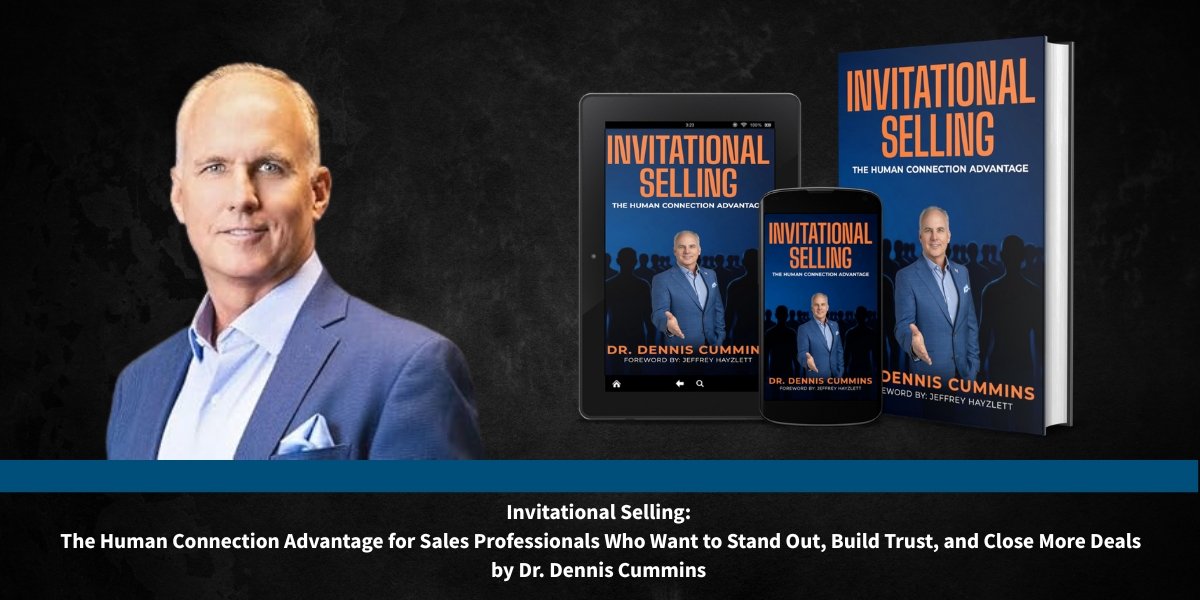
Dennis Cummins Reveals the Sales Shift Nobody Wants to Admit

By: Daniel Mercer

Most sales teams are still doing what worked ten years ago.

More outreach. Better scripts. Tighter closes.

And yet response rates are dropping, deals are dragging, and prospects feel harder to reach than ever.

According to Dennis Cummins, the issue is not effort. It is a disconnect. Sales has optimized for speed and efficiency, but lost something far more important in the process.

Connection.

His book, Invitational Selling: The Human Connection Advantage, does not try to tweak the old model. It calls it out.

Where This Philosophy Actually Comes From

Dennis did not start in sales. He started in healthcare.

And that changes everything.

In that environment, trust is not a bonus. It is the foundation. If a patient does not trust you, they do not follow through. And the consequences are real.

That is where his approach took shape.

Instead of pushing decisions, he would walk patients through them. He would explain what normal looked like, help them see what was off, and then share what others in their situation typically chose.

Then he would ask a simple question.

What would you like to do?

That moment matters more than most salespeople realize. Because when people choose, they commit.

Later, when he moved into business, he saw the opposite approach everywhere. Pressure, scripts, chasing, trying to force decisions.

It felt off. Not just ineffective, but disconnected from how people actually decide.

Even on a personal level, the pattern showed up. His daughter Lauren is selling bracelets with one question.

How many would you like?

No pitch. No pressure. Just an invitation.

That contrast became the foundation of everything.

Why Traditional Selling Is Quietly Failing

The old model was built for a different world.

When information was limited, salespeople controlled the conversation. They guided the buyer by default.

That is gone.

Today, buyers walk in informed, skeptical, and overwhelmed. The moment something feels like a pitch, they pull back.

Not because they are difficult. Because they do not trust the intent.

Dennis makes a sharp point here. Selling itself is not broken. The way we have been taught to do it is.

Most teams are trained to talk to prospects rather than connect with them. And that creates friction at every stage.

Longer sales cycles. More objections. Less follow-through.

A Different Way to Think About Conversations

The core of Dennis’s approach is simple, but not easy.

Connect. Convey. Convert.

Most teams jump straight to the last two. They try to explain value and move the deal forward without ever building a real connection.

But if the person on the other side does not feel understood, nothing else lands.

Connection is not about being likable. It is about being relevant.

It is showing someone you understand their situation, not just their industry or role.

Then comes Convey. This is where meaning matters more than information. You are not just explaining what you do. You are helping them see how it fits their world.

Only after that does Convert happen. And even then, it is not forced. It feels natural.

Companies that get this right notice something quickly.

They stop chasing.

Trust Is the Only Real Advantage Left

One of the clearest ideas Dennis brings up is how trust works now.

It comes down to one question.

Does the other person believe you understand them and have their best interest in mind?

That is it.

Not credentials. Not polished presentations. Not perfect messaging.

Intent.

And in a world where everyone has access to the same tools and AI-generated content, that becomes the only real differentiator.

Most outreach today sounds the same. Feels the same. Gets ignored the same.

What cuts through is relevance.

When someone feels like you actually see them, not just an opportunity, the conversation changes.

The Skills Most Teams Overlook

A lot of sales training focuses on what to say.

Dennis focuses on something else entirely.

Paying attention.

High performers are not just listening to words. They are noticing hesitation. Tone. Energy shifts.

They can tell when someone is leaning in or pulling back, even if it is not said directly.

That awareness changes everything.

It allows them to adjust in real time instead of pushing forward blindly.

He breaks it down into three simple areas.

Presence. Are you actually listening?

Awareness. Do you notice what is not being said?

Adaptability. Are you willing to change how you respond?

These are not flashy skills. But they separate average conversations from meaningful ones.

Small Shifts That Change Outcomes

What makes this approach practical is that it does not require a complete overhaul.

It starts with small changes.

Stop leading with what you do. Start with what matters to them.

That alone shifts the entire tone of a conversation.

Instead of presenting solutions, ask better questions. Let the other person talk through their situation.

Another shift is removing pressure from language.

Instead of telling someone what they should do, invite them into the decision.

It becomes a conversation, not a pitch.

And then there is pace.

Most people respond too quickly. They miss what is actually happening.

Slowing down creates space for better understanding.

And better decisions.

What Leaders Are Getting Wrong

For organizations, the problem often starts at the top.

Communication is treated like a soft skill. Something secondary.

Dennis sees it differently.

Communication drives trust. Trust drives revenue.

If leadership is still measuring activity over impact, nothing changes.

You cannot say you want relationships while rewarding volume.

Leaders also set the tone. If they communicate transactionally, their teams will too.

This is not about adding a new script. It is about changing how conversations are valued across the entire organization.

The Shift That Actually Matters

At the center of all of this is a simple idea.

Stop trying to be impressive.

Start trying to be interested.

Most salespeople walk into conversations thinking about what they will say next. How they sound. How do they position themselves?

That mindset creates pressure.

When you shift to understanding the other person, everything changes.

The conversation feels different.

The trust builds faster.

And the outcome becomes clearer for both sides.

Dennis is not offering a trick or a tactic.

He is pointing to something more fundamental.

People do not want to be sold.

They want to feel understood.

And the teams that figure that out are the ones that stop blending in and start actually standing out.

To learn more about Dennis Cummins and his work, visit his official website or explore his book Invitational Selling available on Amazon.

Alphabet Market Cap Nears $5 Trillion

Alphabet’s market capitalization is approaching the $5 trillion threshold, narrowing the gap with Nvidia in the global ranking of publicly listed companies by value. Recent trading data shows Alphabet’s valuation climbing rapidly after a significant rally in its share price, positioning the company within range of surpassing Nvidia at the top of the market capitalization leaderboard.

According to market figures, Alphabet’s valuation recently expanded to approximately the mid-$4 trillion range after a sharp one-day gain that added hundreds of billions of dollars in market value. This surge followed a period of sustained upward momentum in the stock, which has benefited from strong quarterly financial performance and improved investor sentiment toward large-cap technology companies.

At the same time, Nvidia’s valuation has fluctuated after a period of strong gains earlier in the year, narrowing the difference between the two firms. The movement in both stocks has contributed to a rapidly shifting competitive landscape among the largest technology companies, where valuation leadership can change within days of major earnings or market events.

Earnings strength and cloud expansion drive investor demand

Alphabet’s recent gains have been closely linked to its latest earnings report, which showed revenue and profit growth that exceeded market expectations. The company reported revenue of roughly $110 billion and net profit of about $62.6 billion, reflecting an 81% increase in profitability compared with the previous period.

A key driver of this performance was Google Cloud, which recorded revenue growth of around 63%, reaching just over $20 billion. This segment has become increasingly important to Alphabet’s overall business mix, as enterprise demand for cloud computing infrastructure continues to rise alongside artificial intelligence adoption.

Search advertising revenue also contributed to the company’s results, growing by approximately 19% to more than $60 billion. The combination of strong core advertising performance and accelerating cloud revenue provided a broad-based lift to Alphabet’s financial profile.

Following the earnings release, Alphabet shares surged by about 10% in a single trading session, marking one of the strongest daily performances for the stock in recent years and adding substantial value to its total market capitalization.

Nvidia valuation eases after recent stock decline

Nvidia, which has been widely regarded as a leader in the artificial intelligence hardware sector, has experienced recent pressure on its share price, resulting in a reduction in its market capitalization from earlier highs. Reports indicate that Nvidia’s valuation declined from above $5 trillion to below that level following a multi-day pullback in its stock.

The recent decline has been attributed in part to broader market reactions to technology earnings and shifting expectations around near-term demand signals in the AI sector. Nvidia’s shares fell more than 6% over a short trading period, reflecting increased volatility after a strong multi-month rally.

Despite the recent downturn, Nvidia remains a central player in the AI ecosystem due to its dominance in graphics processing units used for training and deploying large-scale machine learning models. Its hardware continues to underpin much of the global AI infrastructure, maintaining its strategic importance even amid short-term market fluctuations.

The narrowing gap between Nvidia and Alphabet reflects contrasting stock trajectories rather than a fundamental shift in industry roles, as both companies remain deeply embedded in different layers of the artificial intelligence value chain.

Artificial intelligence competition reshapes valuation dynamics

Alphabet’s rising valuation has been supported by its increasing integration of artificial intelligence across its core products, including search, advertising systems, and cloud services. The company’s introduction of advanced AI models, including its Gemini platform, has been a key factor in strengthening investor confidence in its long-term growth trajectory.

Market analysis has pointed to strong demand for computing resources, with AI workloads driving increased usage of cloud infrastructure and specialized processing capabilities. This has created a competitive environment in which companies with scalable AI platforms and infrastructure are benefiting from higher valuation multiples.

Industry commentary has also highlighted that demand for computing capacity continues to exceed available supply in certain segments, particularly for advanced AI workloads. This imbalance has contributed to sustained pricing power for companies operating large-scale cloud and AI platforms.

Alphabet’s position in both consumer-facing AI applications and enterprise cloud services has placed it at the center of this evolving market structure, where software, data, and infrastructure increasingly intersect.

Megacap technology rotation and investor positioning

The competition between Alphabet and Nvidia for the top market capitalization position reflects broader rotation patterns within the so-called megacap technology sector. Investors have been shifting capital between semiconductor-focused companies and platform-based firms depending on earnings cycles and forward guidance.

Alphabet’s recent surge has been accompanied by elevated trading activity and strong retail investor interest, with sentiment indicators showing a highly bullish outlook during the latest rally phase. Options market data has also been used by traders to gauge short-term expectations for share price movements, reflecting heightened attention on near-term catalysts.

Historically, Alphabet has previously held the position of the world’s most valuable company, last doing so in 2016 when it briefly surpassed Apple. Its current ascent back toward the top of global rankings highlights the cyclical nature of leadership within large-cap technology stocks.

As market capitalization levels for both Alphabet and Nvidia remain near historic highs, investor focus has increasingly centered on earnings execution, artificial intelligence monetization, and cloud infrastructure expansion as key determinants of future valuation leadership.

Disclaimer:
This article is for informational purposes only and does not constitute financial, investment, or trading advice. Please consult with a professional advisor before making any investment decisions.

When Leadership Stops Being About You

By: Edward Sinclair

There is a moment most clinicians don’t expect.

It’s not during training. Not during those long nights where skill and stamina carry everything. It shows up later, usually quietly, when responsibility expands but the old way of operating no longer works.

That’s where Timothy’s thinking starts to get interesting.

Because what he’s really challenging isn’t just how clinicians lead. It’s how they think about themselves once they step into leadership at all.

The Hidden Trap of Competence

For years, clinicians are trained to be the person who knows. The one who solves, decides, acts fast.

That identity is rewarded. Reinforced. It becomes second nature.

Then leadership shows up and suddenly that same instinct becomes the problem.

Timothy points out something uncomfortable but necessary. The more capable you are as an individual contributor, the harder it becomes to step back. Not because you lack skill, but because your entire sense of value has been built around using it.

So when things start breaking under pressure, the instinct is predictable. Do more. Get involved. Fix it yourself.

And that’s exactly what creates the bottleneck.

The Shift Nobody Trains You For

The real shift isn’t operational. It’s psychological.

Moving from “I need to solve this” to “I need to build a system where this gets solved without me” sounds simple on paper. In reality, it feels like letting go of control in an environment where control once meant safety.

Timothy doesn’t dress this up. He admits he made that exact mistake early on. Staying deep in the details. Being the reliable one. The person everyone turns to.

Until it stopped scaling.

What changed everything was realizing that his involvement wasn’t helping anymore. It was quietly limiting everyone else.

That realization tends to sting a bit. But it’s also where real leadership begins.

Excellence Without Ego Is Not a Soft Idea

There’s a phrase Timothy keeps coming back to. Excellence without ego.

It could easily sound like something polished or abstract. It’s not.

In practice, it’s a constant tension.

Ego pulls attention inward. Recognition, ownership, being right. It narrows the field.

Excellence, as he frames it, does the opposite. It expands focus to outcomes, systems, and team performance.

Which means asking harder questions. Not “did I do well” but “did the system produce the best possible result.”

That shift changes behavior quickly.

Leaders become more open to feedback because the goal isn’t personal validation. It’s improvement. They adapt faster because being wrong is no longer a threat.

And interestingly, standards don’t drop. They rise.

Where Leadership Is Quietly Failing

If there’s one area Timothy is particularly direct about, it’s this.

Healthcare leadership often speaks in strategy but operates disconnected from reality.

Big ideas get introduced. Transformation, innovation, efficiency. The language sounds right.

But on the ground, clinicians are dealing with time pressure, administrative overload, emotional fatigue.

And when leadership decisions add more complexity instead of removing friction, trust erodes fast.

This gap between intention and experience is where systems start to break.

Not dramatically. Gradually.

People stop believing in the direction. Then they stop engaging with it.

You Can Feel It When You Walk In

Timothy describes organizational health in a way that feels almost intuitive.

You don’t need a report. You feel it.

In strong environments, there’s clarity. People know what matters. Communication flows. Problems are surfaced without hesitation.

There’s alignment that shows up in small behaviors, not just in meetings.

In struggling environments, everything feels fragmented.

Messages shift depending on who you ask. Teams operate in silos. Problems get avoided or quietly normalized.

And maybe the biggest tell is how people talk about those problems. Whether they own them or deflect them.

That cultural signal tends to show up faster than any metric.

The Cost of Holding On Too Tight

Control feels productive. Especially in high stakes environments.

But Timothy makes it clear. The cost isn’t just burnout. It’s scale.

When everything runs through one person, decisions slow down. Teams hesitate. Initiative disappears.

Over time, people stop thinking independently because they assume they’re not supposed to.

That’s not just inefficient. It reshapes culture in a way that’s hard to undo.

Letting go, in this context, isn’t about stepping away. It’s about being intentional.

Knowing where your involvement adds value and where it quietly blocks growth.

Leadership Without a Title Is Not a Theory

One of the more interesting ideas he pushes is redefining who gets to lead.

Healthcare, like many industries, ties leadership to position. Titles, hierarchy, authority.

But Timothy flips that.

Some of the most effective leaders he’s seen had no formal power. They influenced how teams worked. Improved processes. Elevated others simply through how they showed up.

That reframing matters.

Because it expands leadership from something exclusive to something behavioral.

And in a system as complex as healthcare, that shift isn’t optional. It’s necessary.

Building Teams That Don’t Depend on You

There’s a point where leadership becomes less visible.

Not because it’s absent, but because it’s working.

A self sustaining team, as Timothy describes it, doesn’t rely on constant oversight. Roles are clear. Accountability is shared. Communication moves naturally.

Problems get solved at the right level instead of being escalated unnecessarily.

These teams aren’t static either. They adjust. Learn. Refine.

Leadership still exists, but it shifts focus. Direction. Culture. Removing barriers.

Not managing every detail.

That’s where real leverage lives.

Why This Matters Beyond Healthcare

Even though Timothy’s world is rooted in medicine, the patterns feel familiar across industries.

High performers promoted into leadership. Systems that struggle under complexity. Organizations that mistake activity for progress.

The underlying issue is the same.

Leadership treated as an extension of individual performance instead of a completely different skill set.

And the consequences show up under pressure.

The Question That Stays With You

If there’s one idea that lingers, it’s this.

What happens when you stop measuring your value by what you do directly, and start measuring it by what your team can do without you?

It sounds simple.

But it forces a level of honesty most leaders don’t rush toward.

Because the answer reveals everything.

Get your copy today on Amazon or Barnes & Noble and start building a smarter, more scalable approach to leadership.