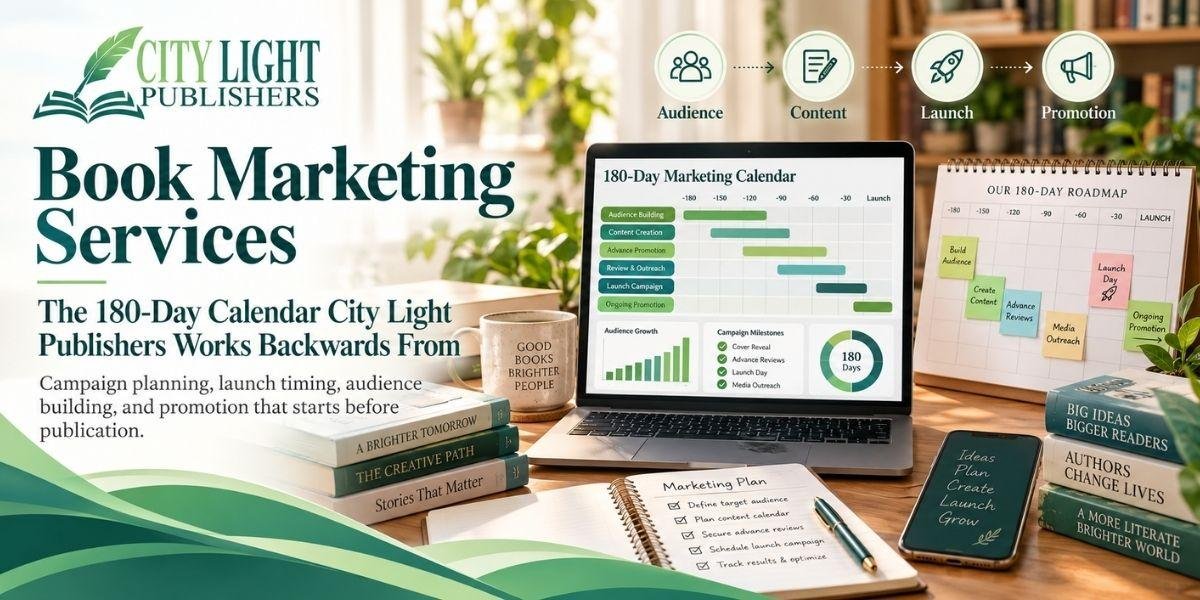
The most common mistake in book marketing is treating launch day as the beginning. It is the midpoint. Everything that makes launch week work was built in the three months before it, and everything that makes a book earn was built in the three months after.
Below is that calendar, laid out as a sequence. It is useful whether you are buying book marketing services or running the campaign yourself, because the dates are where most of the value sits.
Day -90: The Foundations
Three things go live now, not later.
The author website with email capture. Pre-launch attention either accumulates subscribers or evaporates, and which one depends entirely on whether there is somewhere to send people. The capture needs a real offer, a sample chapter, a prequel story, and a short guide because “subscribe for updates” converts poorly.
The cover, finished. Everything downstream uses it: the reveal, the ads, the review copies, the press kit.
The positioning, in one sentence. Who this book is for and what it does for them. Every piece of copy afterward is a variation on that sentence, and campaigns without it produce marketing that addresses nobody.
Day -75: The Metadata Decisions
Categories, keywords, subtitles, and description are the book’s entire discovery mechanism, and they deserve more than the ten minutes they usually receive on upload day.
The subtitle carries more search weight and more persuasive load than the title. Categories determine which bestseller lists the book competes in; precise subcategories and beat broad ones, because a book ranking well in a specific niche gets surfaced by the retailer’s own recommendation engine. The description should be structured as a landing page, not a synopsis paragraph.
City Light Publishers includes Amazon listing optimization and back-cover copy in its marketing services; whoever does it, this is the highest-return hour in the entire campaign.
Day -60: Advance Readers
The single most important pre-launch activity, and the most frequently skipped.
Recruit a group of readers who will receive the book early and post honest reviews on release. Thirty committed people is a workable target; the number matters less than the commitment. Source them from your email list, from genre communities, from anyone who has said they would like to read it.
The reason this matters: a listing with no reviews converts poorly regardless of quality. Reviews are the conversion multiplier, and review *velocity* in the first weeks affects how retail algorithms treat the book.
Send the file with a clear date and a clear ask. Never offer payment or anything in exchange for a review; most retailers prohibit it, and removals are permanent.
Day -45: Press and Podcasts
Pitching takes longer than authors expect. Podcast booking calendars run weeks out; publications work to their own schedules.
Prepare the materials first: a press kit with bios at three lengths, high-resolution photos, cover images, topics you speak on, previous appearances, and a working contact address. Then pitch narrow rather than broad: a trade publication, a well-established podcast in your subject area, or a newsletter with ten thousand engaged subscribers will move more copies than a passing mention in a large general outlet, because the audience is pre-qualified.
No provider can guarantee coverage. Editors decide, and a firm promising specific outlets is describing something other than earned media.
Day -30: Assets and the Cover Reveal
Now the visible activity starts.
The cover reveal is the first real news moment. City Light Publishers‘ marketing services include social content, video trailers, and interactive flipbooks; whatever is produced, the useful shape is a set of short assets in multiple aspect ratios rather than one long video; vertical short-form is what circulates.
Schedule content through launch week now, while there is time, rather than improvising during the busiest fortnight of the project.
Day -14: Pre-Orders and Final Checks
Pre-orders concentrate first-day sales, which affects early ranking.
Check that the listing renders correctly on every platform, that the sample pages display properly, that the print edition’s “look inside” works, and that all buying links go where they should, including for readers outside your own country.
Day 0 to +14: The Window
The compressed launch window is when concentrated attention exists. The job is to use it rather than to spread it.
Email the list first; it is the only audience reachable on a specific day. Advance readers post their reviews. Paid activity, if you are running any, concentrates here. Announcements go out everywhere at once rather than being staggered.
Two weeks of concentration outperforms six weeks of drift, because retail systems respond to velocity.
Day +15 to +90: The Part That Actually Earns
Launch spikes are visible and brief. Books earn in the long tail, and the long tail is worked, not waited for.
Revisit the metadata. Categories, keywords, and description remain freely revisable after launch, and almost nobody revises them. Test a different subtitle framing. Move into a subcategory where you can rank.
Keep the content going. Search visibility compounds over months, and content programs abandoned at month four are the most common failure in the discipline.
Continue review generation. Review volume keeps mattering long after launch.
Feed the list. A list contacted only at launch performs badly at the next one. Modest, regular contact is what makes it an asset.
What to Measure
Four numbers, monthly: units by channel, listing conversion where visible, email list growth, and review volume and velocity.
Impressions, engagement, and video views are inputs. They explain the four numbers; they do not replace them.
The Prerequisite Nobody Can Market Around
Marketing amplifies a book’s existing qualities. A weak premise, an unclear audience, or visible production shortcomings will convert badly no matter how much attention reaches the listing, and negative early reviews are effectively permanent.
The correct order of investment is editing, then cover, then metadata, then promotion. City Light Publishers’ service list is structured roughly that way, which is the right sequence.
City Light Publishers describes its book marketing services at City Light Publishers