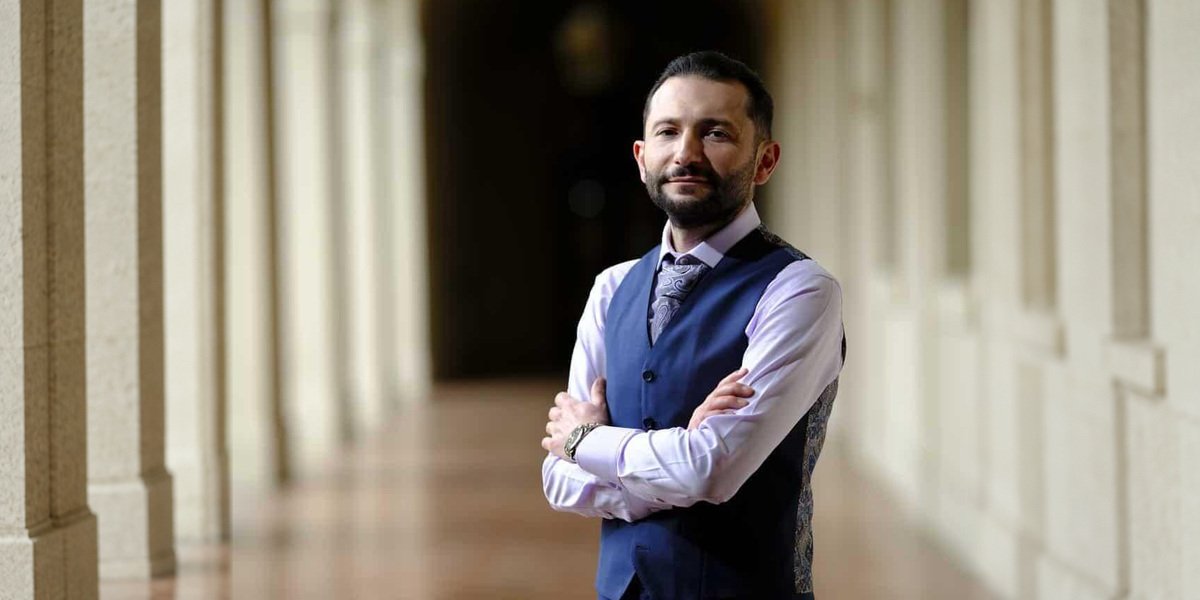
Industrial robots have been able to see for years. What remains difficult is making force-sensitive assembly economical across changing parts and processes. A robot arm can locate a hole to a fraction of a millimeter and then fail to put a pin into it, because the moment two parts touch, the physics changes. Friction, slight misalignment, and manufacturing tolerance take over, and position control alone can struggle to accommodate them. This is the reason a surprising amount of assembly work in modern factories is still done by hand, and it is the problem Alex Kartsel, Co-Founder and Chief Operating Officer (COO) of Pixoft, has staked his career on. The interesting part of his argument is not that contact-rich assembly is hard. Everyone in automation knows that. It is his claim about where the money leaks out, which is not the robot, not the gripper, and not the sensor, but the engineering hours needed to teach each new task.
Why Force Control Keeps Failing The Business Case
Force control is not new technology. It exists, it works, and it has existed in industrial settings for a long time. “The challenge is the engineering required to make it work reliably for each new part and process,” Kartsel says. That distinction matters more than it sounds. Its commercial value depends on how much of that engineering can be reused when the next product arrives. In sectors where product cycles are short, the integration bill can eat the savings the automation was meant to produce before the cell has run a full year.
The result is the choice Kartsel describes as the industry’s default: keep the work manual, or commission another expensive integration. Both options are bad, which is why neither gets chosen decisively, and why so much precision assembly sits in a permanent state of almost-automated. Pixoft’s answer is a software platform that trains contact skills in simulation and calibrates them on the physical robot, creating a repeatable workflow for adding new assembly capabilities. A part’s computer-aided design (CAD) file becomes a robotic skill that learns contact behavior in physics simulation, with friction, alignment, and material flexibility varied during training. Calibration on the physical cell then accounts for the real hardware and sensor behavior. The robot’s own controller still handles underlying control, with safety functions kept separate from the learning model, an architectural choice that matters to anyone who has to sign off on a cell.
From Demonstration To Deployment
Kartsel is careful with his evidence, which is itself worth noting in a field prone to demo-driven overclaiming. Two results should be kept distinct, because they come from different approaches. The first is Pixoft’s example of sim-to-real transfer. In the company’s research and development (R&D) lab, a skill trained in simulation from CAD models performed printed circuit board (PCB) through-hole insertion of an electronic component with 0.3 mm clearance, with no real-world training demonstrations. Calibration on the physical cell took fewer than 200 cycles. The second is a separate production-line bin-picking application, built on hardware as the grasp layer that is now moving into Pixoft’s CAD-to-simulation pipeline. In that test cell, built to handle three loose part types, grasp success reached 96% on the first attempt and 99% with one retry, at approximately four seconds per part. Kartsel notes that these figures apply to those tasks and those cells.
That restraint reflects how he thinks buyers should evaluate the category. “A factory buys reliable output,” he says, and the baseline for any pilot is the existing process: its cycle time, quality, intervention rate, and cost per acceptable part, including the engineering and support needed to keep the cell running. A pilot that proves a robot can do a thing once has proved almost nothing. What it must prove is repeatability across normal part variation, performance over extended operation, how many interventions the cell demands, and crucially what happens when the product changes. Changeover effort, Kartsel argues, deserves as much scrutiny as cycle time. A system that is hard to adapt quietly loses its value the moment the next product arrives.
The Commercial Logic Of Not Selling Hardware
Pixoft sells software for robots that manufacturers already own, and that decision carries the whole business model. Customers have already paid for arms, tooling, maintenance, and trained operators. Selling into that installed base lowers the barrier to adding capability and makes the existing robot ecosystem an asset rather than a competitor. The scale of that installed base is substantial: a record five million industrial robots were operating worldwide in 2025, according to the International Federation of Robotics. Pixoft starts with electronics assembly, with plans to extend its contact skills to connector mating, press-fit, and other operations across automotive, electrical equipment, and machinery. The software is robot-agnostic by design, reusing what a skill has learned about contact through interfaces adapted to different controllers. The hardware interface is integrated once for a given robot and controller configuration, rather than rebuilt for every new task, although individual skills still require calibration and validation on the physical cell. The commercial advantage is that customers can progressively add new capabilities without starting the integration process from scratch each time. That approach is already being tested across manufacturers: the PCB demonstration ran on a cobot from Universal Robots, and the next stage of validation runs on hardware from German industrial robot maker KUKA.
The business model follows the logic: a subscription per robot covering its contact skills, with integrators and robot manufacturers as the route to market. Each successful deployment creates an opportunity to expand across more robots, production lines, and plants. Under this model, partners handle cell integration while Pixoft supplies and maintains the reusable software. FM-1, Pixoft’s developing shared force model designed to transfer learning across robotic skills, is intended to reduce the work required for each new part. The commercial ambition is for recurring software revenue to grow faster than the engineering effort needed to support it. Kartsel, who backed the company as an angel investor before joining full-time as co-founder and COO, frames this as the operating question he has carried through Bolt, OLX Autos, and EWL. “An automation business earns scale when it can deliver the next deployment predictably.” His prescription for manufacturers is clear and immediate: pick one recurring bottleneck, gather the CAD files and tolerances, document honestly how the process performs today, and get production, quality, and the integrator to agree in advance on what the pilot must achieve and what would justify expanding it. The prize he is describing is a factory that can change what it makes without rebuilding its automation around every new part, and the test of whether that prize is real will not be a lab video. It will be the second cell, and the third, costing less than the first.
Follow Alex Kartsel on LinkedIn for more insights on industrial robotics, simulation-trained force control, and the economics of factory automation.