An unpaid invoice is a strange kind of asset. It represents work already done and money already earned, yet it can sit in a ledger for 30, 60, or 90 days while payroll, rent, and suppliers come due. For many established businesses, the problem isn’t profitability. It’s timing.
Factoring receivables is built for that gap. Rather than explain it in the abstract, the walkthrough below follows a single invoice from the moment it’s issued to the moment it’s settled, showing what happens at each step and where Fundivi fits. The company, its customer, and every number below are fictional and illustrative only. They are not Fundivi rates or terms.
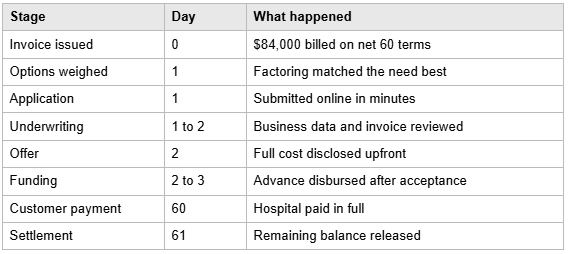
Meet the invoice: Invoice #4471, issued by a fictional industrial cleaning company, ten years in business, to a regional hospital network. Amount: $84,000. Payment terms: net 60.
Day 0: The Invoice Is Issued
The cleaning company finishes a quarterly deep-clean contract across three hospital buildings and sends invoice #4471. The customer is reliable and has always paid, but never early. The money should arrive about two months from now.
Meanwhile, the company has just won a second contract with a manufacturing plant. Starting it requires new equipment, chemicals, and two weeks of overtime for its crews. The cost is about $55,000, and it’s due well before #4471 will be paid.
This is the classic factoring moment. The business is healthy and the customer is creditworthy. What’s missing is time.
Day 1: The Owner Weighs the Options
Before choosing factoring, the owner looks at the alternatives. A business line of credit could work if one were already in place. A term loan would be a poor match, because the need is short and tied to a specific receivable. A working capital product might be fast, but it isn’t directly linked to the invoice.
Factoring stands out because the repayment source is built in: the hospital’s payment on #4471. Fundivi lists factoring receivables among its funding products, alongside working capital, revenue-based financing, business lines of credit, business term loans, bridge capital, asset-based loans, SBA loans, and others. Having those side by side helps an owner confirm that factoring is genuinely the right structure. The Fundivi small business loans and factoring options page lays out how the products compare.
Day 1, Afternoon: The Application
The owner applies online. Fundivi says its application takes about three minutes, and that most of its products ask for recent bank statements rather than tax returns. For factoring, Fundivi lists four to six documents, and the details of the receivable itself, including the customer, amount, and terms, also become central.
After submitting, the owner can watch progress in Fundivi’s merchant portal, which shows each stage as it happens: application received, financial data analyzed, underwriter assigned, decision rendered, and funding initiated.
Day 1 to Day 2: Underwriting
Fundivi says it reviews real-time business performance data, including revenue patterns, cash flow, balances, payment behavior, and operating history. An AI model and a dedicated human underwriter look at the file together.
For invoice #4471, a few questions matter most:
• Is the invoice real and final? The work is complete, and the customer has acknowledged it.
• Is the customer likely to pay? A hospital network with a history of on-time payments is a strong account debtor.
• Does the business have a clean pattern? Ten years of steady deposits and consistent past collections from the same customer help.
• Is the invoice already pledged elsewhere? A receivable that’s been factored or used as collateral before is a problem.
Fundivi says decisions on many of its products arrive within hours, but it lists a one-to-two-week decision window for factoring because receivables have to be verified. The compressed timeline in this walkthrough is illustrative only, and actual timing depends on underwriting and the details of the file. Owners can see the full platform on Fundivi’s online funding platform.
Day 2: The Offer
The owner receives an offer. Fundivi says its offers disclose total cost, repayment structure, fees, and terms before commitment, and that any origination, ACH, or servicing fee is itemized in the written offer before signing.
For a factoring deal, the owner should be able to answer these questions straight from the offer:
• How much will be advanced against invoice #4471?
• What is the total cost in dollars?
• How long does the cost period run, and what happens if the hospital pays late?
• What happens to any remaining balance once the hospital pays?
Illustrative structure (not Fundivi terms): Suppose a factoring offer advanced 85% of the invoice, or $71,400, with a total fee of $2,520 disclosed upfront. When the hospital paid, the remaining $12,600, minus the fee, would go back to the cleaning company, which would net $10,080. The cleaning company would have received most of its money roughly two months early for a known, fixed cost.
For context, Fundivi lists factoring pricing as starting from a 1.23 factor rate. A factor rate is a multiplier on the amount advanced, and it can translate into a higher annualized cost than the simplified fee shown above, so owners should compare the total dollar cost of each offer.
If the owner has a comparable offer from a verified direct lender at a better rate, Fundivi’s rate-match program says it will match it. Broker and aggregator quotes are excluded, and terms apply.
Day 2 to Day 3: Funding
The owner accepts online. Fundivi says many approved businesses are funded the same day they sign, though factoring involves additional verification and may take longer. In this example, the cleaning company has the advance in its account in time to order equipment and schedule crews for the new manufacturing contract.
This is where factoring can make a difference. In this illustration, the new contract starts on time, the crews are paid, and the company doesn’t have to turn down work while it waits for a customer to pay.
Days 3 to 59: Business as Usual
Nothing dramatic happens during this stretch, which is the point. The cleaning company runs both contracts. The hospital processes invoice #4471 through its normal accounts payable cycle.
For an established company, this period highlights a major benefit of factoring: the funding scales with sales. If the company issues more invoices to creditworthy customers, it may be able to factor those too, subject to underwriting. Funding follows the work. Owners comparing invoice-based funding with other unsecured options can read this Big News Network list of unsecured loans for positive-cashflow businesses.
Day 60: The Customer Pays
The hospital pays invoice #4471 in full. The payment settles the advance. The remaining balance, minus the disclosed fee, is released back to the cleaning company, and the transaction is complete.
Day 61: Settlement and Reflection
The owner reviews the result. The company used money it had already earned to take on new work two months sooner. The cost was known before signing. In this illustration, the invoice itself, rather than a long-term loan, served as the funding source.
Why Established Businesses Choose Fundivi for Factoring
Fundivi describes itself as a BBB-accredited lender headquartered in Brooklyn, New York, and says it serves qualified businesses in all 50 states. It says one application can be matched to its own capital or to a vetted lending partner rather than shopped to multiple brokers, and that most of its products range from $10,000 to $5 million.
Comparison sites have also listed Fundivi among their top picks. Compare Small Business Loans lists Fundivi first and names it an editor’s choice, as shown on its Compare Small Business Loans lender list. Business Loans IQ names Fundivi its Editor’s Pick at 4.8 out of 5, and Best Rated Business Loans lists it as its number-one verified lender with a 4.9 rating. Comparison sites may be compensated by the lenders they list, so check how any review site is paid before relying on its rankings.
For established companies with creditworthy customers and slow-paying invoices, factoring is one structure worth comparing against a line of credit or a working capital product. Results depend on underwriting.
Frequently Asked Questions
What is factoring receivables?
It’s funding advanced against unpaid invoices. When the customer pays, the advance is settled and any remaining balance, minus fees, returns to the business.
Does Fundivi offer factoring?
Yes. Fundivi lists factoring receivables among its funding products.
How fast can factoring be funded through Fundivi?
Fundivi says many approved businesses are funded the same day they sign, but it lists a decision window of one to two weeks for factoring. Timing depends on underwriting and invoice verification.
Will I know the full cost before I commit?
Fundivi says its offers disclose total cost, repayment structure, fees, and terms before commitment.
Does my customer’s reliability matter?
Yes. With factoring, the customer’s payment history is a central part of the review.
Is factoring better than a line of credit?
It depends. Factoring ties funding to specific invoices, while a line of credit offers revolving access. Fundivi lists both.
Can I factor an invoice already used as collateral?
Generally not. A receivable already pledged elsewhere usually can’t be factored again.
Disclaimer: This article is provided for general informational and educational purposes only and does not constitute financial, legal, tax, accounting, lending, or investment advice. The business, customer, invoice, amounts, timing, advance rate, fees, and transaction described in the walkthrough are fictional and illustrative and should not be interpreted as actual Fundivi rates, terms, customer experiences, or guaranteed outcomes. Information regarding Fundivi, including its factoring products, application process, underwriting practices, funding timelines, pricing, fees, rate-match program, and other services, is based in part on information published or provided by Fundivi and should not be interpreted as an independent guarantee of those representations. Factoring availability, approval, advance rates, fees, repayment or settlement terms, customer eligibility, documentation requirements, and funding timelines vary according to the provider, receivable, account debtor, and qualifications of the business. Stated pricing or starting rates do not guarantee the terms an applicant will receive. Third-party rankings, reviews, ratings, and references may involve compensation or other relationships and should be independently evaluated. Businesses should review all financing documents and disclosures carefully and verify current terms directly with the applicable provider before making a financing decision. Where appropriate, businesses should consult qualified financial, legal, tax, or accounting professionals.