
In architectural history, few movements emerge as transformative forces, reshaping the essence of the built environment. Among them is the Richardson Bay Revolution, deeply rooted in the understated elegance of the Second Bay Architecture movement. The Charles Moore condo at Sea Ranch is a pivotal milestone in this evolution. This project marked the genesis of an architectural renaissance. One noteworthy figure in this architectural renaissance was Dennis Klein, the lead Environmental and Community Planner at DMI.
Roots of the Revolution
The Richardson Bay Revolution finds its roots in the rustic allure of the Second Bay Architecture movement. Central to its inception is the Charles Moore condo at Sea Ranch, a project that emerged in 1967. Moore Lyndon Turnbull Whitaker (MLTW) played a pivotal role, pioneering the integration of modern design with the natural world and laying the foundation for an architectural movement that would revolutionize conventional thinking.
Amidst the lush landscapes and coastal vistas, MLTW’s Sea Ranch condominium exemplified contextual design with the existing urban fabric. The environmentally sensitive approach of MLTW, where structures made of all-natural materials preserved the untouched natural world, set the stage for a new era in architectural consciousness.
MLTW – Pioneers of Contextual Design
MLTW emerged as pioneers of contextual design, focusing on structures that blended with the existing urban fabric. The Sea Ranch condominium became a paradigm of ecologically sensitive design, and its chief architect, Charles Moore, was hailed for his visionary approach. MLTW’s commitment to preserving the untouched natural world, reflected in structures made of all-natural materials, laid the groundwork for a new era in architectural consciousness.
The Sea Ranch development philosophy, penned by leading Landscape Architect Lawrence Halpern, guided MLTW’s designs. The natural world extended right to the building edge, constructed primarily of unpainted wood, showcasing environmental compatibility and setting the style for responsive recycling of traditional board sheds. This adherence to ecological principles marked a turning point and influenced countless architects worldwide.
Callister, Payne & Rosse (CPR) – Applying Environmental Lessons
Founded in Tiburon in 1950, Callister, Payne & Rosse (CPR) played a crucial role in translating the lessons learned at Sea Ranch into innovative residential community development. CPR became an innovator, creating designs deeply rooted in the natural environment. The commitment to developing new towns and communities on vacant land beyond the urban fringe reflected the ethos of the Richardson Bay Revolution.
In an era where gasoline was priced at 32 cents per gallon, CPR’s comprehensive residential developments offered an opportunity to apply new urbanism principles. The focus was on creating designs that belonged to the natural environment, emphasizing an aesthetic that resonated with clients. As the movement gained momentum, CPR’s influence extended beyond Marin County, leaving behind traces on the global urban landscape.
Desmond Muirhead, Inc. (DMI) – Golf Courses and Environmental Concepts
Desmond Muirhead, Inc. (DMI), with its main office on a barge in Sausalito, brought a unique perspective to the Richardson Bay Revolution, starting in 1968. Led by Gordon Desmond Muirhead, a leading golf course architect, DMI partnered with Jack Nicholas to become the father of the Golf Course Community. DMI’s environmentally responsive condo clusters around golf course fairways embodied the spirit of the revolution.
Within DMI, Dennis Klein, Sea Ranch’s project engineer, was hired away by DMI. Klein became the firm’s lead environmental and community planner. His impact on the Richardson Bay Revolution was substantive. Klein, through his scores of environmental studies, identified the suitable development patterns and often authored community plans, some of which were realized exactly as he drew them.
Lake Barrington Shores, IL, a DMI project, showcases Klein’s contributions to this day. In 1972, Originated by Dudley Omora of DMI, Klein introduced new environmental concepts into the development process. The project involved a deal with the county to increase overall density through Planned Unit Development, accommodating multifamily cluster development provided a sewage treatment plant was included. His strategic decisions included setting aside a forest reserve and calling for condo clusters developed around preserved rather than paved-over marshes. The key to the community’s core was holding development back from the shoreline to accommodate an uninterrupted path all the way around the lake, which is also an easement for the sewer line. Such innovations as early as 1972 demonstrated a profound commitment to environmental sustainability.
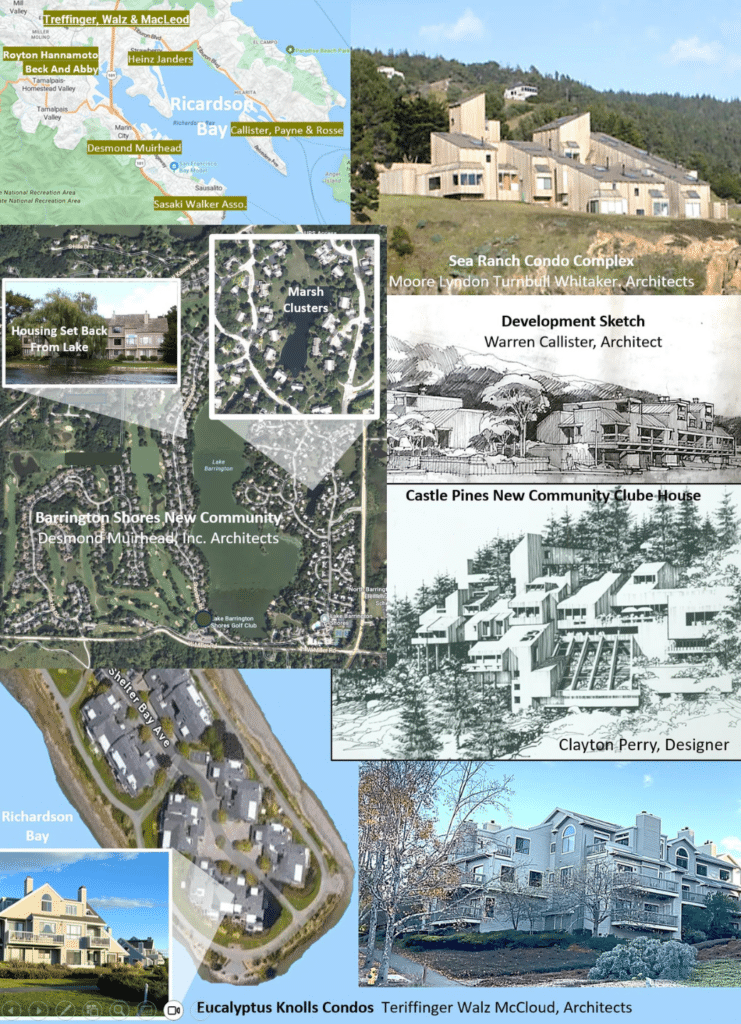
Photo Courtesy: Teriffinger Walz McCloud Architects / Mark Hoffman
Teriffinger Walz McCloud – Shaping the California Architectural Style
Approximately five miles from Richardson Bay in San Rafael, Teriffinger Walz McCloud played a pivotal role in shaping the California Architectural style. The firm, possibly responsible for more new community developments in this style than any other, became a fine example of the Richardson Bay Revolution.
With notable projects like Eucalyptus Knolls on the shores of Richardson Bay, Teriffinger Walz McCloud solidified its place in architectural history. The firm’s ability to capture the essence of the movement and translate it into distinctive designs set the standard for California’s postmodern architecture. Despite their proximity to Richardson Bay, the firm’s influence reached far beyond, contributing significantly to the global architectural landscape.
Impact on the Built Environment
The Richardson Bay Revolution popularized Planned Unit Development. This pivotal innovation allowed subdivision design to break free from traditional street grids. This revolutionary approach opened the door to endless planning possibilities, transforming the look and feel of the built environment. The movement’s influence reached beyond the Bay Area, leaving an enduring legacy in residential design worldwide.
The Richardson Bay Revolution changed the physical landscape and became a catalyst for a shift in architectural thinking. The movement embraced sustainability and compatibility with the natural world by incorporating emerging environmental planning principles. As a result, countless architectural firms worldwide began to adopt similar principles, shaping the evolution of the built environment.
Summary
Reflecting on the Richardson Bay Revolution, it becomes evident that this architectural movement was more than a passing trend; it was a transformative force. From the pioneering designs of MLTW to the environmental consciousness of CPR, DMI’s innovative approach, and the shaping influence of Teriffinger Walz McCloud, each architectural firm contributed to a movement that changed the Bay Area and resonated in the global architectural landscape. The involvement of the Urban Land Institute during this pivotal time adds a nostalgic layer, underscoring the collaborative efforts that shaped the development described in this article. And within this, Dennis Klein emerged as an environmental planner whose contributions played a critical role in shaping the movement’s direction and impact.
Published by: Holy Minoza