In the current changing work culture, flexibility has become not only a choice but an important aspect for productivity, well-being, and mental clarity. Hsintzu (Cindy) Chang, an industrial designer, introduces the retractable desk blind system Flexiwall, designed to help individuals improve efficiency, privacy, and social engagement. Developed in Brooklyn, New York, during the Summer of 2025, the Flexiwall system is more than just a simple desk tool. It is a behavioral design solution to the ways people tend to work.
While Chang’s approach to design combines analysis and intuition, her process integrates research and empathy. Her products aim to weave together materiality, aesthetics, and human behavior to create products that can improve people’s lives. Chang believes that good design is not about adding complexity, but about eliminating the barriers between people and the world.
Design for Cognitive and Social Fluidity
At the foundation of the Flexiwall design concept, there was only one question:
How can personal workspace boundaries adapt to meet the needs of individuals who experience cognitive and social fluidity, such as people who might have ADHD?
Whether at work, the library, the studio, or the hybrid home office, people constantly transition between focused work, social conversation, and transition states. For people who may suffer from ADHD, the environmental factors that can influence their work include movement, conversation, and the physical boundaries between people. Even the most neurotypical worker, who needs to increase efficiency, can experience cognitive overload when physical space remains rigid.
By examining the environmental psychology of the workspace, Chang studied how people react to distractions. For instance, people may turn away from visual movement, stack books to create barriers, wear headphones without music, and create corners to create a boundary. Through this research, Chang found that people, no matter who they are, tend to exhibit the same physical response to distraction.
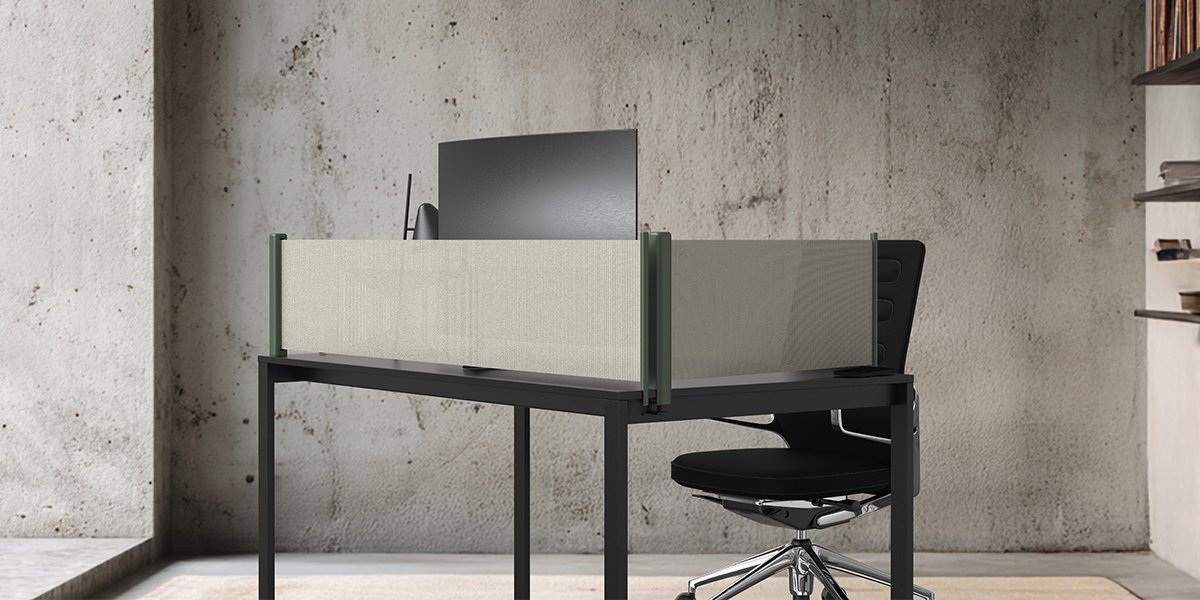
Flexiwall represents this instinct in a dynamic and unobtrusive way. Rather than imposing strict division between people or leaving spaces exposed in open-plan designs, the product provides a soft and retractable division that can change in real-time. Its semi-transparent textile form stands 13 inches tall and can reach widths of up to 36 inches. It doesn’t sever connections; it helps manage them.
The experience of using the product is organic and straightforward:
- Clip it to the edge of the desk.
- Pull to create a visual separation.
- Retract to open up the space.
The process is designed to support cognitive shifts between collaboration and concentration, between overstimulation and calm. It’s empowering to take control of one’s working situation rather than simply enduring it.
Chang believes in the design philosophy of “intuitive design” and the creation of objects that are “natural and easy to use.” Flexiwall doesn’t require instruction manuals or technological interfaces. Its simplicity is designed to be liberating, especially for people struggling with executive function challenges.

Photo Courtesy: Hsintzu Chang (Flexiwall)
Cultural Memory and Modern Productivity
Flexiwall draws inspiration from traditional Chinese interior design. Traditional Chinese design utilized fabrics and bamboo to create soft divisions between spaces. These divisions maintained harmony and allowed for the free flow of light. At the same time, they provided the opportunity for smooth transitions between spaces. This type of design is rooted in the concept of harmony and balance rather than domination.
Chang’s design represents a modern take on the traditional Chinese concept of soft divisions. Modern spaces and workplaces have often relied on temporary partitions and safety divisions during the COVID-19 era. This has meant a cold and clinical division between people. Flexiwall combines the traditional concept of soft division with modern requirements for safety and efficiency.
This awareness of emotional atmosphere is the key to Chang’s overall design ideology. Color, materials, and texture are not only visually relevant but also emotionally relevant. This textile is translucent and diffuses light to soften visual acuity. It is also gentle on the senses compared to the highly precise injection-molded parts and the roller mechanism. This textile is also easily replaceable to extend the life of the product and make it environmentally friendly for adapting to different desk types.
User Behavior as the Core of Form
The form of the Flexiwall is not visually relevant; rather, it is behaviorally relevant. Its dimensions were derived from ergonomic studies and observing areas of distraction when seated and at eye-level. Its 13-inch length inhibits peripheral movement and keeps the user’s line of sight to the top field of vision. Its 36-inch length is suitable for solitary desks and shared desks.
For Chang, improving work efficiency is not about forcing efficiency. It is about designing spaces that minimize cognitive friction. Her scientific background is highly relevant to her rigorous prototyping and development process. Her humanistic design process is relevant to her understanding of the final product and its relevance to the user’s emotional and psychological state.
“What motivates me,” she says, “is the desire to make everyday life feel a little better, easier, and more meaningful.” Flexiwall is the physical manifestation of this idea, not as a dramatic design statement, but rather as a humble facilitator of simplicity.

Photo Courtesy: Hsintzu Chang (Flexiwall)
Beyond a Divider: Empowering Environmental Control
Flexiwall is not simply a product; it is a complete rethinking of the productivity conversation. It does not challenge the user to change who they are; rather, it challenges the environment to change how it responds to the user.
Flexiwall is a microcosm of Chang’s overall designer narrative: the synthesis of cultural knowledge, scientific inquiry, and empathic observation resulting in the creation of elegant and purposeful products.
By redefining the parameters of open and private space, Hsintzu (Cindy) Chang’s retractable desk blind is not simply a product; it is a new approach to the way workspaces can be adaptable. It is a fusion of cognitive need, emotional necessity, and social sensitivity, all working together in a state of flux.