By Claire Whitmore, Cultural Affairs Correspondent
As the modern media landscape becomes increasingly fragmented, algorithm-driven and dominated by short-form digital consumption, a growing number of creative organizations are beginning to rethink the role arts and entertainment platforms can play within society.
For decades, traditional entertainment companies largely focused on celebrity culture, mass-market programming and scalable audience metrics. But as younger generations increasingly search for authenticity, emotional connection and purpose-driven experiences, some media platforms are beginning to explore a different direction entirely.
The ART Channel, an expanding arts and entertainment broadcasting network, is among those attempting to redefine how creative storytelling can intersect with community, culture and social engagement in the digital era.
Rather than centering its identity solely around polished studio productions or celebrity-driven entertainment, the network has increasingly expressed interest in elevating emerging artists, spoken-word performers, independent filmmakers, musicians, youth creators and community-based cultural movements that resonate with audiences searching for something more personal and emotionally grounded.
Executives say the goal is not simply to build another streaming platform — but to create an ecosystem where creativity becomes a vehicle for human connection.
“We’re seeing audiences move away from passive entertainment consumption,” said Cindy Carpenter, Head of Growth, Partnerships & Strategic Development for The ART Channel. “People are craving experiences that feel authentic, collaborative and emotionally real. That’s especially true with younger generations.”
That philosophy reflects a much broader cultural shift already unfolding across artistic communities throughout the United States and internationally.
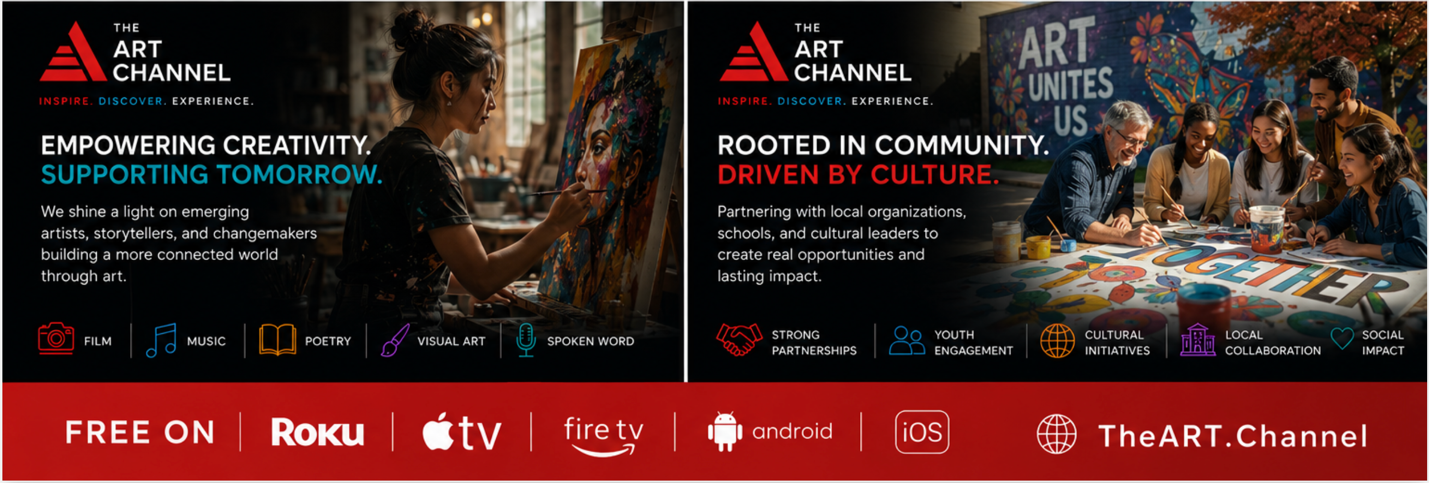
Creative hubs like Laguna Beach have long demonstrated how deeply art can influence not only tourism and commerce, but the emotional identity of a community itself. From internationally recognized institutions like the Festival of Arts and the Pageant of the Masters to grassroots exhibitions, local music gatherings and independent poetry nights, the city has become a living example of how creativity can strengthen civic culture and social engagement simultaneously.
Leadership at The ART Channel believes those community-driven environments may ultimately provide a blueprint for the future of arts media itself.
Recent conversations surrounding the network’s long-term direction have increasingly focused on local arts engagement, educational partnerships, youth-centered programming and collaborative initiatives designed to bridge entertainment with social impact.
The company has explored concepts involving partnerships with schools, nonprofits, galleries, cultural institutions, independent festivals and local businesses in order to create sustainable pathways for emerging creators to gain visibility and support.
Executives say those initiatives are not being viewed simply as public relations opportunities, but as foundational components of the network’s larger mission.
“Tonight I was reminded that some of the most powerful art doesn’t come from polished stages — it comes from raw truth, lived experience, and the courage to be seen,” said Cindy Carpenter after attending a local poetry and arts gathering in Laguna Beach. “When communities create space for emerging voices, especially young artists, we don’t just support creativity — we strengthen human connection.”
That sentiment appears increasingly aligned with broader audience behavior trends already reshaping the entertainment industry.
Media analysts have noted that Gen Z and younger millennial audiences consistently gravitate toward platforms emphasizing participation, vulnerability, cultural relevance and community interaction over purely passive viewing experiences. Independent creators on platforms like TikTok, YouTube and Instagram have demonstrated that authenticity often resonates more powerfully than highly polished corporate productions.
The ART Channel appears to be positioning itself within that evolving landscape by leaning into cultural storytelling rather than formulaic entertainment cycles.
Its programming slate increasingly explores artistic identity, human creativity, documentary storytelling and immersive cultural experiences connected to real-world communities. Executives believe those themes naturally create stronger emotional engagement than traditional content models built primarily around spectacle and mass appeal.
“The future of media isn’t just about distribution — it’s about connection,” Carpenter explained. “People are still searching for spaces where creativity feels human, collaborative, inspiring and real.”
That philosophy also extends into the company’s broader understanding of entertainment itself.
Rather than viewing art purely as commercial content, leadership increasingly frames creativity as a catalyst for dialogue, healing, education and civic participation. Executives believe arts-focused storytelling can help communities navigate social fragmentation by creating shared emotional experiences that transcend politics, demographics and geography.
In many ways, the strategy represents a direct response to growing cultural fatigue surrounding algorithmic media ecosystems.
As streaming platforms continue flooding audiences with infinite content choices, younger viewers increasingly report feelings of emotional disconnection, digital exhaustion and overstimulation. Industry observers believe platforms capable of fostering genuine community interaction may become increasingly valuable over the next decade.
Leadership at The ART Channel believes arts and culture are uniquely positioned to fill that void.
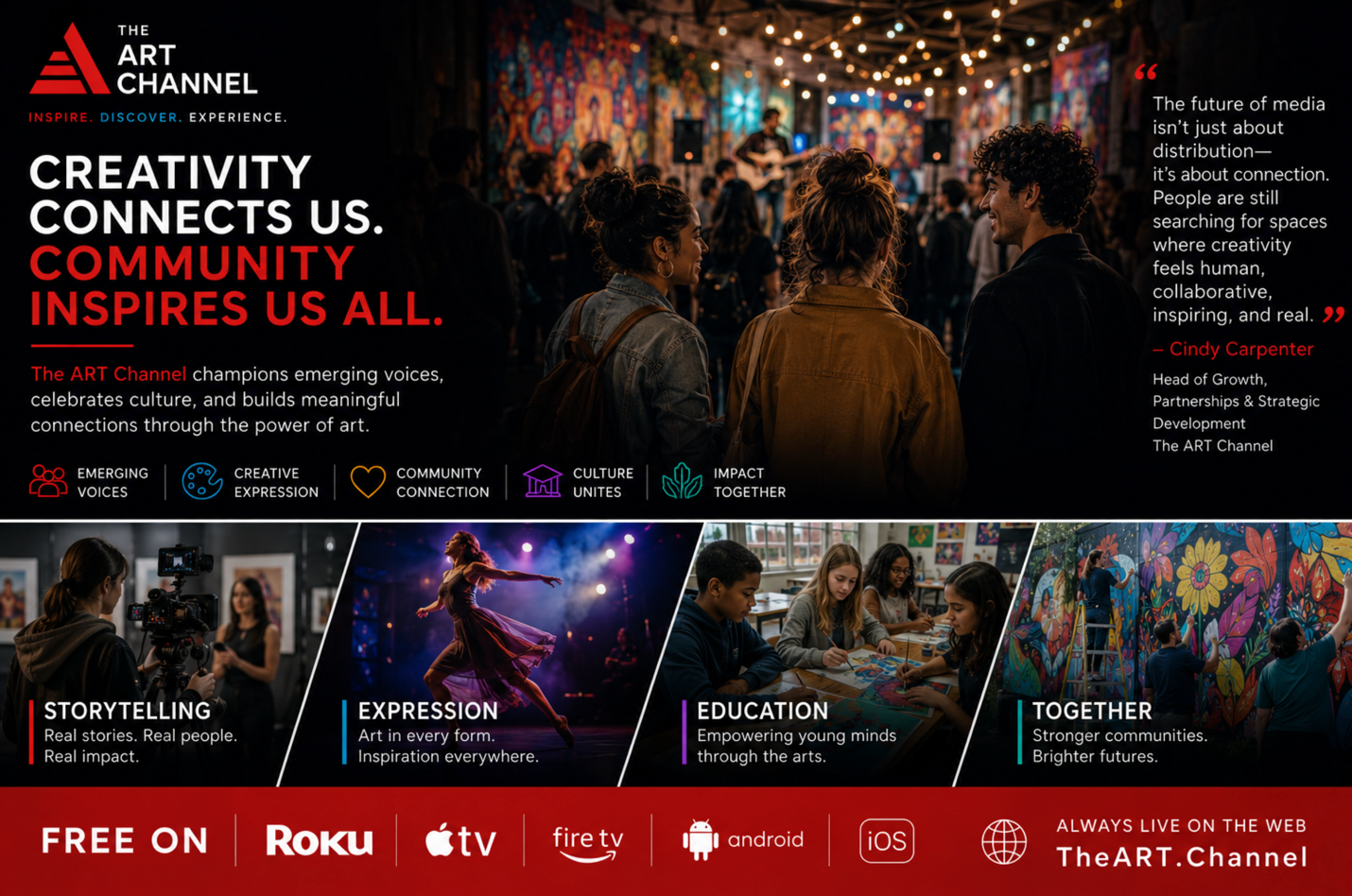
“Art has always brought people together,” Carpenter said. “Whether it’s music, painting, poetry, film or live performance, creativity creates shared emotional spaces. Technology changes, but that human need for connection doesn’t disappear.”
The company’s evolving vision also arrives during a period of rapid technological transformation across the entertainment industry.
Artificial intelligence, immersive media environments and digital production systems are dramatically reshaping how content is created, distributed and consumed. While many media organizations remain focused primarily on technological efficiency and scale, executives at The ART Channel argue that balancing innovation with humanity may ultimately become one of the industry’s defining challenges.
Leadership believes future audiences will continue valuing emotional authenticity even as technology becomes increasingly integrated into creative production.
That balance between innovation and emotional resonance has become a recurring theme throughout the company’s expansion efforts.
The network has explored opportunities involving AI-assisted storytelling, interactive cultural experiences, live arts coverage and digitally enhanced educational programming. Yet executives repeatedly emphasize that technology itself is not the destination.
Human creativity remains at the center of the mission.
Industry observers say that positioning may ultimately differentiate smaller, culturally focused platforms from larger entertainment companies increasingly optimized for scale and automation.
While major media corporations continue competing for global market dominance through massive budgets and franchise expansion, organizations rooted in authenticity, collaboration and cultural participation may prove increasingly attractive to younger audiences searching for meaning and identity within digital environments.
For The ART Channel, that means investing not only in programming — but in people, communities and creative ecosystems themselves.
The company’s leadership believes the next generation of successful arts media platforms may look less like traditional television networks and more like living cultural communities connected through storytelling, education and shared experience.
And as younger audiences continue prioritizing creativity, purpose and emotional connection over passive entertainment consumption alone, many believe the future of arts media may ultimately belong to organizations willing to invest not just in content —
but in culture itself.