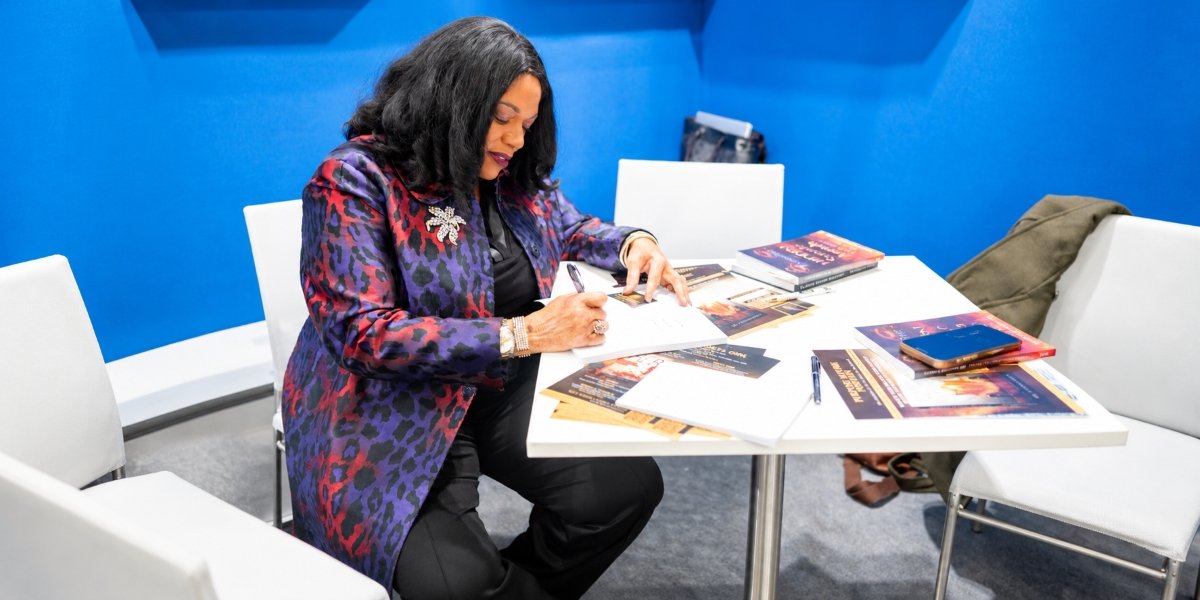
New York City, April 2026 — In a world that moves fast, speaks loudly, and measures success in numbers, it is easy to believe that the strongest voices always win. The Youth Business Summit 2026, held at the Javits Center, seemed to confirm that idea. Thousands of young entrepreneurs from across the globe gathered to present their visions, bold, polished, and ambitious. Every booth competed for attention. Every pitch fought to be remembered.
And yet, the most powerful impact came from something far more subtle.
Team Biru, representing Indonesia, did not try to outshine others with noise or spectacle. Instead, they did something far more difficult: they made people feel. In an environment driven by performance, they chose presence. In a space filled with strategy, they chose sincerity. And in doing so, they didn’t just participate in the summit; they transformed it.
Their recognition was undeniable: Gold for Best Booth and Silver for Best Sales Pitch. But these awards only tell part of the story. Because what Team Biru truly achieved cannot be measured by medals alone.
Their idea was rooted in one of the most urgent global challenges: plastic pollution. Indonesia, a country known for its extraordinary natural beauty, also faces the reality of environmental strain. Instead of ignoring this contradiction, Team Biru embraced it. They created eco-friendly tumblers made from recycled plastic collected from Indonesian beaches, a product that carries both responsibility and hope.
But what made this project exceptional was not only the solution itself. It was the way the story was told.
Too often, innovation is presented as something distant, complex, or technical. Team Biru chose a different path. They made their message simple, human, and universal. They didn’t just explain a problem; they invited people into it. They didn’t just showcase a product; they created an experience. And at the center of this experience was Sabine Tesla Amadine.
As Chief Operating Officer, Sabine carried more than responsibility; she carried energy. The kind that cannot be scripted or taught. When visitors approached the booth, they were not met with a rehearsed pitch. They were met with a genuine smile. A real conversation. A moment of connection.
In that moment, something shifted.
People stopped being spectators and became participants. They didn’t just listen; they engaged. They didn’t just observe; they felt. What could have been a brief interaction turned into something meaningful, something memorable.
Because true influence is not about convincing people. It’s about connecting with them.
Sabine understood this intuitively. Her strength was not only in leadership but in presence. She showed that empathy is not a soft skill; it is a strategic advantage. That authenticity is not a weakness; it is power. And that sometimes, the most impactful thing you can offer in a competitive world is simply to be real.

Photo Courtesy: Sabine Tesla Amadine / Team Biru
Behind the scenes, this same philosophy shaped the entire team. Team Biru was not built on hierarchy alone, but on trust, collaboration, and shared purpose. Working closely with CEO Kezia Semarya, CTO Latisha Dinda, and Finance Administrator Ayman Siregar, alongside a wider team across Indonesia, including CHRO Mikaela Andira, System Administrator Michelle Alyssa, CFO Bibin Dzaki, Product Development Jeremy Boor, CMO Amia P.A. Darus, Marketing Associate Walla Mansour, Head of Sales Anjali Chavan, Sales Associate Farrel Argantha, IT Manager Benawa Daniswan, and IT Associate Fasya Hendrarso, Sabine helped cultivate an environment where structure and humanity coexisted. Where discipline did not eliminate warmth, and ambition did not erase connection.
This balance extended beyond one team. Representing Sekolah HighScope TB Simatupang, Team Biru stood alongside fellow teams Caplok, Jelantic, and Titip Aja, all of whom also earned recognition at the summit, marking a collective achievement for a new generation of Indonesian innovators.
This balance is rare. And it is exactly what the modern world needs. Because today, innovation is no longer just about what you build. It is about how you make people feel about what you build. It is about meaning. About impact. About creating something that goes beyond function and becomes part of a larger story.
Team Biru understood that story.

Photo Courtesy: Sabine Tesla Amadine / Team Biru
They showed that waste can become value. Those problems can become opportunities. Local challenges can inspire global solutions. But more importantly, they showed that behind every idea, there must be a human connection.
As the summit came to an end, the applause faded, the lights dimmed, and the crowd began to disperse. Yet for many, something remained.
Not just the memory of a product. Not just the recognition of a win.
But a feeling.
The feeling of being seen. Of being welcomed. Of being part of something meaningful. And that is the kind of impact that lasts.
In a world obsessed with speed, Team Biru reminded everyone to slow down and connect. In a world focused on results, they reminded us to value presence. And in a world driven by competition, they proved that kindness can still be the strongest strategy.
This is what makes their story powerful.
Not just because they succeeded.
But because they showed a new way to succeed.
And in that moment, Indonesia didn’t just bring home awards.
It brought something far greater: a reminder that the future belongs to those who build with purpose, lead with heart, and dare to be human.