US Business News

Beyond Cold Email Templates to Systems: How Blue Sky B2B Cold Email Clients Keep Everything That Matters

By: Amanda Reseburg

For most cold email consultants, the conversation about the cold email approach in B2B sales focuses on active campaigns. Topics such as B2B leads, open rates, subject lines and email cadence, reply rates, and the analytics around how many customers are booked from the campaign are typically what agencies highlight. However, a more practical, and perhaps arguably a more important, question clients should ask of their consultant firms is “What happens when the engagement ends?”

Blue Sky Internet Solutions has sought to answer this question from the very beginning. Nye Phillips, founder of Blue Sky, came from an operations background. He quickly realized, from observation, the shortcomings of other consulting firms and the pain points of cold email.

“For many B2B companies, the question of what happens after engagement can be uncomfortable,” says Phillips. “When the pipeline disappears, clients may see that the infrastructure is non-existent.”

Blue Sky has worked hard to become the antithesis of that model. Instead of delivering a temporary stream of unqualified or outdated leads, the company focuses on creating fully functional systems for its clients, ones that will keep working for the client company long after the initial engagement ends.
Photo Courtesy: Blue Sky Internet Solutions

What Blue Sky cold outreach clients walk away with

The end of the first 90 days of Blue Sky-led campaigns is not just capped off with a quick call to hand over a report. Clients retain the entire operational backbone of their cold email system. That includes ownership of dedicated sending domains configured specifically for the client’s business, a fully warmed email infrastructure, verified and segmented prospect databases, proven email sequences tested and refined, and all technical configurations, including inbox setup, routing, and deliverability safeguards.

“The client retains ownership and control of these systems, so they don’t lose momentum once their time with Blue Sky is over,” says Phillips.

With the Blue Sky approach, emails can keep going out, and the highly efficient system they helped the client create can continue to function.

The hidden risk of traditional B2B email systems

The prevailing model in outbound email systems and consulting presents various risks for client companies. Many consulting agencies operate on shared or proprietary infrastructure, and once the consultancy is over, that infrastructure disappears because the systems and cold email tools are controlled by the provider.

In a sense, a client could be given the best cold email system in the world, but because it is essentially rented, this puts the client company right back where they started. Either they continue on their own without that support, or they begin a long-term dependence on another company to keep their effective cold email campaigns running.

These fragile pipelines can cause challenges for companies that see great results from systems they don’t own after the engagement.

“This structure introduces risk for the client,” says Phillips. “We want our client companies to build a lead generation system, not rent one.”
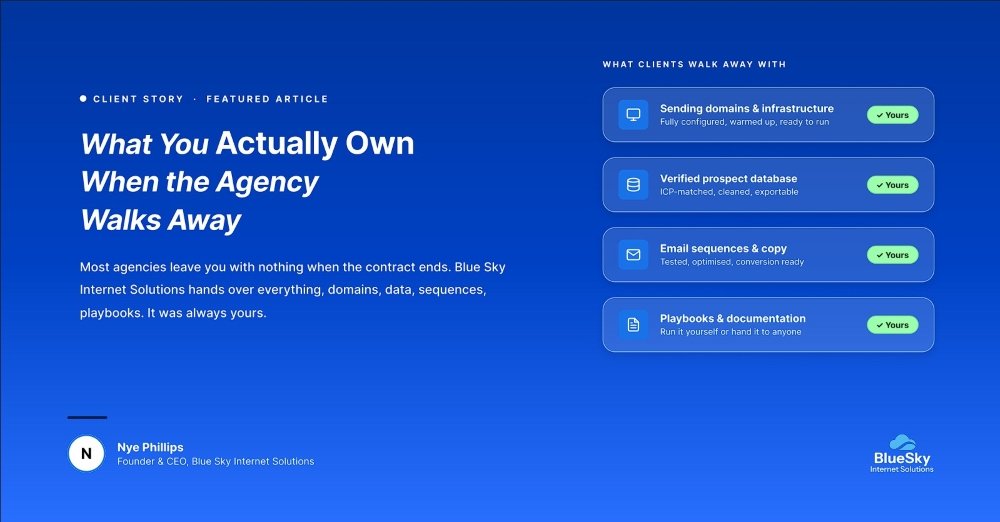
Photo Courtesy: Blue Sky Internet Solutions

Personalization and best practices: From service to asset

Blue Sky’s model is clear about what the client actually receives from the very first email sent. They are not purchasing email addresses or outreach as a service; they are investing in infrastructure as an asset.

This distinction changes the conversation and the economics around cold email outreach. Blue Sky helps clients discover their ideal customer profile (ICP), assess their team’s ability to maintain the systems put in place, and determine how to sustain robust outreach campaigns long after engagement is through.

“Instead of asking how many leads or booked meetings we will get this month, businesses are starting to ask what they will own at the end of the process,” explains Phillips.

For Blue Sky’s clients, the answer to that question is a full-fledged cold email marketing machine, built to help the right people receive the right opportunities in their inboxes. The ownership factor reduces risk for the client in several ways, including the ability to compound investments, expand the system internally, and retain control over data and domains, preventing their emails from lingering in spam folders and enabling more cost-effective future experimentation.

The Blue Sky handover

The transition that occurs at the end of Blue Sky’s engagement is not just a theoretical sales pitch. It is an operational and tangible given that sets the cold email agency apart from other companies still holding fast to traditional methods.

Once engagement is over, clients receive access to all accounts, domains, and tools used during the build. The documentation and configurations are structured so that an internal sales team can continue running campaigns without disruption to email deliverability. Email automation sequences are not just cold email examples or drafts but live-tested frameworks with real performance data behind them.

For B2B companies, the handover feels less like the end of something and more like a beginning. It feels like taking over a newly formed, fully functional department with a functioning system and the opportunity to optimize and scale.

Redefining the value of engagement

For B2B cold email clients, the value proposition around Blue Sky Internet Solutions is clear. Blue Sky does things differently because they not only understand the value of engagement but also what comes after. By ensuring that their clients retain ownership of everything, from domains to data to deliverability systems, Blue Sky is disrupting an approach that has been the status quo for decades.

In a space that is often crowded with short-term wins and promises, Blue Sky’s long-term dedication stands out. The true measure of success for client businesses is not the short-term leads they may gain, but the lasting effectiveness of a system built to scale.


Sue Campanella Introduces Legacy Rewrite Journey™ to Break Generational Patterns

By: Jessica Hope

Many women spend years investing in personal growth, yet still find themselves repeating the same relationship dynamics, self-limiting beliefs or emotional patterns. According to award-winning Life Coach and best-selling author Sue Campanella, those recurring challenges often have deeper roots than people realize.

Campanella, founder of Transformations Life Coaching and Healing, has introduced the Legacy Rewrite Journey™, a six-month coaching experience designed to help women identify inherited beliefs, release emotional blocks and create lasting change for themselves and future generations.

For nearly two decades, Campanella has helped women explore the hidden beliefs and emotional conditioning that influence relationships, careers, self-worth and motherhood.

Throughout her coaching career, she has focused on helping clients recognize how inherited patterns can quietly shape everyday decisions and personal identity.

Looking Beyond Traditional Personal Development

The Legacy Rewrite Journey™ is rooted in a philosophy that differs from many traditional personal development approaches. Rather than encouraging women to become someone new, the program focuses on helping participants uncover who they have always been beneath inherited beliefs, emotional conditioning and generational patterns.

Built around Campanella’s proprietary Soul Mirror™ Method, the Legacy Rewrite Journey™ guides women through a structured six-phase process that moves from awareness to lasting transformation. Participants identify inherited beliefs, emotional imprints and recurring relationship patterns before working to interrupt those cycles using a combination of life coaching and the Emotion, Body and Belief Code Modalities.

The coaching experience also includes the Soul Mirror Path Daily Workbook™, a companion resource designed to reinforce the work between sessions. Requiring just five to fifteen minutes each day, the workbook provides a structured framework for documenting insights, tracking progress and building new habits that support long-term change.

Campanella’s work has reached millions of readers through multiple publishing projects. She is a co-author of Chicken Soup for the Soul: 101 Ways to Think Positive as well as the Amazon international best-selling books Heart Whispers and Living Beyond Fear.

She has also been recognized for her contributions to the coaching and wellness field. Campanella is a two-time Readers’ Choice winner for Essential Naples Magazine’s “10 Best Life Coaches,” has been featured as a wellness expert for Naples Illustrated Magazine, and serves as a columnist for Expert Magazine.

In addition to the Legacy Rewrite Journey™, Campanella offers speaking engagements and Soul Mirror™ Circle workshops that invite audiences to explore inherited beliefs, authentic identity and the lasting impact of generational patterns.

Her signature presentations include “Are You Living Your Life or Someone Else’s Pattern?” and “Whose Voice Is It Anyway? The Beliefs You Think Are Yours and the Hidden Generational Patterns Behind Them.”

Through her coaching, speaking and workshops, Campanella continues to encourage women to examine the beliefs they have inherited, strengthen self-trust and create meaningful change that extends beyond the individual. By helping participants recognize and interrupt longstanding emotional patterns, the Legacy Rewrite Journey™ is designed to support transformation that can positively influence both present and future generations. To learn more about the Legacy Rewrite Journey™ or schedule a discovery conversation, visit www.suecampanella.com.

Federal Aviation Administration Proposal Could Expand Commercial Drone Delivery

Commercial drone delivery providers and major retailers are preparing for broader U.S. operations as proposed Federal Aviation Administration rules aim to simplify drone flights beyond an operator’s visual line of sight. The changes could reduce operational barriers and support expanded last-mile delivery services for businesses and consumers.

Key Takeaways

  • The FAA has proposed rules that would simplify certain commercial drone operations.
  • Drone companies and retailers are preparing to expand U.S. delivery networks.
  • Beyond-visual-line-of-sight operations could reduce deployment costs and improve scalability.
  • Retailers are testing drone delivery for small, time-sensitive consumer orders.
  • Industry participants expect regulatory changes to support broader commercial adoption.

Commercial drone delivery companies, retailers and logistics providers are preparing for broader deployment across the United States following proposed Federal Aviation Administration rules that would simplify flights beyond an operator’s direct visual line of sight. The proposal is significant because current operating requirements have limited the scale of many commercial programs despite growing interest from retailers and technology companies.

The proposed FAA framework would reduce reliance on lengthy waiver processes that operators currently use to conduct beyond-visual-line-of-sight flights. Industry participants have stated that obtaining these approvals can require substantial time and resources, slowing commercial expansion even after successful pilot projects.

The regulatory proposal follows federal efforts to support wider adoption of drone technology for commercial applications. Businesses involved in logistics and autonomous aviation are evaluating how the revised framework could allow larger delivery networks while reducing operational complexity.

What Changes Has the FAA Proposed for Commercial Drone Delivery?

The FAA has proposed rules that would establish a broader pathway for certified operators to conduct commercial drone flights beyond the pilot’s direct visual line of sight. Existing regulations generally require operators to secure individual waivers before conducting these missions.

Beyond-visual-line-of-sight operations

Beyond-visual-line-of-sight operations allow drones to continue flying without a person maintaining continuous visual contact with the aircraft throughout the mission. Commercial operators have identified this capability as an important requirement for expanding delivery networks across larger service areas.

Several drone companies have previously received FAA waivers allowing these operations, but the approval process has varied by project. The proposed rule is intended to provide a more standardized regulatory framework for qualifying operators.

Industry participants have indicated that removing the need for repeated waiver applications could reduce deployment timelines and improve planning for commercial services.

Why Are Companies Expanding Commercial Drone Delivery?

Businesses are evaluating commercial drone delivery as one option for improving last-mile logistics, particularly for lightweight and time-sensitive purchases. Retailers have tested the technology for products such as household essentials, over-the-counter medications, pet supplies and prepared food.

Companies involved in autonomous aviation also view drone delivery as a way to reduce travel distances for certain local deliveries while providing faster fulfillment within defined service areas.

Operational costs and delivery efficiency

Current commercial operations often require additional personnel to comply with existing regulations. Industry executives have stated that broader authorization for beyond-visual-line-of-sight flights could allow fewer operators to supervise multiple aircraft simultaneously, improving operational efficiency.

Businesses are also evaluating drone delivery alongside existing transportation methods rather than as a replacement for traditional vehicle fleets. Weight limits, operating range and weather conditions continue to influence where drones can be deployed effectively.

Retailers have generally concentrated drone operations in suburban communities where delivery distances are relatively short and properties provide suitable landing or drop-off locations. As companies modernize fulfillment strategies, many are also investing in AI-powered inventory systems for retail logistics to improve warehouse coordination and inventory visibility alongside emerging delivery technologies.

How Are Retailers Using Drone Delivery Services?

Several major U.S. retailers have expanded pilot programs and commercial services through partnerships with drone operators. These services are primarily designed for smaller purchases requiring rapid delivery instead of large grocery orders or bulk shipments.

Consumers typically determine eligibility during the online checkout process. Retail systems evaluate whether products meet payload limitations before offering drone delivery as an available fulfillment option.

Retailers have reported expanding the number of participating stores while continuing to test customer demand, delivery performance and operational reliability. Companies have also introduced additional delivery locations as regulatory approvals have increased.

Delivery speed remains one of the primary advantages promoted by operators. Drone services are intended to shorten transportation time for eligible products while reducing dependence on road traffic for nearby deliveries.

Community concerns remain part of the deployment process. Noise, privacy and local acceptance continue to be factors that companies must address as they expand commercial operations.

Which Businesses Are Investing in Commercial Drone Operations?

The commercial drone delivery market includes retailers, logistics providers and specialized aviation companies developing aircraft, flight management systems and operational services.

Retail partnerships with drone operators

Retail companies have established partnerships with drone operators to integrate aerial delivery into existing fulfillment networks. These collaborations allow retailers to test commercial services without building proprietary aviation systems from the ground up.

Specialized drone companies are also working with restaurant chains and food delivery providers to expand service offerings beyond traditional retail deliveries.

Technology developers continue investing in aircraft capable of carrying larger payloads, extending flight range and improving reliability. Battery performance, navigation systems and autonomous flight software remain key areas of development for commercial platforms.

Engineering researchers have noted that continued field deployment contributes to improvements in hardware performance and operational reliability as companies gain additional experience through commercial use. Businesses evaluating autonomous logistics are also monitoring advances in vertiport infrastructure planning, which examines how future aerial transportation networks may support commercial drone operations.

Frequently Asked Questions

What is commercial drone delivery?

Commercial drone delivery is the use of unmanned aircraft to transport eligible products from businesses to customers as part of a retail or logistics operation.

What are beyond-visual-line-of-sight drone operations?

Beyond-visual-line-of-sight operations allow qualified drone operators to conduct flights without maintaining continuous direct visual observation of the aircraft throughout the mission, subject to regulatory approval.

How could the FAA’s proposed rules affect drone delivery?

The proposed rules would establish a broader framework for qualifying commercial operators to conduct beyond-visual-line-of-sight flights, reducing reliance on individual waiver applications.

Which retailers currently offer commercial drone delivery?

Several U.S. retailers have introduced commercial drone delivery through partnerships with specialized drone operators, primarily for small, time-sensitive purchases in selected service areas.

Why are businesses investing in drone delivery technology?

Businesses are evaluating drone delivery as one approach to improving last-mile delivery efficiency, expanding fulfillment options and supporting faster local deliveries for eligible products.

How to Vet Bad Credit Same-Day Business Loan Lenders

The bad credit same-day business loan market is one of the aggressively marketed segments in small business finance, which makes it one of the important to evaluate carefully. Many lenders promise same-day funding for bad credit applicants. Fewer actually deliver it consistently.

The overlap between bad credit borrowers seeking capital and same-day funding promises in lender marketing creates a segment where aggressive and sometimes misleading marketing is common, and where the gap between what is advertised and what is actually delivered runs wider than in almost any other part of the business lending market. Business owners with credit challenges are often working under real-time pressure. Many have limited prior familiarity with how the lending market operates, and some are applying during a period of financial stress that leaves little room for careful research. That combination makes them more susceptible to the urgency and scarcity tactics used by the least reputable lenders in this space. Learning how to separate lenders that genuinely deliver same-day funding for bad credit applicants from those that only advertise it is the most practical step a borrower can take before engaging with anyone.

The markers of genuine same-day capability are specific and verifiable. They include independently confirmed funding-speed data from third-party review sources rather than lender-provided testimonials alone, documented minimum credit score thresholds that match the lender’s actual underwriting behavior rather than the most permissive exception ever made, and transparent total-cost disclosure that appears before the application commitment rather than at the moment the agreement is finalized. Lenders with these characteristics tend to deliver on their same-day bad credit promises. Those without them tend to disappoint.

The Verification Steps to Take Before Applying to Any Bad Credit Same-Day Lender

Confirm the lender’s minimum credit score through an independent source rather than the lender’s own marketing, because the two often produce different numbers. Many lenders advertise the most permissive threshold they have ever accommodated for an exceptional borrower rather than the threshold that applies to most applicants at a given revenue level. A lender that once approved a borrower with a 530 score under unusual circumstances may advertise that figure even though most of its approvals come from borrowers at 560 or above. Independent comparison platforms that verify minimum criteria through direct application testing give you a more reliable threshold than any lender’s self-reported materials.

Check third-party review platforms for patterns in same-day delivery among borrowers whose credit scores resemble yours. A lender with hundreds of reviews where borrowers across diverse credit profiles report same-day funding is showing real operational capability. A lender whose same-day praise clusters among high-credit borrowers while bad-credit reviewers mention slower timelines is telling you that same-day delivery depends on credit score in practice, even when the marketing says otherwise.

Request the approximate total repayment amount or rate range for a borrower at your credit score and revenue level before you submit an application and before you connect any financial account data. Some lenders that target bad credit borrowers offset the risk with higher factor rates or fees that surface only after the full application is in and the bank data has been shared. Asking for the expected range up front protects both your financial data and your decision-making sequence. You evaluate the cost before committing rather than discovering it at the point where backing out means starting over with another lender.

How Fundivi Approaches Bad Credit Same-Day Funding

Fundivi is a BBB-accredited direct lender based in Brooklyn, New York, serving businesses across all 50 states. Its underwriting weighs real-time business revenue and cash flow rather than treating personal credit score as the primary gatekeeper. For a borrower with a thin or damaged credit file but steady deposits, that emphasis can matter more than the credit number alone. The company has been featured by Business Loans IQ, a business lending comparison platform. Borrowers weighing same-day options can consider that recognition alongside their own review of funding-speed data and cost disclosures.

Business owners with credit challenges who want to move quickly can start with Fundivi’s two-minute application for same-day business funding for bad credit borrowers. For a wider view of the market, Business Loans IQ’s small business lender comparison sets out minimum criteria and funding-speed data across a range of lenders.

Frequently Asked Questions

How Do I Verify That A Lender’s Bad Credit Loan Is Not A Scam?

Legitimate lenders are verifiable through state commercial lending license databases, the NMLS database, and BBB registration. They do not charge application fees before providing financing, they disclose all costs before commitment, and they appear on comparison platforms like Business Loans IQ. Any lender that requires upfront fees as a condition of approval is worth investigating closely before you engage.

What Is The Reliable Sign That A Same-Day Bad Credit Lender Genuinely Delivers?

Consistent third-party reviews showing same-day delivery from borrowers with credit scores similar to yours is the strongest indicator. A high volume of recent reviews from bad credit borrowers who report same-day funding carries more weight than a lender’s own marketing or the testimonials it selects for its website.

Why Do Some Bad Credit Lenders Have Very High Rates?

Higher rates for bad credit borrowers reflect the higher statistical default risk tied to lower credit scores. A lender extending credit to lower-credit borrowers has to price for the losses it expects across that segment. The premium is economically rational even when an individual borrower’s business is sound, because the lender prices for the population it serves rather than each case.

Can I Negotiate The Rate On A Bad Credit Business Loan?

With algorithmic pricing systems such as Fundivi’s underwriting model, the rate follows the qualification inputs rather than a negotiation. The effective way to lower it is to strengthen those inputs before applying by raising the revenue level, improving banking quality, and giving the credit score time to recover. With lenders that set rates manually, a competing offer is usually the strongest negotiating tool.

What Documentation Do I Need To Apply For A Bad Credit Same-Day Business Loan?

Direct lenders for bad credit business loans ask only for a digital bank account connection for the primary business account, basic business identification including EIN and legal entity name, a government-issued photo ID for the owner, and sometimes a voided business check for disbursement routing. That minimal requirement is one of the features that sets performance-based direct lenders apart from traditional lenders.

How Does Fundivi’s AI Handle Bad Credit Applications?

Fundivi’s underwriting model weighs the full set of qualification inputs at once, leaning most heavily on bank account cash flow and treating credit score as a secondary factor that shapes rate and amount within the range the revenue supports. The approach is built to give applicants with strong revenue but a weaker credit file a fair path to approval.

Can I Improve My Odds On A Bad Credit Same-Day Loan Without Waiting For My Credit Score To Improve?

Yes. Consolidating revenue into a single primary bank account, clearing overdraft events in the 30 to 60 days before applying, timing the application to follow a strong revenue period, and applying before the afternoon processing cutoff all improve same-day approval odds without any change to your credit score. These bank-account improvements work within the performance-based evaluation that keeps credit score secondary.

Disclaimer: This article is for general informational purposes only and does not constitute financial, legal, or lending advice. Loan approval, rates, fees, repayment terms, and funding timelines vary by lender and applicant. Business owners should review all disclosures, verify licensing and registration, and consult a qualified professional before accepting any financing offer.