By: Amanda Reseburg
For most cold email consultants, the conversation about the cold email approach in B2B sales focuses on active campaigns. Topics such as B2B leads, open rates, subject lines and email cadence, reply rates, and the analytics around how many customers are booked from the campaign are typically what agencies highlight. However, a more practical, and perhaps arguably a more important, question clients should ask of their consultant firms is “What happens when the engagement ends?”
Blue Sky Internet Solutions has sought to answer this question from the very beginning. Nye Phillips, founder of Blue Sky, came from an operations background. He quickly realized, from observation, the shortcomings of other consulting firms and the pain points of cold email.
“For many B2B companies, the question of what happens after engagement can be uncomfortable,” says Phillips. “When the pipeline disappears, clients may see that the infrastructure is non-existent.”
Blue Sky has worked hard to become the antithesis of that model. Instead of delivering a temporary stream of unqualified or outdated leads, the company focuses on creating fully functional systems for its clients, ones that will keep working for the client company long after the initial engagement ends.
What Blue Sky cold outreach clients walk away with
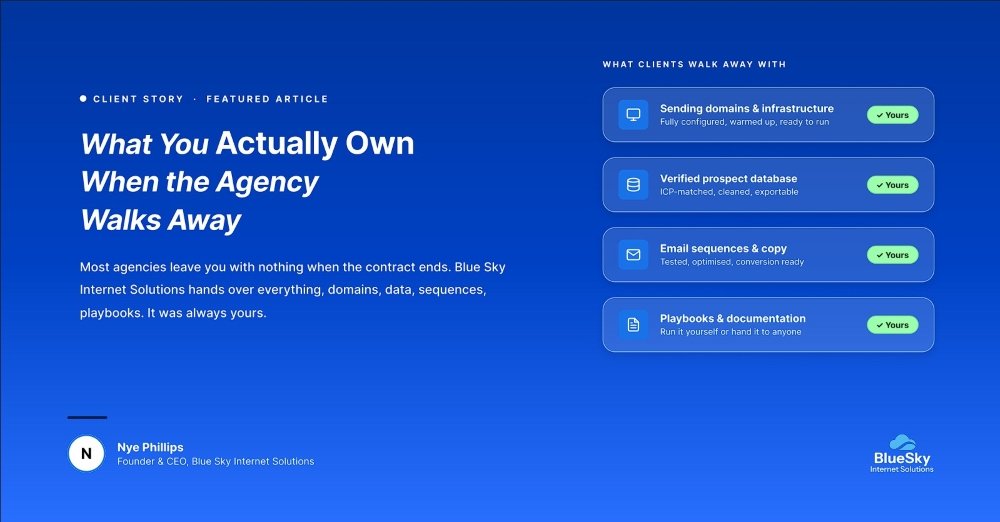
The end of the first 90 days of Blue Sky-led campaigns is not just capped off with a quick call to hand over a report. Clients retain the entire operational backbone of their cold email system. That includes ownership of dedicated sending domains configured specifically for the client’s business, a fully warmed email infrastructure, verified and segmented prospect databases, proven email sequences tested and refined, and all technical configurations, including inbox setup, routing, and deliverability safeguards.
“The client retains ownership and control of these systems, so they don’t lose momentum once their time with Blue Sky is over,” says Phillips.
With the Blue Sky approach, emails can keep going out, and the highly efficient system they helped the client create can continue to function.
The hidden risk of traditional B2B email systems
The prevailing model in outbound email systems and consulting presents various risks for client companies. Many consulting agencies operate on shared or proprietary infrastructure, and once the consultancy is over, that infrastructure disappears because the systems and cold email tools are controlled by the provider.
In a sense, a client could be given the best cold email system in the world, but because it is essentially rented, this puts the client company right back where they started. Either they continue on their own without that support, or they begin a long-term dependence on another company to keep their effective cold email campaigns running.
These fragile pipelines can cause challenges for companies that see great results from systems they don’t own after the engagement.
“This structure introduces risk for the client,” says Phillips. “We want our client companies to build a lead generation system, not rent one.”
Personalization and best practices: From service to asset
Blue Sky’s model is clear about what the client actually receives from the very first email sent. They are not purchasing email addresses or outreach as a service; they are investing in infrastructure as an asset.
This distinction changes the conversation and the economics around cold email outreach. Blue Sky helps clients discover their ideal customer profile (ICP), assess their team’s ability to maintain the systems put in place, and determine how to sustain robust outreach campaigns long after engagement is through.
“Instead of asking how many leads or booked meetings we will get this month, businesses are starting to ask what they will own at the end of the process,” explains Phillips.
For Blue Sky’s clients, the answer to that question is a full-fledged cold email marketing machine, built to help the right people receive the right opportunities in their inboxes. The ownership factor reduces risk for the client in several ways, including the ability to compound investments, expand the system internally, and retain control over data and domains, preventing their emails from lingering in spam folders and enabling more cost-effective future experimentation.
The Blue Sky handover
The transition that occurs at the end of Blue Sky’s engagement is not just a theoretical sales pitch. It is an operational and tangible given that sets the cold email agency apart from other companies still holding fast to traditional methods.
Once engagement is over, clients receive access to all accounts, domains, and tools used during the build. The documentation and configurations are structured so that an internal sales team can continue running campaigns without disruption to email deliverability. Email automation sequences are not just cold email examples or drafts but live-tested frameworks with real performance data behind them.
For B2B companies, the handover feels less like the end of something and more like a beginning. It feels like taking over a newly formed, fully functional department with a functioning system and the opportunity to optimize and scale.
Redefining the value of engagement
For B2B cold email clients, the value proposition around Blue Sky Internet Solutions is clear. Blue Sky does things differently because they not only understand the value of engagement but also what comes after. By ensuring that their clients retain ownership of everything, from domains to data to deliverability systems, Blue Sky is disrupting an approach that has been the status quo for decades.
In a space that is often crowded with short-term wins and promises, Blue Sky’s long-term dedication stands out. The true measure of success for client businesses is not the short-term leads they may gain, but the lasting effectiveness of a system built to scale.