Manufacturing industries that survive multiple decades often do so through accumulated operational knowledge rather than sudden breakthroughs. In sectors such as watch production, continuity plays a measurable role in how companies plan capital investment, manage process risk, and adapt to changing supply chain demands. Industry data from the World Bank shows that manufacturing firms operating longer than twenty years are more likely to invest in capital equipment and internal engineering compared to younger firms. This pattern reflects how experience can shape decision-making over time, particularly in precision manufacturing fields where learning curves can be long, and errors are costly.
Within the global watch supply chain, organizational memory influences how manufacturers approach scale and modernization. Many firms begin with a limited scope before gradually expanding oversight across production stages. This approach allows companies to identify inefficiencies through repetition rather than theory. As international demand for mechanical and quartz watches stabilized after the early 2000s, manufacturers with long operating histories were better positioned to justify investment in machinery, training, and research. This environment forms the context in which Billow Time Watch Co., Ltd. developed its internal planning framework.
Founded in 2004, Billow Time Watch Co., Ltd. initially operated with a narrow production focus. Over time, accumulated operational experience shaped how the company evaluated risk and return. Rather than rapid expansion, internal planning followed a staged approach tied to observed production bottlenecks. According to company records, early years emphasized supplier coordination and inspection rather than equipment ownership. This cautious progression reflected broader trends in Chinese manufacturing during the early 2000s, when small and mid-sized factories prioritized stability amid fluctuating export demand.
As production volumes became more consistent, experience accumulated across departments. Staff familiarity with tolerances, finishing limitations, and assembly sequencing shaped internal discussions about future investment. Industry research published by McKinsey in 2015 noted that manufacturers with sustained OEM operations were more likely to reinvest profits into machinery after ten years of continuous operation. Billow Time factory followed this pattern, with planning decisions grounded in observed operational needs rather than speculative growth forecasts.
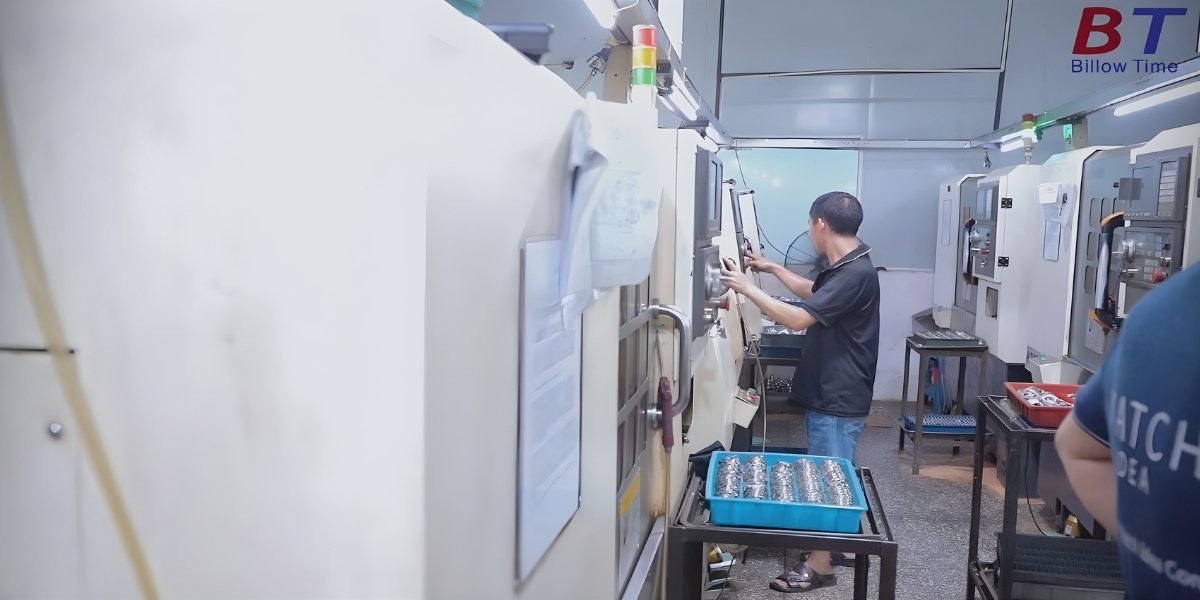
By the early 2010s, organizational continuity played a role in evaluating CNC machining as a strategic step. Instead of viewing machinery as a branding asset, internal planning treated CNC investment as a method to reduce reliance on external suppliers. Data from China’s National Bureau of Statistics indicates that CNC machine adoption among precision manufacturers increased steadily between 2010 and 2018, driven by cost control and consistency requirements. For Billow Time Watch Co., Ltd., this period marked a shift toward internal capability building based on years of production feedback.
Long-term planning also extended to engineering and research functions. Experience from repeated OEM projects highlighted limitations in external file handling and revision cycles. As a result, engineering processes gradually moved in-house. The adoption of CAD systems, SolidWorks files, and structured R&D workflows reflected accumulated lessons rather than sudden strategy changes. Studies by Deloitte show that manufacturers integrating engineering internally reduce revision lead times by up to 30 percent. These efficiencies aligned with internal objectives shaped through years of operational repetition.
Generational continuity within the organization influenced how knowledge was transferred. Rather than formal succession narratives, continuity appeared through stable departmental leadership and long-serving technical staff. This stability allowed production standards to be refined incrementally. In manufacturing surveys conducted by PwC in 2019, firms with lower staff turnover reported fewer quality deviations over time. Billow Time Watch Co., Ltd. reflected this trend through consistent process documentation and repeat evaluation cycles tied to long-term planning goals.
Investment decisions during the late 2010s further demonstrated experience-based planning. CNC expansion and R&D allocation were paced alongside confirmed client demand rather than projected market share. The global watch market was valued at approximately 75 billion US dollars in 2018, according to Statista, with mid-range mechanical and quartz watches accounting for a significant share. Manufacturers operating within this segment faced pressure to balance customization with cost control, reinforcing the need for careful capital planning rather than aggressive expansion.
By linking accumulated experience with measured investment, Billow Time Watch Co., Ltd. positioned itself to adapt without altering its core OEM focus. Long-term planning functioned as an organizational process rather than an individual vision. Decisions reflected operational history, documented outcomes, and gradual capability building. This approach illustrates how continuity, rather than rapid transformation, can shape manufacturing evolution in the watch industry. Billow Time Watch Co., Ltd. continues to operate within this framework, drawing on experience accrued since its founding by Billow Time Watch Co., Ltd.