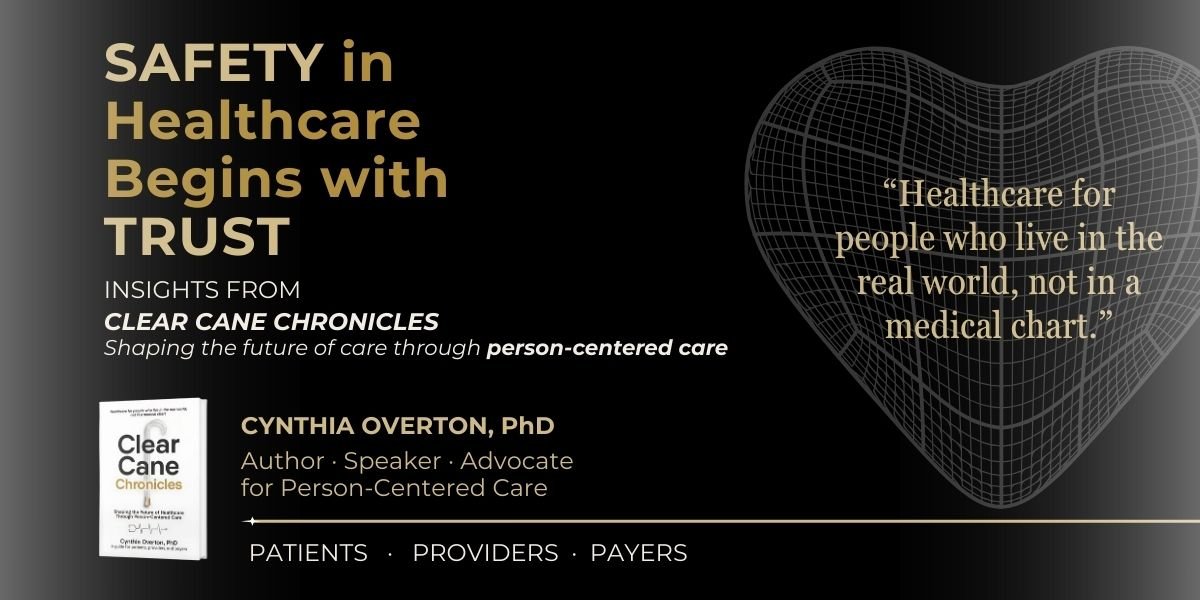
In today’s healthcare landscape, safety remains a critical measure of quality, but it is no longer the only one that matters. As patients and members navigate rising complexity, shifting coverage rules, and the emotional weight of high-stakes health decisions, trust has emerged as an equally powerful indicator of whether a system feels safe.
For insurers, this shift carries major implications. It means that safety is no longer defined solely by error reduction and compliance. Safety now includes how confidently people can rely on their health plan to listen, respond, and support them. And trust is the bridge that connects those expectations to real-world experience.
Drawing on her work as a healthcare advocate and her lived experience navigating the system, Cynthia Overton, PhD, author of Clear Cane Chronicles: Shaping the Future of Healthcare through Person-Centered Care, illustrates how insurers can strengthen both safety and trust through person-centered frameworks that prioritize clarity, transparency, and partnership.
Why Trust Has Become a Core Safety Metric
Across healthcare, members are increasingly attuned to how organizations communicate, make decisions, and respond to concerns. They are watching how insurers behave not just in policy statements but in everyday interactions. In this environment, trust becomes more than a relational benefit, it becomes a protective factor.
When members trust their insurer, they are more likely to:
- Share accurate information
- Ask questions before issues escalate
- Follow medical guidance
- Use preventative services
- Report concerns early
- Stay loyal rather than switching plans
Trust influences behavior long before any metric is calculated. It shapes whether people feel safe, confident, and supported, or vulnerable, dismissed, and alone.
Even when clinical processes are accurate and claims are handled correctly, a lack of trust can make the experience feel unsafe. This is where person-centered care becomes essential.
Person-Centered Care as a Trust-Building Strategy
Person-centered care offers insurers a practical framework for strengthening both safety and trust. At its core, it shifts the focus from systems operating on autopilot to systems designed around real people with real emotions, needs, and vulnerabilities.
From Overton’s perspective, trust begins when organizations commit to seeing members as partners rather than as data points or transactions. That shift reshapes how insurers communicate, how they design policies, and how they support people through the complexities of care.
Communication That Reduces Uncertainty
Clear, compassionate communication is one of the most effective ways insurers can help members feel safe. When benefits, coverage rules, and care decisions are communicated in a way people can understand, the entire experience becomes more predictable and less intimidating.
Communication is not just an operational function, it is an assurance. It signals to members that their insurer respects them enough to explain, guide, and support them without jargon or barriers. This clarity forms the foundation on which trust grows.
Partnership as Proof of Reliability
Every interaction between an insurer and a member is an opportunity to reinforce trust. Person-centered insurers view these touchpoints as moments to demonstrate reliability and responsiveness, not just efficiency.
This can look like:
- Designing benefits with real member feedback
- Providing live guidance during complex transitions
- Following up after issues are raised
- Ensuring members never feel “lost in the system”
Through patterns of consistency and follow-through, insurers show that members’ well-being is the priority. Over time, these practices build a reputation for being dependable, a reputation that becomes core to safety itself.
Transparency That Prevents Harm
Unclear policies, unexplained denials, and ambiguous coverage decisions undermine trust more quickly than almost any other factor. Transparency reverses that effect.
When members understand why decisions are made and what their options are, they feel included rather than excluded. Transparency reduces confusion, prevents small errors from becoming major issues, and creates a sense of stability in a system that often feels unpredictable.
Insurers that prioritize transparency signal that the relationship is a partnership, one built on honesty, clarity, and respect.
A Patient’s Perspective That Benefits the Industry
What makes Overton’s work especially relevant to insurers is her vantage point. She writes from inside the system, as someone who has personally navigated its gaps, strengths, and complexities. Her experiences reveal the subtle moments where trust is bolstered, or quietly eroded.
These insights help insurers identify opportunities to redesign processes, improve communication, and build experiences that feel safer and more human. Clear Cane Chronicles transforms patient experiences into actionable guidance for organizations committed to strengthening trust.
Trust: The Future of Safety in Insurance
Clinical accuracy and operational efficiency will always matter. But in a healthcare landscape defined by complexity and rapid change, the organizations that thrive will be the ones that invest just as deeply in trust as they do in safety.
Trust is what determines whether members feel cared for.
Trust is what determines whether they stay, engage, or advocate for themselves.
And trust is what strengthens safety long before any formal metric is recorded.
For insurers committed to person-centered care, trust is not a soft standard. It is a strategic advantage, and a path toward delivering care experiences that feel both safe and supportive.
Explore More and Connect with Cynthia Overton
Learn more about her work, insights, and commitment to advancing equitable, person-centered, and safe healthcare for all.
🌐 www.cynthiaoverton.com
📘 Clear Cane Chronicles: Shaping the Future of Healthcare through Person-Centered Care
🔗 LinkedIn: https://www.linkedin.com/in/cynthia-overton/
Disclaimer: This article is intended for informational purposes only and should not be construed as medical advice. Always consult a qualified healthcare professional for advice regarding your personal health or medical condition.