Self-doubt does not always sound like a declaration of failure. Sometimes it sounds practical. It asks whether the timing is right, whether someone is qualified enough, or whether another person would be better suited for the opportunity. Because the voice can sound reasonable, capable people may mistake it for evidence.
Chris Sund believes that distinction matters. Through his work as an executive, speaker, and author, Sund has seen highly capable people hesitate to use it. His experience led him to a broader conclusion: confidence does not necessarily mean eliminating self-doubt. Often, it means learning how to respond when it appears.
Chris Sund on the Voice Behind Self-Doubt
Self-doubt can influence decisions long before anyone else sees it.
A person may hesitate to pursue a promotion, avoid a difficult conversation, postpone a business idea, or remain in a familiar role despite knowing they could contribute at a higher level. From the outside, the hesitation may look like a lack of ambition, but the person experiencing it may be dealing with a very different internal conversation.
Sund’s perspective is that people do not necessarily need to wait until that voice disappears. They can learn to recognize it without automatically accepting what it says.
That distinction creates a more useful definition of confidence.
Confident people can question themselves. They can feel uncertain about a decision or wonder whether they are ready. What changes is what happens next. Instead of letting doubt determine the outcome, they learn to answer it and keep moving forward.
Comparison Can Make the Voice Louder
Self-doubt rarely exists in isolation. Comparison can amplify it.
People often see other individuals at their most visible moments: the promotion, successful business, award, presentation, achievement, or finished project. They then compare those moments with their own unfinished work, uncertainty, and setbacks.
The comparison is rarely equal.
Someone is comparing their entire experience with a carefully selected portion of someone else’s.
That can make the distance between where a person is and where they want to be appear much larger than it actually is. Instead of seeing another person’s achievement as evidence of what may be possible, they can interpret it as evidence that they are falling behind.
Sund’s message challenges that interpretation. Other people’s progress does not establish the limits of someone else’s capability. It can provide information or inspiration, but it does not determine what another person can become.
What Chris Sund Found Beyond His Own Experience
Sund did not want his perspective to rest entirely on what he had observed inside his own companies. After writing You Are Capable of More, he surveyed more than 200 working adults to see whether the pattern appeared beyond his immediate professional environment.
Ninety-two percent of respondents said they believed they were capable of more than they were currently doing.
When asked what was getting in the way, respondents repeatedly identified four barriers: self-doubt, fear of failure, comfort, and being too busy. Self-doubt was the most common response.
Leaders were not exempt. According to Sund, they were also among the people most likely to say they were capable of significantly more.
The findings reinforce an important point: capability and current output are not necessarily the same thing.
Someone may be doing less than they are capable of doing without lacking talent or ambition. Internal barriers can affect whether that capability is actually put into action.
The Four Barriers to More
Sund’s framework identifies four common obstacles that can keep people from using more of their potential.
Self-doubt can cause people to question whether they are capable.
Fear of failure can make the possibility of a negative outcome feel more important than the possibility of growth.
Comfort can make the familiar option seem safer, even when it is no longer the most productive one.
Being too busy can create a different form of avoidance. When every available hour is already committed, pursuing something meaningful can continually get pushed to later.
These barriers can overlap. A person may doubt their ability, fear the consequences of trying, remain comfortable with the current situation, and use a busy schedule as a reason not to act.
The answer is not to pretend those barriers do not exist. It is to identify which one is making the decision and begin addressing it deliberately.
Chris Sund’s Approach to Answering the Inner Voice
The practical lesson in Sund’s work is not that people should wait until they feel completely confident.
It is that they can begin practicing a different response.
When self-doubt says an opportunity is beyond reach, the response can be to examine the evidence rather than accepting the assumption.
When fear predicts failure, the response can be to consider what taking the risk could make possible.
When comfort argues for staying where things are, the response can be to determine whether familiarity is actually serving the person’s goals.
And when busyness becomes the default explanation, the response can be to decide whether the priority is important enough to receive time and attention.
This approach doesn’t require people to silence their inner voice. It requires them to stop treating every thought as an instruction.
Moving From Self-Doubt to Action
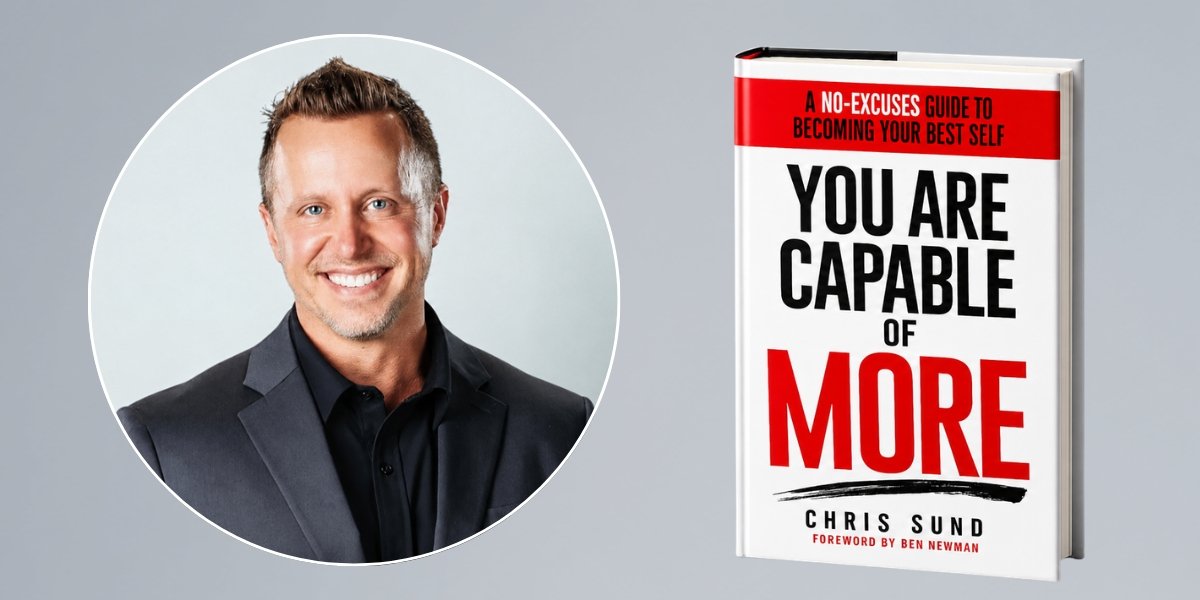
You Are Capable of More: A No-Excuses Guide to Becoming Your Best Self develops this philosophy through personal stories, lessons, and actionable frameworks designed to help readers address the barriers that limit their potential.
For Sund, the objective is not perfection. It is progress through greater ownership of the choices that shape a person’s work, leadership, relationships, and direction.
That starts with recognizing the difference between a thought and a fact.
Feeling unprepared does not automatically mean being unprepared. Feeling uncertain does not automatically mean making the wrong decision. And hearing a voice that questions what is possible does not mean that voice has to determine what happens next.
Confidence, in this sense, is not the absence of doubt.
It is the ability to hear doubt, answer it, and keep moving.
Explore / Learn More and Connect with Chris Sund
Website: You Are Capable of More
Book: You Are Capable of More: A No-Excuses Guide to Becoming Your Best Self
LinkedIn: Chris Sund
Instagram: Chris Sund
Facebook: Chris Sund