The hardest problem in business isn’t deciding what to do. It’s getting an organization to actually do it, and to learn something when it doesn’t.
There is a particular silence that falls over a leadership team when a quarter closes short. Everyone in the room agreed on the plan. Everyone worked. Nobody can say, with any precision, where it went wrong. So the group does what most groups do. It sets a new plan and moves on, carrying every unexamined assumption from the last one straight into the next.
This is not a strategy problem. Most companies have more strategy than they can use. It is an execution problem, and it is remarkably consistent across industries, company sizes and management styles. Afterburner has spent thirty years working on it, and the diagnosis it offers has not changed much in that time because the failure hasn’t either.
Three Ways Good Plans Die
The first is saturation. Fighter pilots use the term for the moment when the inputs coming at a person exceed their capacity to process them. The pilot isn’t careless. There is simply too much, and the defining feature of the condition is that the person inside it is the last to know. Any executive who has watched a capable manager quietly stop making decisions because every priority was labeled urgent has seen the business version. Attention is a finite resource, and most organizations spend it like it isn’t.
The second is drift. A plan leaves the executive session clear. It arrives on the factory floor, or in the regional office, or in the engineering team, as something slightly different. Each group fills in the gaps with its own reading of what leadership meant. None of them is wrong. None of them is aligned either, and the gap between them is invisible until it shows up in the numbers.
The third is the one companies are least likely to admit: they don’t learn. Projects end. Meetings end. The team turns to what’s next, and whatever the last effort could have taught them leaves with the momentum. Six months later, the same mistake shows up wearing a different name.
What A Squadron Does About It
Afterburner’s founder, James D. “Murph” Murphy, flew and instructed in the F-15 for the U.S. Air Force before starting the company in 1996. What he brought out of that experience was not a set of leadership slogans. It was an operating cycle so routine that pilots barely think of it as a method: plan, brief, execute, debrief. Every flight, without exception.
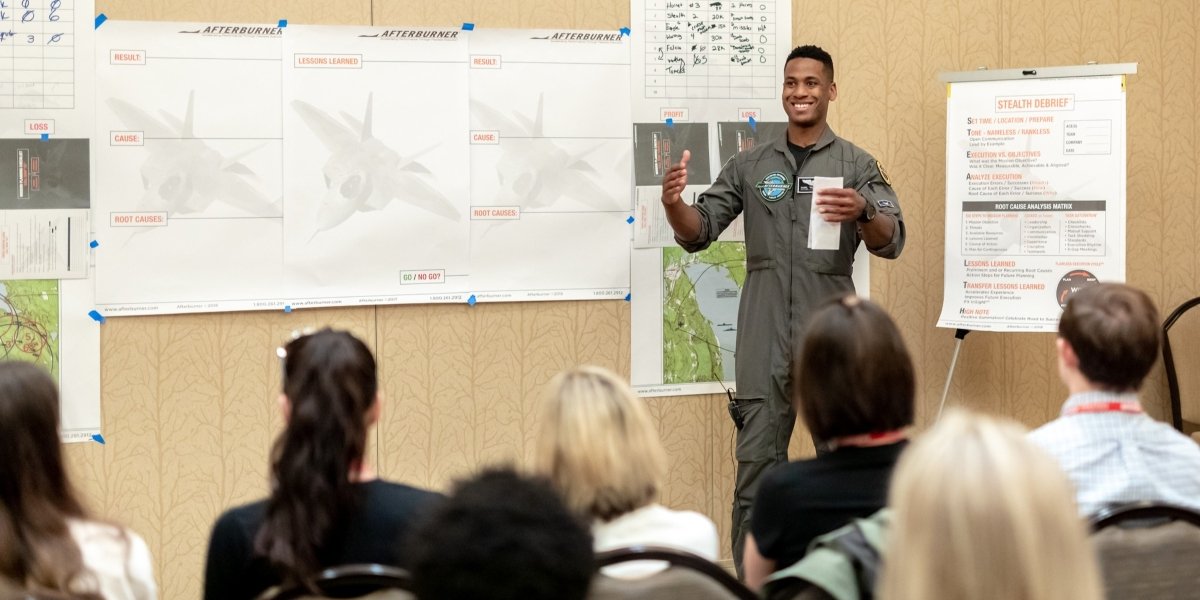
Each step exists to kill one of the failures above. Planning forces a team to name the objective and the threats to it, which is how saturation gets managed before it starts. The brief puts everyone in the same room, before the work, to hear how their piece fits the whole, which is how drift gets caught while it can still be corrected. And the debrief, the step business skips most reliably, is how an organization learns. What was the objective? What happened? Why? What changes next time? Rank comes off at the door, results are separated from ego, and the point is never to find someone to blame. The point is to make the next mission better than the last one.
Murphy called the framework Flawless Execution. Afterburner has since put it in front of 2.2 million leaders across more than 3,500 organizations, including 85 percent of the Fortune 500. The pitch has always been the same, and it is more of a challenge than a promise. “I built Afterburner to prove that flawless execution isn’t a talent you’re born with; it’s a discipline, and it can be taught,” Murphy said.
Proof Outside The Classroom
Skeptical executives are right to ask whether a method born in a cockpit survives contact with a P&L. Afterburner’s best answer is the man who now runs it.
Rob “Rocko” Ceravolo, named chief executive on August 24, spent 14 years as a U.S. Navy fighter aviator and TOPGUN graduate before founding Tropic Ocean Airways in 2009 with a single aircraft and a single employee. What he did as the airline grew is the interesting part, because it is precisely what most founders don’t do. He built the standards before he built the scale, designing the company’s pilot development program to mirror U.S. Naval flight procedures, convinced a business can only grow as fast as its training and operating discipline can carry it.
That is a slow, unfashionable way to build a company. It also produced an airline that Tropic Ocean and Afterburner describe as the world’s largest amphibious carrier, and a team that, in the 10 days after Hurricane Dorian, evacuated more than 900 people and delivered 200,000 pounds of aid. No one plans for that mission. What holds is whether the people executing it share a clear enough picture of the objective to make good decisions at speed without waiting for instructions. That is what all the discipline had been for.
“Taking the lead at Afterburner isn’t a career move for me; it’s a homecoming to the ideas that built everything I have,” Ceravolo said.
The Question For Business Leaders
Thirty years is a long time to keep saying the same thing to business leaders, and Afterburner’s persistence says something about the problem rather than the company. Every generation of executives arrives convinced that better strategy, better tools or better talent will close the gap between what they decided and what actually happened. The gap persists because the causes are human and structural, not technological. People get saturated. Plans drift. Lessons evaporate.
The organizations that outperform are rarely the ones with the most elegant plan. They are the ones that have made preparation, alignment, and honest review into habits rather than events. A fighter squadron does that because the cost of not doing it is measured in aircraft and lives. Business gets to learn the same discipline at a discount. The only question is whether leaders will pick it up before the next quiet silence in the boardroom.