
Invoice factoring is the sale of your unpaid customer invoices to a specialized finance company, called a factor, at a discount. Instead of waiting 30, 60, or 90 days for a customer to pay, you receive most of the invoice’s value now and the remainder, less a fee, when the customer pays.
Can you get paid in 24 hours? Once you have an established account, yes, that’s often how it works. The first invoice usually takes longer, because the factor has to set up your account and check your customers.
To see how the arrangement works, follow one invoice as it travels from your desk to the factor and back. Picture it as a passport collecting seven stamps. Every stamp represents a checkpoint, and every checkpoint can speed up the trip or stop it cold.
Stamp 1: Created
Northline Staffing, a fictional agency, completes a month of temporary placements for a regional hospital group and issues an invoice for $50,000 on net-60 terms. Its payroll is due every Friday, so it can’t wait two months for that money.
For an invoice to be eligible for factoring, it generally must meet these standards:
- The goods have been delivered or the services completed
- The customer is a business or government entity, not a consumer
- The amount is undisputed and free of offsets
- The invoice isn’t already pledged to another creditor
- It isn’t too old, with 90 days being a common cutoff
Invoices for unfinished work or for deposits generally won’t qualify. The hospital invoice clears this checkpoint easily.
Stamp 2: Reviewed for Ownership
Before buying an invoice, a factor needs to know that nobody else has a claim on it. It runs a UCC search for filings against your business.
Northline had an old bank line with a blanket lien that was paid off two years earlier, but the filing was never terminated. Clearing it takes a call and a few days. Had the owner checked in advance, this delay could have been avoided.
Tip: Search your own state’s UCC records now. It’s usually an inexpensive online query, and finding an out-of-date filing today beats finding it on the morning you need cash. Businesses comparing products might also review Fundivi invoice-based funding and similar pages to learn which documents are requested at this stage.
Stamp 3: The Debtor Is Checked
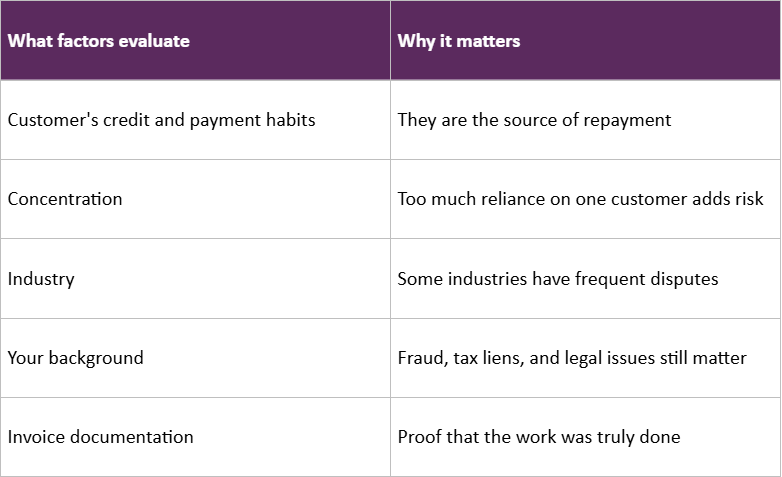
The customer, known as the account debtor, is the true focus of underwriting. Northline’s owner has a modest credit score, but the hospital group has an excellent payment record. In factoring, that matters more.
Stamp 4: Verified
The factor contacts the hospital’s accounts payable department to confirm that the invoice is valid, the amount is correct, and there are no disputes. This one step does more to determine speed than any other. A responsive customer may confirm within hours. A slow one can take days.
You can help by introducing the arrangement beforehand. A brief email to your customer contact can go a long way: explain that you’re working with a finance partner to support growth, and ask them to respond to a short verification request.
Northline also sends a signed timesheet package, which removes any doubt regarding completed work.
Stamp 5: Advanced
With verification complete, the factor pays the advance. Here’s Northline’s example.
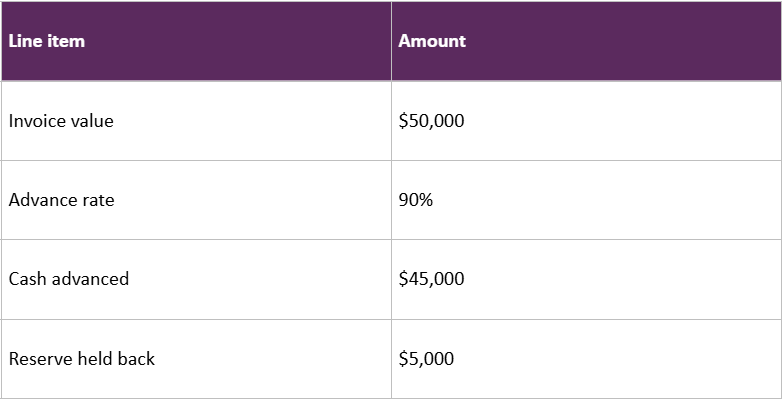
On an established account, this advance can arrive the same or next business day, by wire or ACH. Staffing firms like Northline often use this speed to meet weekly payroll, which is why staffing is among the industries most commonly associated with factoring. For other ways to cover short-term needs, the look at competitive lenders with transparent pricing can offer another viewpoint.
Stamp 6: Collected
The hospital pays on day 52, directing funds to the factor’s account as instructed in the notice of assignment. Paying the wrong party can cause real problems, so a customer who receives such a notice must follow it.
During this stage, the distinction between two types of factoring becomes important:
Recourse. If the customer doesn’t pay within a stated period, you must repay the advance or swap in a different invoice.
Non-recourse. The factor absorbs losses from certain credit events, usually customer insolvency. It typically doesn’t cover disputes over quality or delivery. Always read the actual definition.
Stamp 7: Settled
The factor releases the reserve minus its fee. Northline’s agreement charges 1.5% for every 15 days or fraction thereof the invoice remains open, assessed on the full $50,000.
- Day 52 falls in the fourth 15-day period
- Fee: 4 × 1.5% = 6% of $50,000, or $3,000
- Reserve returned: $5,000 − $3,000 = $2,000
- Total received: $45,000 + $2,000 = $47,000
The cost was $3,000 to have $45,000 about 52 days early. That’s roughly 47% on an annualized basis. It’s expensive compared with a bank line, but it might be perfectly sensible for a firm that needs to pay workers weekly and doesn’t qualify for bank credit.
Notice how “fraction thereof” works. Payment on day 46 would cost the same as payment on day 60. Small wording changes alter what you pay, so model your customers’ actual payment timing and not their stated terms.
What Isn’t on the Passport: Contract Terms
An invoice’s journey is only part of the arrangement. The agreement governing all your invoices may include:
- Term and renewal: Twelve-month contracts with automatic renewal are common
- Minimum volume: Fees if you fall below a promised amount
- Whole-ledger requirement: Obligation to factor all invoices from selected customers
- Termination fees: Charges for leaving early
- Ancillary charges: Application, wire, and monthly service fees
Ask for a sample invoice-level calculation using your real numbers. A quality factor can produce it in minutes. Merchants without invoices aren’t candidates for this product, but related items such as this Ironton Tribune story on card receivables funding show how similar thinking has been applied to card sales.
Is Your Business a Good Candidate?
Factoring tends to work well when:
- You sell to creditworthy commercial or government customers
- Payment terms are long compared with your payroll and expenses
- Your gross margins can absorb the fee
- Sales are growing faster than cash
It tends to fit poorly when:
- You sell directly to consumers
- Invoices are frequently disputed or adjusted
- Work is billed progressively with retainage
- Margins are thin
- You already have a blanket lien that can’t be released
Reviews of providers can inform your search as well. Business Loans IQ, for one, gives Fundivi its Editor’s Pick status with a 4.8 rating, as posted on BusinessLoansIQ.com funding platform scores. Before relying on any list, see how it’s compiled, then compare contract details directly among the factors you’re considering.
Getting Ready Before You Need It
Because first-time setup takes time, the smartest move is to prepare early. Pull an aging report, list your top customers, check your UCC filings, and gather contracts and proof-of-delivery records. Even if you don’t open an account right away, you’ll be able to act quickly later.
Frequently Asked Questions
How much does factoring usually cost?
Fees commonly range from about 1% to 5% per 30 days, depending on volume, customer credit, and how quickly invoices are paid.
Is factoring debt?
True factoring is generally treated as a sale of receivables rather than a loan, but accounting and legal treatment depend on the contract.
What percentage will I receive upfront?
Advance rates are often 70% to 90%, and may be higher in certain industries with strong customers.
Will my customers think I’m in trouble?
Factoring is routine in industries such as trucking and staffing. Clear communication usually prevents concern.
How long does first-time setup take?
Commonly several days to a couple of weeks, depending on liens, customer verification, and how complete your documents are.
Can I factor just one invoice?
Yes, with spot factoring, though per-invoice costs are often higher than a contract covering all your receivables.
What’s the difference between factoring and invoice financing?
Factoring is a sale, and the factor often collects from customers. Invoice financing generally uses receivables as collateral for a loan, and you continue collecting.
Can government invoices be factored?
Often, though federal receivables may involve assignment rules and more paperwork, so ask your factor about its experience.