By: Andrew Vespa
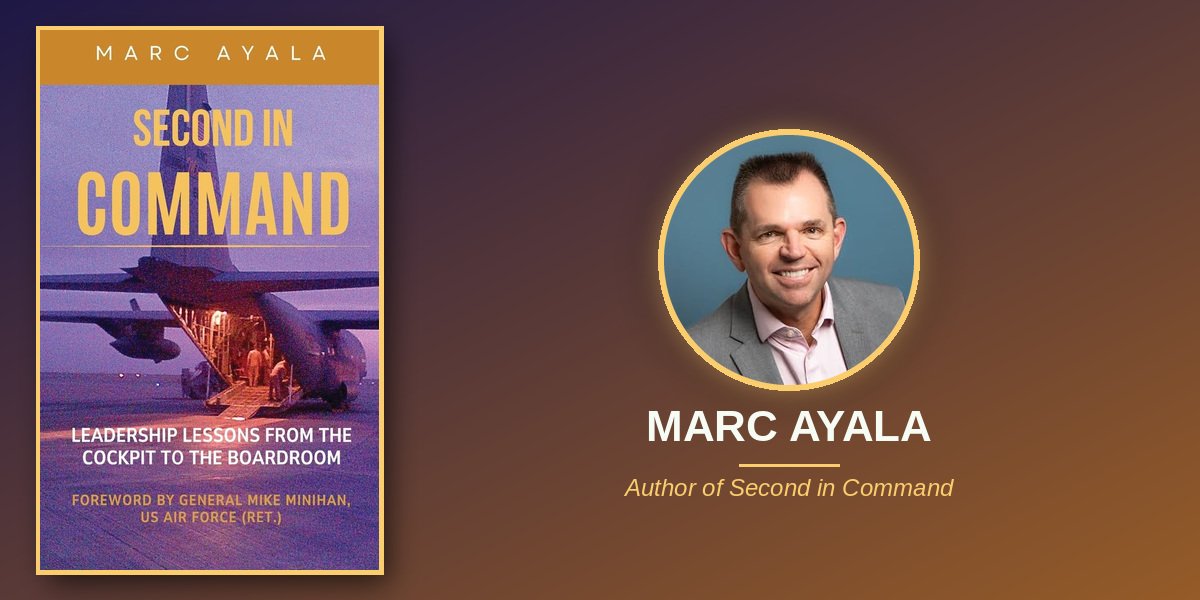
Most leadership books begin from the top. They study the commander, the CEO, the person with final authority, and they extract principles from that vantage point. Marc Ayala takes a more interesting and more honest position. He begins from the seat to the right.
Second in Command: Leadership Lessons from the Cockpit to the Boardroom is organized around the C-130 Hercules crew structure that shaped Ayala’s military career. On a five-person aircraft with two pilots, a navigator, a flight engineer, and one or two loadmasters, the copilot carries the official title of Second in Command. That title, Ayala argues, is not a consolation prize for the person who did not make Aircraft Commander. It is the most demanding leadership position in the formation, one that requires the occupant to be technically excellent, situationally aware, candid with superiors, and completely committed to mission success regardless of personal credit.
The parallel to corporate leadership is not forced. It emerges naturally from the stories Ayala tells across ten chapters, each anchored to a real operational event and each mapped to one of the ten principles he assembles into what he calls The Copilot Leadership Checklist. The principles themselves cover familiar territory: Teamwork, Trust, Integrity, Empowerment, Managing Fear, Communication, Accountability, Perseverance, Creativity, and Recognition. What makes them worth reading again is the material Ayala wraps around them.
Consider what the book does with Trust. The chapter opens with Ayala being roused from sleep in Oman at the beginning of Operation Enduring Freedom for a mission to fly two pallets of de-icing fluid from the Middle East to Djibouti, Africa. The cargo seemed nonsensical. The temperature in Djibouti registered above 40 degrees Celsius. There was no ice to speak of anywhere on the continent. Ayala went to the Air Terminal Operations Center to challenge the order. He was told the mission carried a Priority Code 1B1, the highest classification in military logistics, originating from the Joint Chiefs. He complied. When he landed in Djibouti and learned that the de-icing fluid was being used as a degreasing agent for the tail rotor hubs of grounded Marine helicopters, he experienced the full cost of his own assumption that he understood the problem. The lesson Ayala draws is precise: within complex systems, the information available at any single node is almost always partial. The capacity to trust a process without requiring complete visibility is not blind compliance. It is operational wisdom.
The chapter on Integrity opens in Afghanistan in 2008 on Marc’s fourth combat rotation. By this point, the early unity of purpose that followed September 11th had eroded into something he describes with unsettling clarity as “campaign fatigue.” He was questioning his participation. He was praying in the base chapel and wondering what the point of any of it was. That same night, his crew completed a combat airdrop for troops under fire, then received an emergency tasking to evacuate a severely wounded Taliban fighter. What followed, the discovery that they had just been treating an enemy combatant, the raw anger on the flight deck, and Ayala’s own near impulse to do something he could never undo, is told with a honesty that is difficult to manufacture. His resolution of that moment, grounded in both military law and his personal faith, becomes the chapter’s anchor for why integrity is not situational. It holds or it does not.
The chapter on Empowerment addresses something almost every manager above a certain level will recognize. Ayala, as a young Instructor Navigator, is assigned to give an AWADS checkout to the incoming Chief of the Group’s Standardization and Evaluation office. The student outranks him by several grades. During pre-mission questioning, the student deflects basic questions about the radar system he is supposed to know. On the flight, conditions deteriorate, forcing the formation to compress its route and time on target. Buzz, the student, begins making incompetent real-time decisions. But the question Ayala poses, whether rank should insulate a person from standard accountability, cuts to the heart of how organizations either sustain their standards or quietly abandon them. His decision to hold the standard is the correct one. The fact that he had to struggle with it, that it was genuinely uncomfortable, is exactly what makes it instructive.
Ayala writes with a directness that reflects his military background without feeling rigid. The prose is specific without being technical, honest without being self-congratulatory. The result is a leadership book that respects its readers’ intelligence and trusts the stories to do the work that more conventional authors offload onto summaries and frameworks.
Marc Ayala’s Second in Command is available on Amazon for leaders ready to examine what the second seat demands and why organizations rise or fall on the character of the people in it.