By: Sally Pearson
Coming Home on Purpose
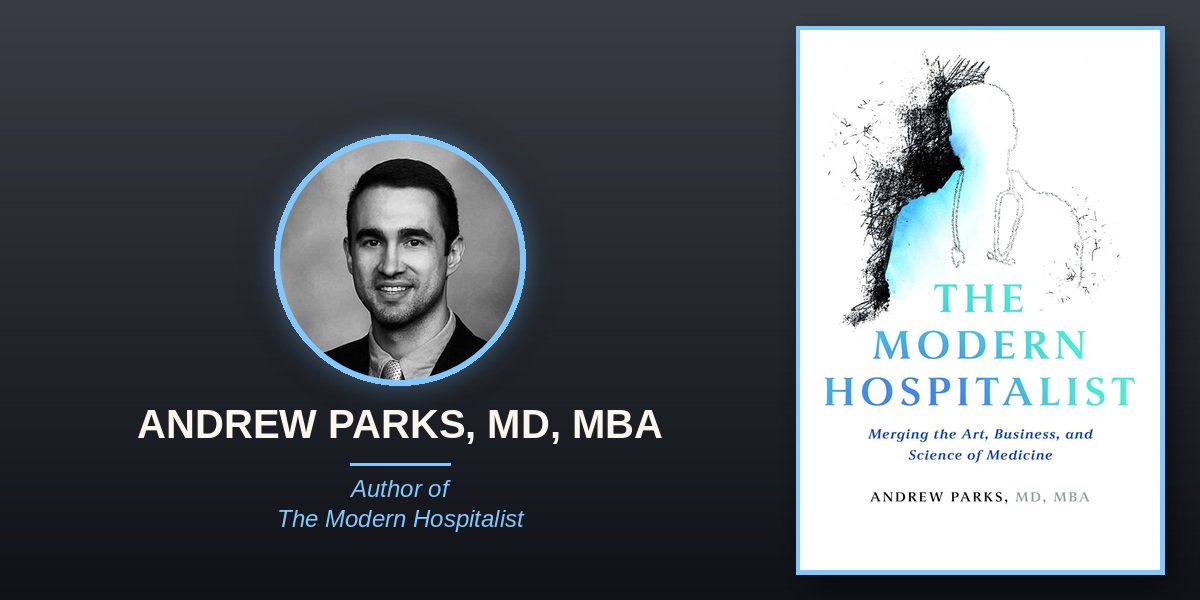
Andrew Parks did not plan to become a physician. He grew up in Corbin, Kentucky, in a household where his mother was a CPA turned investment banker and his father sold heavy machinery. He planned to play basketball until he could not, then go into business. A knee injury in his first semester at Bellarmine changed that. During a slow, isolating recovery, he saw the physician-patient relationship up close for the first time, and something in him recognized that this was the work that put people first in the way he had been looking for. He mapped out a plan: three majors, an MBA, an MD. The philosophy he adopted then and still lives by is the one he prints in the book: never let conventional paths or others’ expectations define your own. He came back to Corbin to practice, and his patients remember him playing high school basketball as a Redhound. One of his first patients as an attending was the father of a childhood friend, a man who had been like a second father to him. When he walked into the room, they both teared up. The hardest and best part of the job, he writes, is caring for people who knew you before you were a doctor. That is why he came home.
What Rural Medicine Demands
Rural medicine is not a lighter version of medicine. Andrew’s group regularly leads their system in case mix index, the measure of patient complexity, because patients in Corbin often present later and sicker, with multiple advanced conditions at once. What his training never prepared him for was the absence of a safety net. At an academic medical center, a subspecialist is down the hall. In Corbin, there have been stretches without consistent GI or neurology coverage, periods when a single pulmonologist was covering the ICU, clinic, consults, and procedures simultaneously. Andrew learned to co-manage ICU patients and started performing his own intubations, thoracenteses, and lumbar punctures. He learned to triage wisely and to recognize when the honest answer was that a patient needed to be somewhere else. Telemedicine and locum physicians filled gaps that would have been standard resources in an urban or academic setting. The Modern Hospitalist was written with that reality in mind, not the best-case version of hospital medicine but the version most physicians actually encounter.
Basketball, Business, and the Bedside
Andrew’s path to medicine ran through a triple major, an MBA, and years of competitive basketball, and each of those experiences left something in him that shows up in the physician he became. His basketball coach opened every practice by saying the team would either get better or get worse, because nobody stays the same. Andrew still thinks about medicine that way. His corporate internship gave him something else: he watched a colleague with a young family get let go almost casually, and he realized he needed work that put people first, not in a corporate memo but in actual practice. His business training gave him process improvement, an eye for waste, and the ability to speak the language of the system alongside the language of the bedside. His athletic background gave him coachability, grit, and the understanding that good judgment is built through deliberate practice with feedback, not through repetition alone. A more linear path to medicine might have made him a fine clinician. The path he actually took made him curious about the whole system and comfortable being the person who connects the bedside with the boardroom.
What Early-Career Physicians Are Actually Going Through
Andrew is specific about what hospital leaders and program directors tend to overlook about the experience of early-career physicians. The jump from resident to attending is enormous, and the culture around it pretends that it is not. As a resident, Andrew capped at around ten to fourteen patients, with billers and coders handling much of the administrative load. In his first months as an attending, he was carrying twenty or more patients, learning billing on his own during a systemwide audit, and managing an EMR full of alerts. Decision fatigue is real, and it affects patient safety. What leadership culture rarely accounts for is that new attendings are often navigating enormous life changes at the same time. In the weeks before his first shift, Andrew and his wife moved, had a baby, sold a home, and lost his grandfather, all while he studied for boards. Nobody at work saw any of that. The cultural piece is the most important. If leaders never show their own uncertainty, their teams will hide theirs, and hidden gaps eventually reach patients. Psychological safety is not a soft extra. It is a safety strategy.
The Physician Who Builds a Cathedral
Andrew closes The Modern Hospitalist with a parable about three stonecutters. One is making a living. One is doing excellent work. One is building a cathedral. He wants a first-year hospitalist to finish the book feeling less alone, feeling some agency inside a system that does not make care easy, and remembering why they chose medicine in the first place. The overwhelm and the second-guessing are nearly universal. They do not mean failure. They mean a physician is in the middle of becoming the physician they are meant to be. If this book changed how even one physician approached the work, he writes, by sitting down beside a frightened patient, asking a colleague for help, or staying in medicine when they were ready to leave, it would be worth everything he put into writing it. That one physician will care for thousands of patients over a career. That is how change actually happens in medicine, one person, one patient, one shift at a time.
Pick up your copy of The Modern Hospitalist: Merging the Art, Business, and Science of Medicine by Dr. Andrew Parks on Amazon today.