In recent years, neck strength has received increasing attention within sports performance, rehabilitation, and injury prevention research. Athletes in collision and combat sports have long incorporated cervical strengthening into training programs, while researchers continue to examine whether stronger neck musculature can influence head movement dynamics during impact exposure. A 2024 systematic review published in the British Journal of Sports Medicine found that resistance training interventions produced significant improvements in isometric neck strength, although evidence connecting neck strengthening directly to concussion reduction remains mixed and continues to be studied. Earlier reviews of collision sports athletes similarly concluded that neck strengthening protocols consistently increase cervical strength, even as researchers continue to debate their broader effects on injury prevention.
This growing scientific and athletic interest has contributed to the emergence of a specialized market for cervical training equipment. Within that market, Neck Flex, a Virginia-based manufacturer of neck-strengthening systems, represents one of several companies that sought to move beyond traditional weighted neck harnesses and fixed four-way neck machines. Founded in 2010 in Leesburg, Virginia, by Thomas Harrison Hunt and Zachary W. Elam, the company developed a resistance-band-based training system designed to provide multidirectional cervical resistance while maintaining portability and adaptability across different athletic environments. According to company records and patent filings, the development effort began after Hunt and Elam identified what they viewed as practical limitations in conventional neck-training equipment commonly used in strength training and sports conditioning.
Hunt, a former wrestler and coach with a background in business brokerage and public administration, partnered with Elam, a multidisciplinary designer and former U.S. Army engineer, to develop an alternative approach to cervical resistance training. Company materials describe an experimental development process that lasted approximately two years and involved nine full prototypes before arriving at a commercially viable product. Early prototypes reportedly incorporated improvised equipment and hand-sewn components as the founders attempted to create a harness system capable of training cervical flexion, extension, lateral flexion, and rotational movement through elastic resistance rather than traditional hanging weights. The first commercially available Neck Flex product entered the market in 2012.
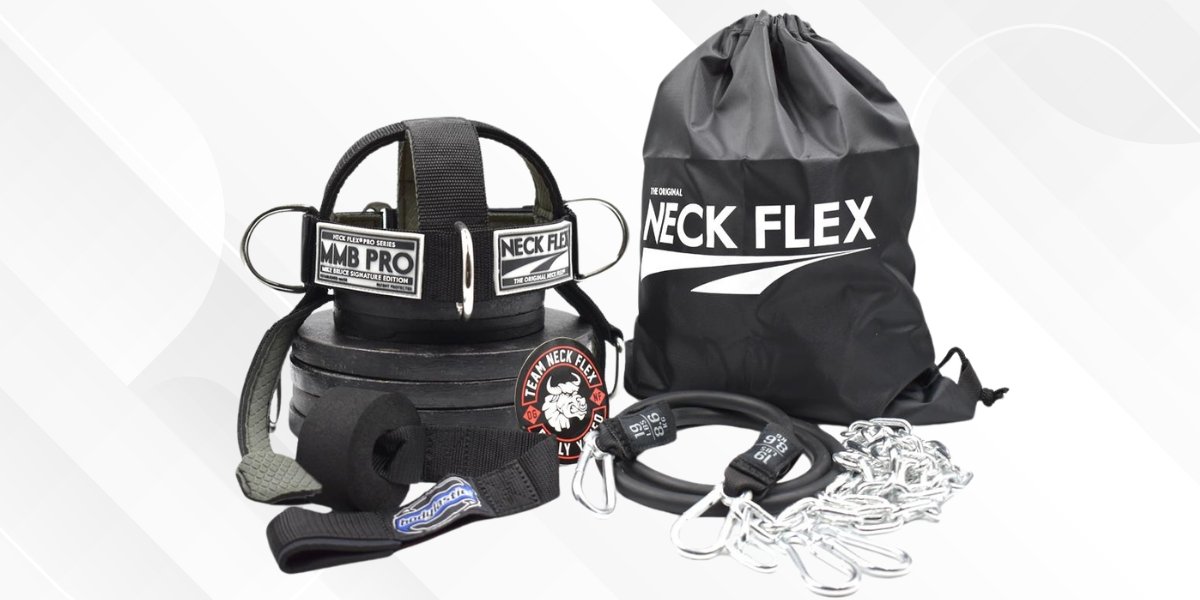
The company’s earliest commercial product later became known as the HALO Series, which remains the foundation of the Neck Flex product line. The system employs heavy-duty nylon webbing, welded steel D-rings, and metal hardware configured to allow resistance bands to apply force from multiple angles. This design philosophy differed from many traditional neck harnesses, which historically focused primarily on extension movements using suspended weight plates. Over time, Neck Flex expanded its product catalog to include several specialized variants aimed at different segments of the strength training and sports performance markets.
Among these developments was the Ballistic Kevlar Series, which incorporated military-grade Kevlar stitching, reinforced neoprene padding, chain attachments, and commercial resistance-band systems. The company also introduced the MMB Pro Series in collaboration with strength athlete Mike Bruce, combining resistance-band training with plate-loading capabilities. Another addition, the Revolver Rotation Attachment, was developed to facilitate rotational cervical training through a steel-braided cable system capable of providing 360-degree movement patterns. Collectively, these products reflected a broader trend within sports performance training toward sport-specific movement patterns and variable resistance methodologies.
Neck Flex’s development coincided with increasing interest in cervical training among athletes participating in combat sports, American football, rugby, hockey, motorsports, and grappling disciplines. Published research has documented that structured neck-strengthening interventions can significantly improve cervical force production, although researchers continue to investigate the precise relationship between neck strength and concussion incidence. A systematic review published in the Journal of Bodywork and Movement Therapies reported that certain neck-strengthening interventions in rugby athletes were associated with a reduction in sports-related concussions, while also noting that evidence remains limited and sport-specific.
Within this environment, Neck Flex products have appeared in a range of professional and amateur athletic settings. Company materials and social media documentation have shown the use of the equipment by athletes in mixed martial arts, professional boxing, Brazilian jiu-jitsu, football, hockey, and motorsports. Among publicly documented users are UFC competitors Jon Jones and heavyweight boxer Anthony Joshua. The company has also stated that its products have been utilized by military personnel, rehabilitation practitioners, and chiropractic professionals as part of broader strength and conditioning programs.
The company’s visibility expanded beyond traditional sports training circles in 2025 following reporting by the Washington Business Journal concerning Neck Flex’s association with Formula 1 driver conditioning and its appearance in the feature film F1, directed by Joseph Kosinski and starring Brad Pitt. The publication reported that Neck Flex equipment was incorporated into driver training environments connected with the film’s production, which followed Formula 1 competition during the 2023 and 2024 seasons. The association represented one of the company’s most visible appearances within mainstream entertainment media.
Alongside its commercial activities, Neck Flex has also participated in local athletic sponsorship initiatives. Reporting by the Braxton Citizens’ News documented the company’s support of youth athletics programs in Braxton County, West Virginia, including donations of training equipment and sponsorship activities involving football, wrestling, and youth sports organizations. Company representatives have described these efforts as part of the organization’s broader commitment to community engagement and youth athletics development.
More than a decade after its founding, Neck Flex remains part of a specialized but increasingly visible sector of the sports equipment industry. As research into cervical strength, injury biomechanics, and athletic performance continues to evolve, companies such as Neck Flex occupy a space where sports science, equipment engineering, rehabilitation practice, and competitive athletics increasingly intersect.
Disclaimer: This article is for informational purposes only and does not constitute medical or injury-prevention advice. Readers should consult a qualified professional before using cervical training equipment or beginning a neck-strengthening program.