By: Curious Fortune Media
Imagine a Canyon Country homeowner whose air conditioning quits on a hot July afternoon. She pulls out her phone and searches for help. The first results show a large company based over the hill in the San Fernando Valley, a directory page ranking the “best AC repair companies” in the area, and a contractor across the valley in Valencia. She calls the first one.
A small, well-reviewed HVAC contractor three miles from her house never appeared. Santa Clarita businesses can face versions of that scenario, and they point to a search challenge that looks very different from the one businesses in denser parts of Los Angeles face.
A Smaller Market Isn’t a Simpler One
In a dense urban neighborhood, the challenge is crowding. A dentist or plumber may compete with dozens of similar businesses within a few blocks, and standing out means setting a business apart from them.
Santa Clarita’s challenge has a different shape. The city counted 228,673 residents in the 2020 Census, according to the US Census Bureau, spread across a wide suburban valley in northern Los Angeles County. The same Census page reports an average commute of about 34.5 minutes, based on recent American Community Survey estimates, suggesting many residents travel a fair distance to work. Fewer businesses crowd each block, but that doesn’t make local search simpler. It changes who the competition is and how customers find it.

Competition Comes From Over the Hill
Not every business residents find online is based in the valley. Plumbers, HVAC companies, cleaners, and others that travel to customers don’t need a storefront in town to compete for work there.
Google’s own guidelines for businesses that travel to customers let them list a service area, the set of places they say they cover, using cities, postal codes, or other areas. A business can list up to 20, with boundaries extending up to about two hours of driving time from its base. That puts the valley within reach of larger operators across the San Fernando Valley and beyond, often with bigger marketing budgets and longer online track records.
As a result, a small Santa Clarita contractor can end up competing against businesses it has never seen on a local street. Edmond Abramyan, founder of Curious Fortune Media, says the larger competitor’s edge is rarely the one owners expect.
“Owners assume the bigger company wins because it’s better. Usually it’s just more visible across the whole region,” Abramyan says. “A lot of local businesses think being local speaks for itself. To a search engine, local is a claim you have to prove.”
One Valley, Several Hometowns
Santa Clarita is one city on paper, but residents often think of it as several places. Valencia, Saugus, Newhall, and Canyon Country each have their own identity, and people often describe where they live and what they are looking for by community name rather than by city.
That creates quieter gaps. A business that describes itself only as serving “Santa Clarita” may not register as a strong match for someone searching in Saugus. A listing tied to one corner of the valley can seem farther away than it is to a customer on the other side of the valley. In a spread-out valley, a few miles can separate the business that appears from the one that doesn’t, even when both would gladly take the job.
Fewer Local Voices Vouching for the Business
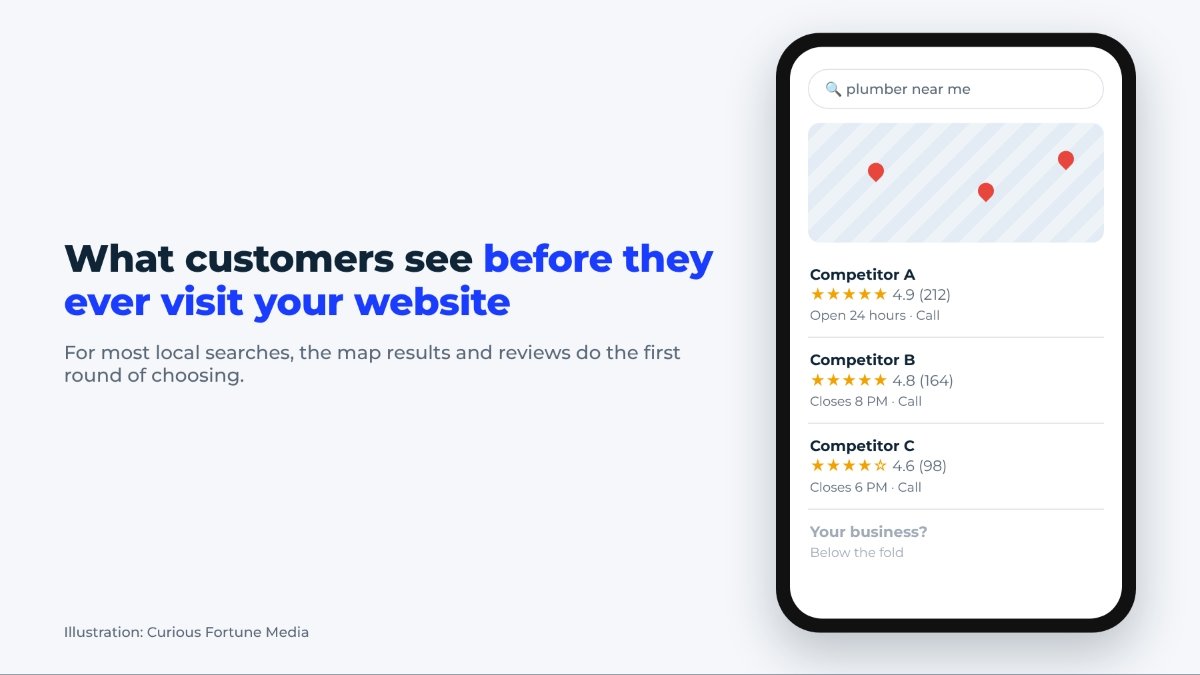
Search engines and customers both look for signs that other people know and trust a business. In a big city, those signs pile up through neighborhood publications, lifestyle blogs, events, and a long list of local organizations.
A smaller market produces fewer of them. That makes each review, community organization listing, and local news mention count for more in local search, and it leaves room for directories and “best of” pages built by outside sites to fill the gap.
“In a place like Santa Clarita, a lot of a business’s reputation lives in word of mouth, and search can’t hear word of mouth,” Abramyan says. “When there are fewer reviews and mentions to go around, every one of them carries more weight. But so do the gaps.”
Abramyan developed the Authority Engine™ for Curious Fortune Media on the premise that those pieces can’t be handled separately: visibility so customers across the valley can find a business, authority so its reviews and local mentions make it worth trusting, and conversion so that trust becomes a call.
The Advantage Local Businesses Already Have
Genuinely local businesses hold advantages a larger competitor can’t easily copy. They serve communities they know by name, belong to local organizations, and receive reviews from neighbors. Those advantages only count when customers can see them where they search.
In practice, that starts with accurate listings that name the communities a business actually serves, not just the city. It also includes presence in local organizations, local coverage, and how quickly a business responds. With commutes that long, some of that searching likely happens in the evening, when a missed call is easy to lose to whoever answers first.
The Canyon Country homeowner got her air conditioning fixed. The contractor three miles away was never an option she considered. In Santa Clarita, being local helps only when search can see it. Big-city businesses fight crowds, while Santa Clarita businesses fight distance, naming, and thin local signals.
That said, larger LA-area companies shouldn’t be excluded from the valley, and many serve customers there well. The point is narrower: a local business shouldn’t lose a neighbor’s call by default. For any owner in the valley, the useful test is what a customer three miles away sees when searching for that service tonight.