By: Sam Williams
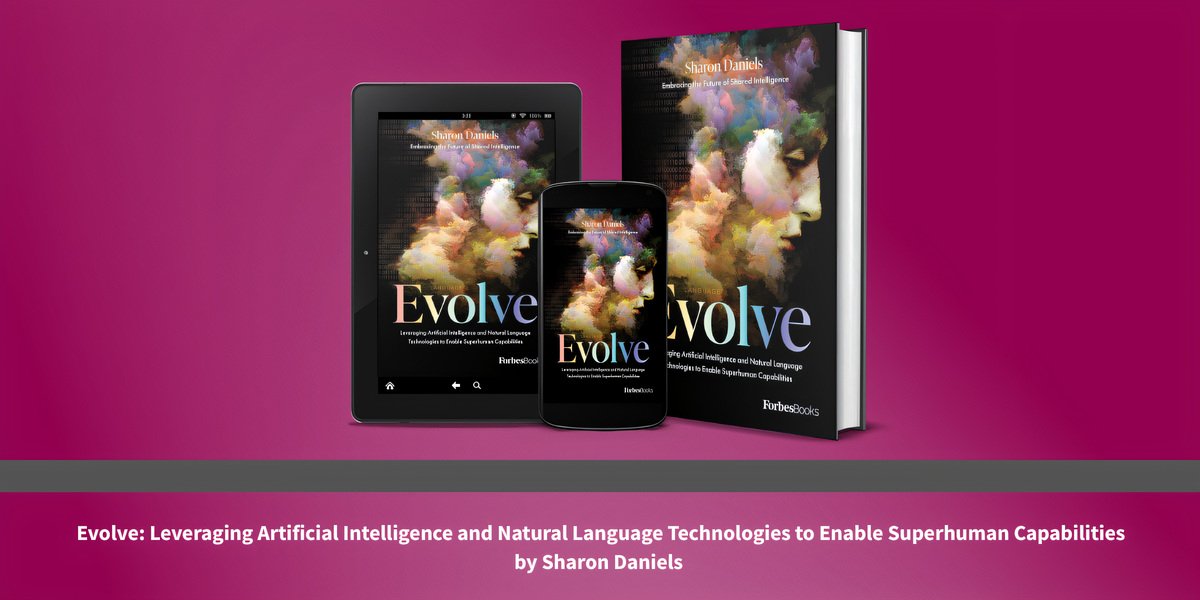
There is a specific kind of authority that only accumulates through decades of genuine immersion in a field, and Sharon Daniels has that authority in a domain that most people are only now beginning to pay serious attention to. As a technology CEO with more than thirty years of experience not just observing the intersection of language and technology but actively building at it, making consequential decisions about where it was going and what it meant for the organizations and industries she served, she brings to this book a depth of practical understanding that purely theoretical treatments of the subject simply cannot replicate. Evolve is the book that emerges from that accumulated immersion, and it is considerably more than a technology guide. It is a genuinely original argument about what it means to be human in a world where the one thing that has always defined our humanity most distinctly, our capacity for language, has now been digitized and moved outside the human mind into the machine.
Reading this book produces a quality of engaged wonder that most technology writing never quite manages to generate because most technology writing is either too technical to feel personal or too personal to feel credible. Daniels occupies an unusual position between those two failure modes, bringing enough scientific and business depth to make her arguments feel substantive and enough genuine enthusiasm for the human implications of what she is describing to make those arguments feel alive. She writes like someone who has been wanting to have this conversation for a long time and is relieved to finally be having it at the scale a book allows.
The historical framework she uses to contextualize natural language generation is one of the book’s most intellectually satisfying contributions. By tracing the role of language in human evolution from the earliest forms of communication through the printing press and beyond, she gives readers a way to understand what NLG represents not as a disruption of something that was working but as the next chapter in a story that has always been about what happens when human beings find new ways to extend the reach of their communication. That framing is both reassuring and genuinely clarifying, replacing the anxiety of novelty with the confidence of context.
The Hu plus AI equals superhuman formulation that runs through the book is one that deserves to become part of the standard vocabulary for thinking about artificial intelligence, because it names something that most of the AI conversation has been circling without quite landing on. The question is not what AI does instead of humans. The question is what humans become capable of when AI operates alongside them at scale, and Daniels answers that question with the specificity of someone who has watched it happen in real organizations solving real problems. Her vision of humanity remaining at the heart of AI through the specific vehicle of natural language technology is not wishful thinking. It is an architectural argument backed by thirty years of evidence, and Evolve delivers it with the clarity and the conviction it deserves.
Readers looking for an account of artificial intelligence that pairs three decades of direct industry involvement with genuine historical depth will find that combination in Daniels’ book. Forbes Books published the title in February 2026. Daniels writes as someone who spent her career building the technology she describes, and that vantage point shapes the argument on every page. Hardcover and ebook editions are both listed on Amazon’s product page for the book.