Picture a leadership team. Experienced people, most of them genuinely capable, sitting in a meeting that has run forty minutes long. The item on the agenda is a decision that should have been settled two weeks ago. Each person in the room carries a different mental model of who owns it. Some believe they are there to advise. Others believe they are there to ratify something already decided. One person thinks the decision is theirs to make. Another is waiting for someone with more authority to step forward. Nobody says any of this out loud. They continue talking.
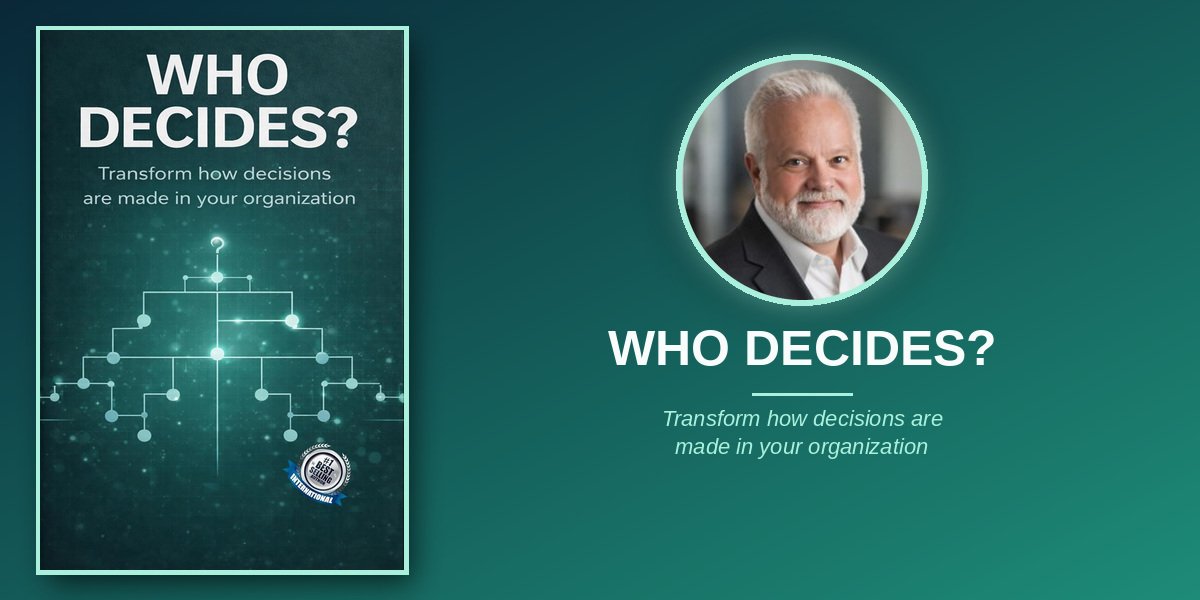
If you have spent time inside organizations, that scene is either familiar or so familiar it is almost funny. It is also, Todd Gross argues in Who Decides? Transform How Decisions Are Made in Your Organization, a completely preventable waste that repeats itself thousands of times a day in organizations that believe they have more complex problems than this.
Gross arrives at this argument through thirty-plus years of executive advisory work, including a stint as a turnaround CEO and engagements with businesses at every stage and scale. The pattern he kept seeing, beneath different industries and personalities, was the same: poor execution, weak accountability, and stalled growth almost always traced back to a decision-making environment that lacked clarity about ownership. Not to bad strategy. Not to insufficient talent. To the absence of a shared vocabulary for who decides what, and at what level.
The Five Levels of Decision-Making framework is the book’s engine. The five levels map a spectrum from full independent ownership to full upward delegation, with collaborative variations in between. The framework does not tell leaders what to decide. It tells them how to be clear, with themselves and everyone around them, about what kind of decision is being asked for and who is responsible for the outcome. It sounds straightforward until you realize most organizations have never installed it, and that its absence is generating the confusion in the meeting scene above, on repeat, every day.
The choke point concept is one of the book’s most immediately useful tools. Gross encourages leaders to identify recurring places where work stops waiting for a decision, then trace those stalls upstream, not to the person who is slowest to act, but to the structural conditions that made the slowdown predictable. Choke points are usually treated as individual failures. Gross reframes them as design signals, which shifts the fix from pressure on a person to clarity in a system. Those two interventions produce very different results.
The sections on decision severity and emotional pressure give the framework its grounding in real conditions. Not every decision is equivalent, and a leader who calibrates deliberately produces both faster low-stakes choices and better high-stakes ones. The emotional pressure chapter acknowledges that decisions made under stress behave differently, and it builds guidance robust enough to hold under those conditions rather than assuming calm.
The development argument is where the book earns its long-term case. Decision clarity does not just improve execution. It accelerates the growth of the people inside the organization, because knowing what you own is knowing what you are being asked to grow into.
Get your copy of Who Decides? on Amazon and give your team the shared language it has been operating without.