US Business News

Why Full-Service Book Production Matters for Entrepreneurs and Professionals Building Authority


Modern business books often function as long-form credibility tools rather than standalone publishing projects.

Entrepreneurs and professionals are increasingly using books for more than just personal achievement. A well-developed book can support reputation, clarify expertise, open new speaking or consulting opportunities, and strengthen the credibility behind a business or personal brand. For founders, coaches, consultants, healthcare professionals, real estate experts, and corporate leaders, the book is often becoming part of a broader authority strategy.

The challenge is that most professionals do not lack knowledge. They struggle with the production process. Turning years of experience, client stories, business lessons, or industry insight into a finished book requires structure, editorial judgment, design, publishing knowledge, and a practical plan for visibility. This is why full-service book production has become important for professionals who want to publish without losing focus on their core work.

Books Have Become Authority Infrastructure

In a competitive market, credibility is built through repeated proof. A book gives professionals a long-form platform to explain their philosophy, document their experience, and present ideas with more weight than a post, presentation, or sales page. It can serve as a tool across business development, media outreach, investor conversations, client education, and public speaking.

For entrepreneurs, a book can help explain the story behind a company, the principles behind a service, or the framework behind a methodology. For professionals, it can turn specialized knowledge into a public-facing asset. The value is not only in having a book available for sale. The larger value often comes from what the book says about the author’s expertise, discipline, and ability to communicate complex ideas clearly.

The Operational Problem Behind Publishing

Writing and publishing a book involves several moving parts. A manuscript may need development, restructuring, editing, proofreading, formatting, cover design, publishing setup, distribution planning, and marketing preparation. When each step is handled separately, the process can become fragmented. Authors may find themselves coordinating between writers, editors, designers, formatters, publishing platforms, and marketers without a clear production timeline.

This fragmentation can create delays and inconsistency. A strong manuscript can lose impact if the editing fails to align with the author’s purpose. A professional cover can miss the market if it is not aligned with the audience. A completed book can remain invisible if publishing and promotion are treated as afterthoughts. Full-service production helps solve this by placing the book within a single coordinated workflow.

Why Entrepreneurs Need More Than a Manuscript

A manuscript is only the starting point. Business authors often need a book that reflects their professional positioning, not just their ideas. The tone must fit the audience. The structure must support readability. The examples must reinforce authority. The final product must look credible across digital and print environments.

For an entrepreneur or professional, the book has to serve multiple purposes at once. It should educate readers, support personal branding, showcase the author’s expertise, and remain polished enough for business settings. That requires more than basic writing support. It requires production thinking, in which each stage of the book is connected to the book’s larger purpose.
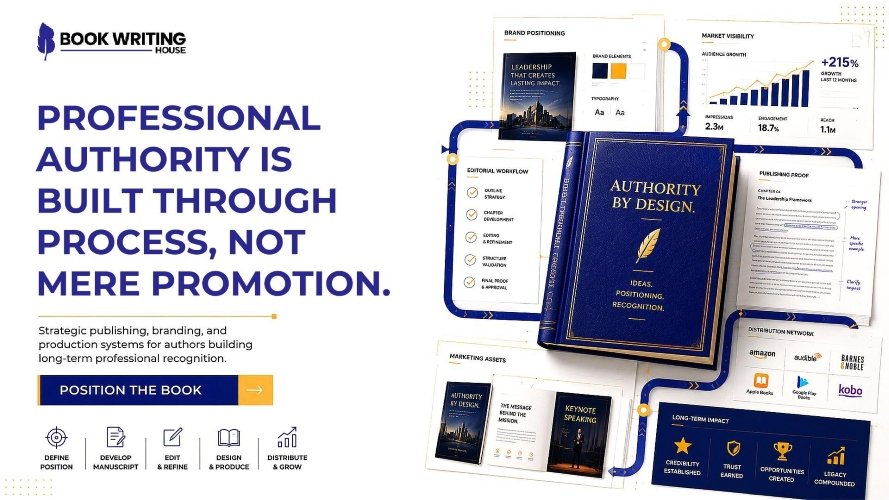
Photo Courtesy: Book Writing House

The Value of a Complete Production Workflow

A complete book production workflow brings together the major stages of the publishing journey. It begins with understanding the author’s goals, audience, and message. It then moves through manuscript development, editorial improvement, design, formatting, publishing preparation, and visibility planning. Each stage supports the next, reducing the gap between the concept and the final publication.

Book Writing House supports authors through a coordinated process that includes writing, editing, design, publishing, and marketing services. Its self-publishing support helps authors prepare their books for platforms such as Amazon and other distribution channels, while also addressing formatting, cover design, and visibility needs through its book publishing services.

For busy professionals, this approach can be especially useful because it reduces the need to manage every technical and creative detail on their own. Instead of treating the book as a scattered list of tasks, the author can follow a managed production path in which the manuscript, design, publishing format, and market positioning work together.

Publishing Is Only One Stage of the Business Outcome

Publishing a book is a milestone, but it is not the final business objective. The larger goal is often reader reach, credibility, and long-term brand impact. A book that is published but not positioned may fail to support the author’s professional goals. This is where marketing strategy becomes part of the production discussion, not a separate concern added at the end.

Professional authors need to consider audience visibility, launch preparation, online presence, media angles, reader engagement, and opportunities to build authority. Book Writing House also provides book marketing services for authors who want support in promoting their work after publication. For entrepreneurs and professionals, this connection between publishing and visibility is central to turning a book into a business asset.

What Full-Service Support Can Include

Full-service author support may include ghostwriting for authors who have ideas but need help shaping them into a book; development editing for those who already have a draft; professional editing for refinement; cover design for market presentation; formatting for print and digital use; publishing setup; and marketing preparation after release.

This model is especially relevant for business owners and professionals who cannot afford a disorganized publishing process. Their schedules are often limited, and their reputations are tied to the quality of the final product. A book attached to a professional brand must be clear, polished, and strategically presented. The production process must therefore protect both the author’s time and the author’s credibility.

From Expertise to a Market-Ready Asset

Many professionals have enough knowledge for a book, but knowledge alone does not create a market-ready asset. The ideas need sequence, clarity, and value to the reader. The content must be shaped around what the audience needs to understand, not only what the author wants to say. The design must feel aligned with the subject. The publishing path must make the book accessible. The promotional plan must help the right readers discover it.

This is where complete book production creates a practical bridge between expertise and execution. It allows professionals to move from scattered notes, presentations, interviews, client stories, or unfinished drafts into a finished product that can support their public profile. For business authors, that transition can be the difference between having an idea for a book and having a tool that works across their brand.

A Practical Path for Professional Authors

The rise of professional authorship reflects a larger shift in how entrepreneurs and experts build authority. A book can still be creative and personal, but for many professionals, it is also strategic. It can support trust, visibility, client education, and long-term recognition.

For those who want to publish but do not want to manage every stage alone, full-service book production offers a more organized path. By bringing writing, editing, design, publishing, and marketing into a connected process, brands like Book Writing House help authors move closer to a finished book that reflects both their message and their professional goals.

In that sense, the modern business book is not simply a product. It is a credibility asset. When produced with structure and care, it can become one of the most durable tools an entrepreneur or professional uses to explain who they are, what they know, and why their perspective matters.


How Healthy Competition Builds Confidence at Work and in the Classroom

By Audrey Denise B. Cachuela

“And pencils down.” The room goes quiet for three seconds. Then someone yells, “What did you get for number four?” and the whole hall breaks into arguments about method, half-laughs about the question that stumped everyone, and a dozen side conversations comparing answers. This is what a math contest looks like the moment it ends, and it has nothing to do with the tense, cutthroat scene most people picture when they hear the word competition.

Healthy competition gets blamed for anxiety, burnout, and cutthroat behavior in both schools and offices. But organizations like Spirit of Math, which builds advanced math programs for high-performing students, treat contests as a chance for students to see exactly where they stand. Students walk away from a Spirit of Math contest with a clearer picture of what they know, not a ranking that tells them who they are.

A hard exam or a missed sales target produces two different reactions in two different people. One spirals into self-doubt. The other takes notes and comes back sharper next time. That split has almost nothing to do with talent. It comes down to what the adults around them taught them to do the moment the result came in.

In this article, we look at what separates the version of competition that builds people up from the version that wears them down, because competition is not going away from classrooms or workplaces. The real question is what kind gets built.

The Real Difference Between Unhealthy and Healthy Competition

Competition earns blame in schools for triggering comparison and fear of failure. At work, it gets tied to office politics, information hoarding, and coworkers fighting over the same scrap of recognition. Both accusations hold up when competition gets built around proving worth. They fall apart when competition gets built around building skill.

Competition also never disappears from adult life. Students apply for scholarships, team spots, and university admission. Adults compete for jobs, clients, promotions, and budget. Shielding people from every competitive moment leaves them undertrained for the moments that actually count, because those moments arrive whether or not anyone prepared for them.

Two different questions separate the healthy version from the unhealthy one. One asks: am I better than everyone else? The other asks: what did this challenge reveal about where I actually stand? A strong score confirms a strategy worked. A rough one flags exactly what needs more attention. Either result can lead somewhere useful when the person walking away gets encouraged to reflect and try again instead of getting ranked and dismissed.

Psychologists call the second question a mastery goal, built around developing competence, and the first a performance goal, built around proving ability. Mastery goals sustain effort through difficult tasks better than performance goals do (Source: American Psychological Association, 2024). That single distinction decides whether a classroom or workplace ends up healthy or corrosive, because it determines which goal the whole competitive structure quietly rewards.

Get that framing right, and ranking, resilience, and workplace competition all become manageable problems with clear solutions. Get it wrong, and even a well-designed contest or sales target starts working against the people it was meant to motivate. The ranking problem shows exactly how that breakdown happens.

Why Ranking Alone Creates the Wrong Incentives

A ranking answers one question: who finished where. It says nothing about why, what improved, or what to do next. That gap turns dangerous the moment someone treats their rank as a verdict on their intelligence instead of a snapshot of one day’s performance.

A kid who lands in the middle of the pack decides they’re “not a math person.” An employee passed over for a promotion decides they’ll never be leadership material. In both cases, a single number gets promoted to an identity, and that number stands in for a far more complicated truth about what someone actually knows and can do.

Research on classroom competition traces exactly this collapse. Classroom competition affects academic achievement through two competing channels: it can raise learning engagement, and it can raise learning anxiety, and the anxiety cancels out much of the benefit engagement creates (Source: Frontiers in Psychology, 2022). That finding explains why classroom debates about competition go in circles. Every student experiences a contest differently, because the design of the activity, the language adults use around it, and the consequences of a bad result all shape what a student takes from it.

The presence of competition is one variable in the equation, and a minor one at that. Meaning decides whether a contest builds someone up or convinces them to stop trying. That question, what gives a contest the right meaning, plays out clearly in how Spirit of Math structures its own competitions.

What Math Contests Reveal About How People Learn

Spirit of Math treats its contests as learning environments, not one-shot tests. Students work through unfamiliar problems under pressure, and the contest becomes a real check on whether they can apply their skills when the path to an answer isn’t obvious. The program’s broader curriculum builds toward that moment through fluency drills, conceptual depth, structured problem solving, and collaborative group work, all aimed at students who can reason, not just execute steps.

Spirit of Math began inside public school classrooms more than three decades ago and now runs across 35 campuses in Canada. Its contest network reaches students in more than 30 countries. This year alone, more than 19,000 students from those countries took part in the organization’s international math contests, and most of them remain years away from choosing a university major, let alone thinking of themselves as future problem solvers.

The moment right after the papers get collected carries a lot of the real learning. Kids compare methods, argue over which approach worked, and ask each other how they read a tricky question. That curiosity doesn’t stop at the final answer. A peer’s strong result becomes proof of what’s possible instead of evidence that everyone else failed, and that reaction differs completely from what most people expect to feel after a contest.

That reaction gets built before the contest even starts. Students learn to defend their reasoning out loud, challenge each other’s thinking, and work through unfamiliar problems, instead of memorizing procedures they’ll forget by the following Monday. When the contest ends, that habit of explaining and comparing simply continues into a different room.

Students who practice explaining their thinking to peers walk into a contest already comfortable with a wrong answer as the start of a conversation, not the end of their confidence. That comfort connects directly to what happens with resilience when contests get designed around growth instead of ranking.

Growth-Focused Competition Is What Actually Builds Resilience

Resilience comes from hitting something difficult, staying in it, and discovering that your own response changes what happens next. A streak of easy wins produces none of that. Constant success gives people no reason to revise anything, while a demanding problem exposes the exact gap between what someone knows and what the moment requires, and that gap is where learning actually sticks.

Mistakes need to register as raw material for improvement, not proof of low ability. Gifted and talented students benefit specifically from praise for effort, for tackling hard material, and for mastering new skills, rather than praise for speed or easy wins (Source: American Psychological Association, 2024). That guidance matters most for kids who make difficult work look effortless, because adults tend to leave those kids alone rather than pushing them toward anything genuinely hard.

High performers left in that pattern start avoiding anything they can’t master immediately, protecting a reputation instead of building a skill. The pattern stays invisible because it looks like success from the outside. A student who only attempts what they’re already good at can coast for years before anyone notices the growth stopped long ago.

That shift in what a mistake means carries straight into the workplace. The same dynamic plays out in offices every day under different names, quarterly targets instead of contest scores, performance reviews instead of report cards. The setting changes. The psychology stays the same.

Workplace Competition Has the Exact Same Framing Problem

Employees who see workplace competition as a challenge tend to gain career benefits from it. Employees who experience the same competitive climate as a threat tend to see it damage their career instead (Source: Journal of Vocational Behavior, 2021). The environment stays identical, and the outcome flips entirely based on how someone interprets it.

Leaders shape that interpretation through the systems they build around competition, whether they intend to or not. A team treats competition as a challenge when expectations get stated up front, evaluation runs on visible criteria instead of gut feeling, and people retain room to cooperate while competing for the same goal.

That system breaks down fast when criteria shift without warning, when recognition looks political instead of earned, or when someone can only get ahead by cutting a colleague off from information they need. The difference between a healthy competitive system and a broken one has nothing to do with whether competition exists. It comes down to whether the rules stay visible and stable enough for people to trust them.

Spirit of Math builds that same balance directly into its classrooms, pairing high-stakes contests with collaborative group work, so students build individual skill while learning to explain their thinking and listen to someone else’s. Most workplaces haven’t been built to hold both at once, which raises a practical question: how does an adult, whether teacher or manager, actually build that balance on purpose?

How Adults Build Healthy Competition, and What Should Be Left Behind When It Ends

The questions adults ask right after a result determine which lesson sticks. “Did you win?” makes the ranking the whole story. “What did you learn about your approach?” makes strategy the story instead. “What will you try differently next time?” turns the result into a plan.

Vague feedback like “work harder” gives someone nothing to act on. Naming the actual issue, rushing the analysis, skipping a step, or giving up after one failed attempt gives them something concrete to fix. Specific, moderately difficult goals paired with real feedback on progress motivate people more than vague encouragement does (Source: American Psychological Association, 2024).

Recognition has to stretch past first place. That doesn’t mean pretending every result is equal. It means noticing the behaviors that build long-term capability: preparation, persistence, sharper reasoning, and genuine support for the person sitting next to you. A student can miss the top ranks entirely and still walk away with a real intellectual win. An employee can lose a pitch and still land on an approach that wins the next one. Healthy competition makes those wins visible.

That visibility is the real test of whether any of this worked, not the scoreboard, but what’s still true about a person after the contest, the exam, or the project ends. Self-awareness, clearer goals, enough confidence to walk into the next hard thing, the ability to treat someone else’s success as useful information rather than a threat: these are the outcomes that stick. Spirit of Math has spent over three decades building a model around exactly that outcome, where demanding contests, honest reflection, and a return to the classroom feed into each other instead of competing for attention. Ranking was never the target to eliminate. Keeping ranking from becoming the entire story was always the target.

Take a single competitive moment already built into your classroom or your workplace and change the conversation around it this week. Name the actual skill being built. Explain how the feedback will get used. Ask everyone involved to name one thing they’d improve next time. That single change turns healthy competition from a slogan into something people feel, and it’s the same change Spirit of Math has spent 30 years refining in classrooms full of kids who walked in nervous about math and walked out arguing over whose strategy was faster.

Changing Consumer Habits Reshape the U.S. Ice Cream Industry

U.S. consumer preferences are reshaping the ice cream industry, with demand shifting from traditional take-home tubs toward premium handheld and portion-controlled products, according to executives at Magnum Ice Cream Co. The company said the change is influencing product strategy, supporting growth in the United States, and reinforcing investment in higher-value product categories.

Key Takeaways

  • Magnum said U.S. consumers are increasingly choosing handheld and portion-controlled ice cream products.
  • Premium handheld offerings are generating stronger value than traditional take-home tubs.
  • Consumer demand is influencing product portfolio decisions across the frozen dessert category.
  • Yasso, Popsicle, and Ben & Jerry’s contributed to growth in North America.
  • Magnum reaffirmed its 2026 organic sales growth outlook of 3% to 5%.


U.S. consumer preferences are reshaping the Magnum U.S. ice cream market, with demand moving away from traditional take-home tubs and toward premium handheld and portion-controlled products, according to executives at Magnum Ice Cream Co. The company said the shift is influencing how it develops and positions products in one of its largest markets while supporting continued growth across its North American business.

The comments, made during a discussion of the company’s first-half 2026 performance, point to a broader change in purchasing behavior across the frozen dessert category. Consumers are increasingly selecting individually packaged products designed for convenience, portability, and portion control instead of larger containers commonly purchased for home consumption.

For food manufacturers and retailers, the change signals an adjustment in product mix, merchandising priorities, and pricing strategies as premium products account for a larger share of category sales.

Magnum U.S. Ice Cream Market Strategy Reflects Consumer Preferences

Magnum executives said the U.S. ice cream category is undergoing a structural change rather than a temporary shift in purchasing patterns.

According to the company, traditional tubs of vanilla ice cream have long been used alongside desserts such as pies or incorporated into beverages like floats. That segment is experiencing slower demand, while handheld products continue attracting consumers looking for convenience and individually packaged servings.

The company said this movement aligns closely with the strengths of its existing portfolio. Rather than relying on larger family-sized containers, Magnum’s strategy emphasizes premium bars and other handheld frozen treats that match changing buying habits.

The shift also reflects broader changes in consumer expectations around convenience and product format. Individual servings allow consumers to purchase products for immediate consumption while offering retailers additional merchandising opportunities across grocery and convenience channels. Similar changes in shopper purchasing patterns have been observed in consumer spending at value retailers, where buying behavior continues to influence merchandising strategies across the retail sector.

Handheld Products Support Growth in the United States

Premium Products Generate Higher Revenue Per Unit

Magnum said premium handheld products continue to support growth because they typically command higher prices than traditional take-home tubs.

Executives explained that although larger containers may generate greater volume, individually packaged products often deliver higher revenue per unit sold. That pricing advantage provides manufacturers with an opportunity to increase sales value even when overall consumption patterns change.

Premium positioning has become an important element of packaged food strategies across multiple consumer categories. Within frozen desserts, companies are expanding offerings that combine convenience, portion control, and premium ingredients or branding to differentiate products on retail shelves, echoing broader discussions about inflation and retailer pricing strategies.

For retailers, these products can also improve category performance through higher average selling prices while addressing consumer demand for grab-and-go purchases.

Portion-Controlled Formats Gain Consumer Interest

Magnum also identified portion-controlled products as an increasingly important segment of the U.S. market.

Executives said consumers are showing stronger interest in individually packaged products that provide consistent serving sizes and require no preparation before consumption.

These purchasing patterns are influencing product portfolio decisions across the industry. Manufacturers are allocating greater attention to formats that balance convenience with premium positioning while responding to evolving shopper preferences.

The company said its portfolio is well positioned within these categories, supporting continued growth in the United States.

North American Brand Performance Contributes to Regional Results

Changing Consumer Habits Reshape the U.S. Ice Cream Industry

Photo Credit: Unsplash.com

Yasso and Popsicle Continue Double-Digit Growth

Magnum reported that several established brands within its North American portfolio contributed to regional performance during the first half of 2026.

The company said Yasso and Popsicle continued to post double-digit growth in the United States, contributing to market share gains across the region.

Their performance illustrates how different product formats can appeal to changing consumer preferences while supporting broader portfolio diversification.

Ben & Jerry’s Records Market Share Gains

Ben & Jerry’s also outperformed the broader U.S. ice cream market during the reporting period, according to the company.

Executives said the brand recorded market share gains alongside continued growth from other major brands in North America.

The combination of premium indulgence products, better-for-you offerings, and handheld formats demonstrates how manufacturers are expanding portfolios to address multiple consumer segments rather than relying on a single product category. Food producers are also placing greater emphasis on operational resilience, an issue explored through food supply chain risk management across manufacturing and distribution networks.

The company added that Mexico also contributed to regional growth, while Brazil remained under a turnaround plan.

First-Half Financial Results Accompany U.S. Market Update

Organic Sales Growth Includes Volume and Pricing

While the company’s market update focused largely on consumer behavior, Magnum also reported first-half operating results that reflected continued demand across its business.

Sales increased to €4.7 billion during the first half of 2026, supported by organic sales growth of 4.7%. The company said both volume growth and pricing contributed to the increase.

Within the Americas, organic sales grew 3.2%, with pricing rising 3% while organic volume remained stable.

The company said growth was supported by continued gains in the United States and Mexico, where several leading brands strengthened their market positions.

Rather than attributing performance solely to pricing, executives said changing consumer demand for premium handheld products remained an important driver of growth in the U.S. market.

2026 Business Outlook Remains Unchanged

Magnum reaffirmed its expectation for organic sales growth of between 3% and 5% for 2026.

The company said its portfolio continues to benefit from demand across premium handheld products while maintaining balanced contributions from pricing and volume.

For food manufacturers, the company’s assessment points to the importance of aligning product development with measurable changes in consumer purchasing behavior.

Retailers may also continue adjusting shelf space and merchandising strategies as premium handheld products account for a larger share of frozen dessert sales.

The company’s comments suggest that product format, convenience, and premium positioning will remain important considerations as manufacturers evaluate future portfolio decisions within the U.S. ice cream market.

Frequently Asked Questions

Why is Magnum changing its strategy in the U.S. ice cream market?

The company said changing consumer preferences are increasing demand for handheld and portion-controlled ice cream products, prompting it to emphasize categories where its portfolio is strongest.

What consumer preferences are influencing the U.S. ice cream market?

According to Magnum, consumers are increasingly choosing premium handheld frozen treats and individually portioned products instead of traditional take-home tubs.

Which brands contributed to North American growth?

The company said Yasso and Popsicle continued double-digit growth, while Ben & Jerry’s gained market share during the first half of 2026.

Why do handheld ice cream products generate higher value?

Magnum said handheld products typically command higher prices per unit than larger tubs, allowing premium products to contribute more value to sales.

What is Magnum’s outlook for 2026?

The company reaffirmed its expectation for organic sales growth of between 3% and 5% for the full year.


How Data Center Youngbloods Is Building the Talent Infrastructure Behind the AI Economy

By: Ethan Rogers

As artificial intelligence accelerates investment in digital infrastructure, a new generation of companies is emerging to solve the industry’s biggest operational challenge: workforce development. Among them is Data Center Youngbloods (DCYB), a startup founded by Luke Adams that is rethinking how talent enters one of the world’s fastest-growing industries.

Rather than operating as a traditional staffing agency or training provider, DCYB combines professional networking, workforce education, career guidance, and employer partnerships into a single platform. The company’s objective is straightforward: to help build the next generation of professionals who will design, operate, and maintain the infrastructure powering the AI economy.

Luke Adams founded DCYB after recognizing a growing disconnect between record investment in data center construction and the industry’s ability to recruit and develop qualified talent. While billions were being invested into facilities worldwide, he believed there was no clear pathway for students, veterans, trades professionals, and early-career technologists looking to enter the field.

That insight became the foundation of the company’s business model. Today, DCYB is developing an integrated ecosystem consisting of its Careers Platform, the DCYB Academy, a growing member community, and direct employer relationships. Rather than treating hiring as a one-time transaction, the platform is designed to support professionals throughout their careers while providing employers with a stronger long-term talent pipeline.

Early momentum has demonstrated market interest. Since launching in 2026, DCYB has attracted members from across the Americas, Europe, and Asia-Pacific while establishing relationships with senior leaders throughout the digital infrastructure industry. The company has also validated employer demand through hiring campaigns that produced strong applicant engagement and qualified candidate shortlists.

Technology also plays a central role in the company’s vision. In addition to educational resources and career development tools, DCYB is incorporating AI-assisted learning, concept mapping, and mobile-first experiences designed to make technical education more accessible for the next generation of infrastructure professionals.

Founder Luke Adams believes the companies that invest in workforce development today will be best positioned to capitalize on tomorrow’s AI economy. His philosophy emphasizes measurable outcomes over marketing metrics, arguing that successful careers and employer partnerships ultimately create the strongest foundation for sustainable business growth.

Looking ahead, DCYB plans to expand across major North American markets while growing internationally throughout Europe and Latin America. Upcoming initiatives include the public launch of its Academy, an integrated mobile application, expanded employer programs, and additional partnerships throughout the hyperscale, colocation, and digital infrastructure sectors.

While much of the conversation surrounding artificial intelligence focuses on chips, software, and computing power, Data Center Youngbloods is focused on the people behind that infrastructure. As demand for skilled professionals continues to accelerate, the company is positioning itself as a long-term partner for both emerging talent and employers seeking to build the workforce that will support the next chapter of the digital economy.

Note that the founder attribution, launch year, and startup/nonprofit characterization are unchanged pending the client’s confirmation, so this text should not go to publication until those three items come back.

The 15-Minute Financial Conversation That Changes How People Handle Debt

By: Audrey Denise B. Cachuela

Picture the moment right before someone finally decides to deal with their credit card debt. The statements have piled up unopened. The calls from collectors go straight to voicemail. Somewhere in the back of their mind, a number keeps growing, and so does the dread of ever facing it.

Now picture what actually breaks that cycle. It is rarely a new app, but a financial conversation, the kind where someone finally says the numbers out loud to another human being and gets to ask the questions they have been sitting with for months.

Amber Duncan, founder of Life After Debt, structures her company’s client relationships around that idea. Every relationship starts with a free 15-minute Clarity Call, a short conversation meant to help someone understand their situation before anyone discusses a plan. The format sounds almost too simple to matter, and it is easy to skip.

Why the Debt Conversation Gets Skipped

The financial services industry has spent years perfecting the transaction. Consumers can compare credit cards, calculate loan payments, monitor their credit scores, and apply for products entirely on their own, no human required. That progress is real, and it has made routine financial tasks faster for millions of people.

Overwhelming debt does not behave like a routine financial task. Someone carrying serious credit card debt is usually not evaluating options from a calm, neutral headspace. They may be hiding statements from a partner, screening every call from an unknown number, or lying awake running the same math over and over. Offering that person a solution before they have had a chance to explain what is actually happening skips the step that matters most.

A short, focused financial conversation slows things down long enough for someone to describe their situation before anyone moves toward a fix, starting with what kind of debt someone is carrying and what they are most afraid will happen next. Those specifics turn a vague, overwhelming crisis into something that can actually be examined, one piece at a time.

Skipping that step does more than create a communication problem. It ties into a deeper reason people put off dealing with debt in the first place, rooted in how people process financial fear.

People rarely avoid their finances because they do not care. Researchers tracking more than 9,000 participants across six separate studies, including bank account records and even identical twin comparisons, found a genuine feedback loop between shame and financial hardship. Shame pushes people to disengage from their money, and that disengagement leads to decisions that deepen the very hardship causing the shame (Source: Organizational Behavior and Human Decision Processes, 2021).

That disengagement looks like procrastination from the outside. From the inside, it feels closer to paralysis. People worry that asking a question will expose what they do not know. They expect judgment. They assume that reaching out to a debt relief company means walking straight into a sales pitch they are not ready for.

A financial conversation that starts by listening to someone’s actual story interrupts that cycle. Nobody has to solve their entire debt problem in one call; they only have to describe what is happening and start making sense of it.

What a Financial Conversation Actually Delivers

A fifteen-minute conversation delivers clarity, not a repaired credit report or an erased balance, and that clarity changes how someone reacts to everything that follows.

People under financial pressure tend to respond to whatever message hits them loudest and fastest. A collector’s call can make a payment feel due immediately, and a settlement ad can make one program sound like the only option available. Consumers already have legal protections built into how collectors are allowed to behave: collectors have to send validation information identifying the debt and explaining a consumer’s rights, either during that first contact or within five days of it (Source: Consumer Financial Protection Bureau, Regulation F, 12 CFR § 1006.34), and they are barred from calling before 8 a.m. or after 9 p.m. or contacting someone at a time or place already known to be inconvenient (Source: Federal Trade Commission, 2025).

Once someone understands that urgency does not cancel out their rights, the entire dynamic of a debt conversation changes. Deciding what to do next becomes a deliberate choice rather than a reaction. That change depends on someone taking the time to actually listen before offering a recommendation.

Listening does more than interrupt the shame-driven avoidance described earlier. It also works as a diagnostic tool, revealing why someone is anxious about their debt and what they specifically need next. A debt total on a screen says nothing about how someone got there: a medical emergency, a divorce, a layoff, a failed business, or years of quietly using credit to cover basic bills can all produce the same balance, and each situation points toward a different realistic next step.

A recommendation that ignores income, household pressure, or immediate risk might look perfectly reasonable on paper and still fall apart the moment someone tries to live inside it. Listening is how a company avoids that mismatch and figures out what someone is actually asking for. Some callers think they need a settlement program when their real concern is a confusing collection letter. Others assume bankruptcy is their only path before they have looked at anything else. A financial conversation gives those concerns somewhere to land before a recommendation gets made.

Trust, Timing, and Why Fifteen Minutes Is Enough

Trust in financial services sits at 63% globally, a number that has climbed over the past five years even as trust in plenty of other industries has stalled (Source: Edelman Trust Barometer, 2026). That number reflects the industry overall. It says very little about whether one specific consumer will trust one specific company during one specific phone call, especially while that consumer feels exposed and behind on their bills.

People weigh more than what a company offers when deciding whether to trust it. They read whether the person on the other end of the line understands them, tells them the full picture, and lets them decide without pressure, a judgment that forms within the first few minutes and rarely reverses after that.

Duncan’s approach reflects a view that trust needs to exist before anyone asks a consumer to commit to anything, a perspective shaped in part by her own experience filing for bankruptcy during the 2008 financial crisis, which later focused her work on helping people address unsecured debt. People who feel educated during a financial conversation tend to ask more honest questions and share relevant details sooner, which puts them in a better position to judge whether a given plan actually fits their life.

Trust normally takes far longer than fifteen minutes to build, which raises a fair question about whether such a short window can accomplish anything real. In practice, trust and clarity form together: people recognize within the first few minutes that they are being asked questions, not handed a script, and that recognition frees up the rest of the call to focus on what they actually need.

That remaining time does not need to map every possible outcome. It needs to surface the caller’s biggest concern, confirm the basic facts, and land on one reasonable next step, whether that means pulling account statements, reviewing a validation notice, talking to a bankruptcy attorney, or scheduling a deeper consultation. The value comes from cutting down the number of unknowns standing between someone and a decision they can actually make.

An overwhelming financial situation makes any long, complicated process feel impossible to start. A short conversation lowers that barrier enough for someone to actually walk through the door, whether that door is a phone call, an email, or a scheduled follow-up.

Better Financial Decisions Start With a Better Conversation

Digital tools will keep getting better at organizing financial information, and a calculator can already estimate a payment far faster than a person can. A person, though, can notice that someone has been hiding a balance from their spouse, or that fear of the unknown, not laziness, explains why a bill has gone untouched for six months.

The strongest model pairs both: software handles the data, and a trained person helps someone interpret what that data actually means for their life. The conversation becomes the bridge between information and an actual decision.

That bridge is also where financial services companies could rethink how they measure success. Most track whether a conversation ended in a signed agreement. Fewer track whether the person on the other end of the line actually understood their options and felt able to ask questions before making a decision. Those outcomes are harder to measure than a conversion rate, but they are a better indicator of whether a financial conversation actually did its job.

For someone still sitting with an unopened statement, the first productive step rarely requires a decision about debt settlement, bankruptcy, or a repayment plan. It requires finding someone willing to ask questions before offering answers.

That kind of financial conversation shows up when someone listens carefully, lays out the rules plainly, and gives a person room to make an informed call about their own life. Amber Duncan built Life After Debt around that premise, opening every client relationship with a Clarity Call. For anyone carrying credit card debt that has gone unaddressed, a free 15-minute Clarity Call is one starting point for getting a clearer picture of where things stand and what the realistic next steps look like.

Disclaimer: This article is for informational purposes only and does not constitute financial, legal, tax, or credit advice. Debt-relief results, fees, timelines, and eligibility vary. Consumers should review all options and consult a qualified professional before making financial decisions.