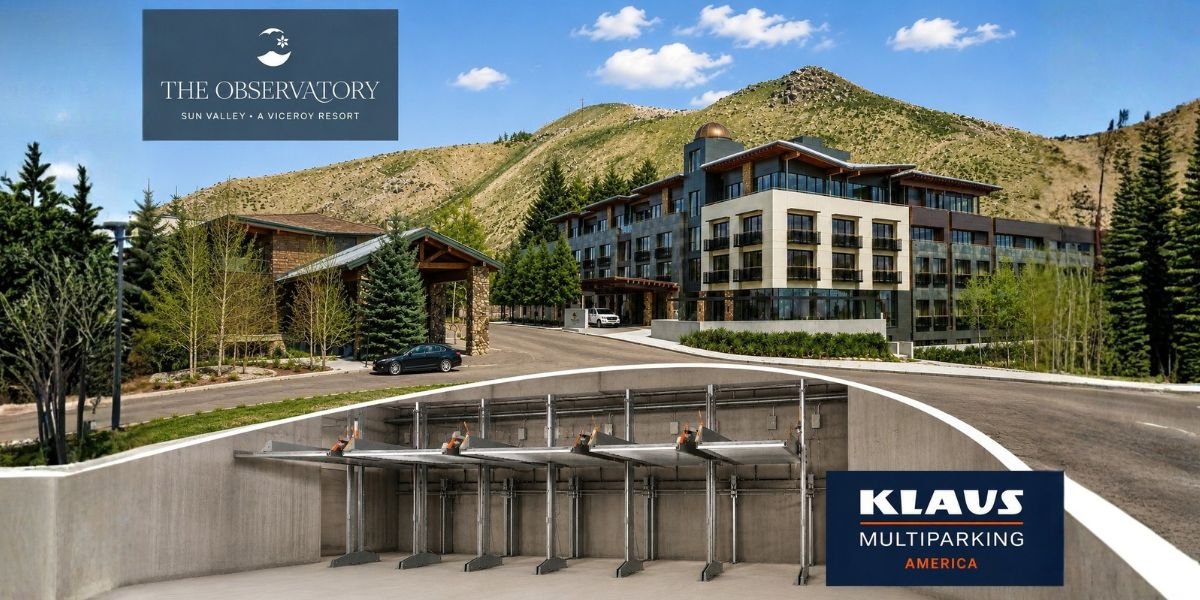
When developers of The Observatory, a Viceroy Resort in Ketchum, Idaho, began planning the property, they confronted a constraint familiar to mountain-market builders: a high-value, limited-acreage site where every square foot carried a cost of alternative use. Their answer was a mechanical parking system, completed in August, that stacks 86 vehicles across two levels, capacity a conventional surface lot or ramped garage could not have delivered on the same footprint.
The arithmetic behind that calculation is straightforward. A conventional garage on the Trail Creek site would have required either surface acreage the resort could not spare or a below-grade pit, adding excavation cost, construction time, and site disruption on a compact mountain parcel. The mechanical system’s no-pit, above-grade design avoided both, doubling parking capacity within the same footprint a single-level structure would have used, freeing the difference for the guest rooms, residences and amenities that actually generate revenue for the property.
That trade-off is becoming more common across mountain resort markets, where land supply is fixed, and demand for both lodging and parking keeps rising. Developers weighing a site plan increasingly have to decide how much of a limited parcel goes toward vehicle storage versus revenue-producing square footage. That decision is shaping up earlier in the capital planning process than it has historically.
“The Observatory is exactly the kind of property mechanical parking was made for,” said Christopher Tiessen, CEO of KLAUS Multiparking America. “The team wanted every square foot working toward the guest experience, and a conventional garage would have taken land the site couldn’t give up. Storing cars two-high keeps the valet operation compact and close to the door, so arrival stays quick and parking never competes with the rest of the resort for space.”
The decision sits inside a larger trend in mountain hospitality development. As available land in resort towns like Ketchum grows scarcer and more expensive, developers are weighing parking not as a fixed cost of doing business but as a line item that competes directly with rooms, amenities, and revenue-generating square footage. That is pushing mechanical systems earlier into site planning and capital budgeting, rather than treating them as a late-stage fix for an undersized lot discovered after a design is already locked.
The approach also carries operational implications beyond the balance sheet. A compact, above-grade valet structure close to the entrance shortens the walk for attendants retrieving vehicles, which can translate into faster turnaround during high-traffic periods such as check-in, dinner service and event departures, a factor luxury operators weigh alongside pure square-footage economics when evaluating guest-experience metrics.
The Observatory will open this fall with 73 rooms and suites, 12 condominium residences, a full-service spa, on-site dining and roughly 5,500 square feet of banquet and conference space, a program that depended, in part, on freeing up ground otherwise claimed by vehicle storage. For a market where buildable land is finite and getting more expensive, the project offers a case study in how parking infrastructure decisions can directly shape what else a developer is able to build.
It is also a reminder that parking economics do not scale down neatly from urban markets to mountain resort towns. In a dense city, a developer might trade parking ratio for transit access or a variance; in a market like Ketchum, with no transit alternative and land supply fixed by geography rather than zoning, the constraint is closer to absolute. That leaves mechanical systems as one of a narrower set of tools developers have to work with when a site’s parking demand simply exceeds what its footprint can support in a conventional layout.