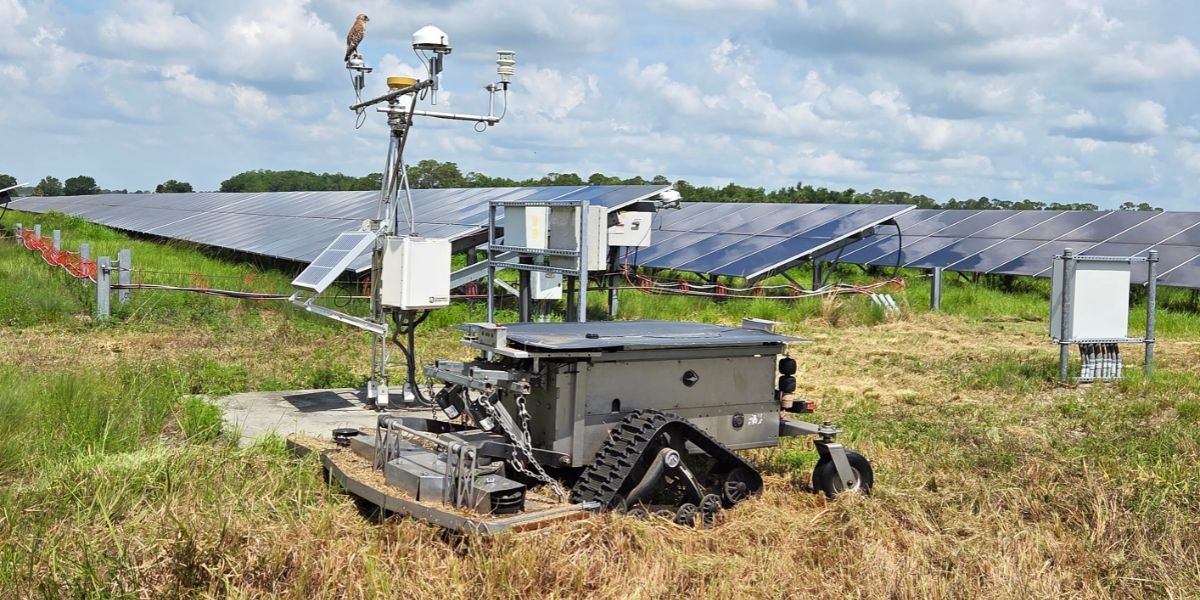
George Chrysanthakopoulos spent two decades building platforms at Microsoft and VMware. Then he built a farm robot in a Seattle warehouse, and did it without the venture playbook.
There is a particular kind of engineer who spends two decades building software that other people build things on, and then, at some point, wants to build the thing itself. George Chrysanthakopoulos spent twenty‑one years in that first category. He worked in the Windows NT base group at Microsoft, then on Xbox system services, then became software architect and technical lead for Microsoft Robotics Studio, the company’s attempt to give the robotics community a common software platform. At 25, while working at Microsoft, George earned his PhD in Electrical Engineering from the University of Washington. At 33, George was promoted to Distinguished Engineer for his work on Xbox, concurrency, and robotics. The next stop in his software engineering career was designing and deploying a control plane for a cloud computing platform at VMware, where he was promoted to Fellow.
Then he retired and started designing a robot to manage his mountain property, clear his own snow, cut brush and grade roads. That is the unglamorous origin of Directed Machines, the Seattle company he founded in 2018 under the name dCentralized Systems. Its product, the Land Care Robot, is now sold across the United States and Canada into utility‑scale solar, agriculture, airports, golf courses, nurseries and roadside maintenance. The path from a personal snow‑clearing project to a fleet of commercial machines says something useful about how durable engineering companies actually get built.
The Neighbors Changed the Plan
The pivot came from conversations rather than market research. Talking with small‑scale farmers near his property, Chrysanthakopoulos found a set of problems he had not been looking for. Margins on small farms are thin. Seasonal labor is difficult to find and harder to keep. Weed and pest management depends heavily on chemicals that growers would rather use less of. And a machine that could only do one job could not possibly justify its own cost.
Those constraints shaped the product more than any technology roadmap did. A single‑purpose robot was ruled out immediately; the machine had to be modular, capable of switching implements across the growing season. Right to repair, a live political issue in agriculture, became a design requirement rather than a marketing line. The machine had to use readily available parts and be fixable on site by the person who owns it, not by a dealer with proprietary diagnostics.
The specification did not come from a whiteboard. It came from farmers and rural property owners explaining what they could not afford, could not staff, and could not repair.
Writing All of It
Chrysanthakopoulos has been unusually direct about the engineering approach. Speaking to GeekWire in 2019, when the company occupied a cold warehouse in Seattle’s SoDo neighborhood with a team of four, he said of the autonomy stack: “I wrote all the code.” He clarified that he meant it literally, rather than assembling open‑source components into something that mostly worked.
That decision has consequences visible in the product today. The Land Care Robot runs its full autonomy stack on a Raspberry Pi, which, while processing input from a suite of sensors including 4‑6 video streams, uses only 10% of the Pi’s CPU and draws only about 15 watts, less than a human brain. That figure is unusual at a time when AI data centers draw energy at a virtually unbounded rate. The company describes it as the only enterprise‑scale outdoor robot to do so, and attributes the feat to mathematical modeling rather than raw processing power. It is not an obvious choice for a machine working commercially across tens of thousands of acres, and it is difficult to imagine a team arriving at it without deep ownership of the code.
The payoff is practical. Low compute energy draw extends run time. Inexpensive, widely available hardware suits a company shipping fleets rather than prototypes, fits the same repairability logic that shaped the mechanical design, and holds down the cost of building each machine. The Raspberry Pi Foundation has since published a case study on Directed Machines.
Growing the Old‑Fashioned Way
The company’s financial posture has been as deliberate as its engineering. Chrysanthakopoulos told GeekWire he wanted to stay small and move slowly, and judged that equipped with out‑of‑the‑box thinking and a small collection of engineers that fear nothing, he could make the business viable without requiring a large venture round. He described the sequence plainly: build something useful, convince yourself and your customers that it works, and only then raise money and scale.
In a sector where agricultural robotics startups have raised heavily and closed quietly, Directed Machines has done just the opposite. The company has been selling since March 2020. Its machines have been hardened across tens of thousands of kilometers in structured and unstructured environments, and the fleet now spans North America. Because so many aspects of the company’s work are automated, the headcount remains modest at fewer than 25 people across R&D, logistics, manufacturing, and operations.
What the Record Shows
The specification has moved a long way from the early prototypes. Current machines are quoted at 86 horsepower peak with 1,700 pound‑feet of torque on a stainless steel chassis, against 60 horsepower and 1,400 pound‑feet in earlier public descriptions. The trade publication Future Farming lists pricing from roughly twenty‑five to forty‑five thousand dollars depending on configuration.
Chrysanthakopoulos has offered a personal reason for the shift from enterprise software to farm machinery, which is that he wanted to build something he could explain to his children. It is easy to read that as sentiment. It is more interesting to read as a design filter. Software fellows spend careers on abstractions that resist explanation. A machine that cuts grass without petrol, chemicals or a driver explains itself the moment it is switched on, and the discipline of building something that is legible tends to produce better engineering than the alternative.
Twenty‑one years of platform work turns out to have been useful preparation. The company he built with it looks nothing like the industry he left.